
MyKitchenInHalfCups

Once Upon a time: Cooking … Baking … Traveling … Laughing …


8 Comments

18 Years Bread Baking Babes

Some may speak of water under the bridge, I speak i of loaves out of the oven. In the last 18 years I’ve been baking bread with the Babes, I’ve taken many a loaf out of any number of ovens and I hope for many more to come. But today … Today marks 18 years of the Bread Baking Babes pulling amazing fresh bread from our ovens.

Happy Anniversary 18 Years Babes!!!
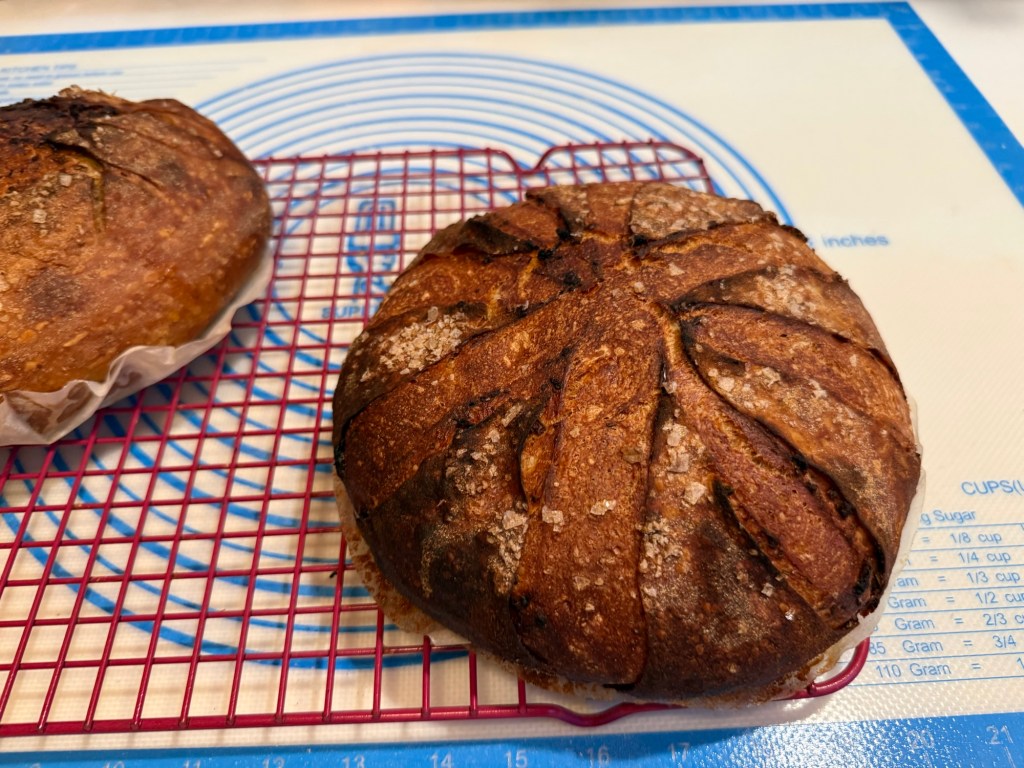
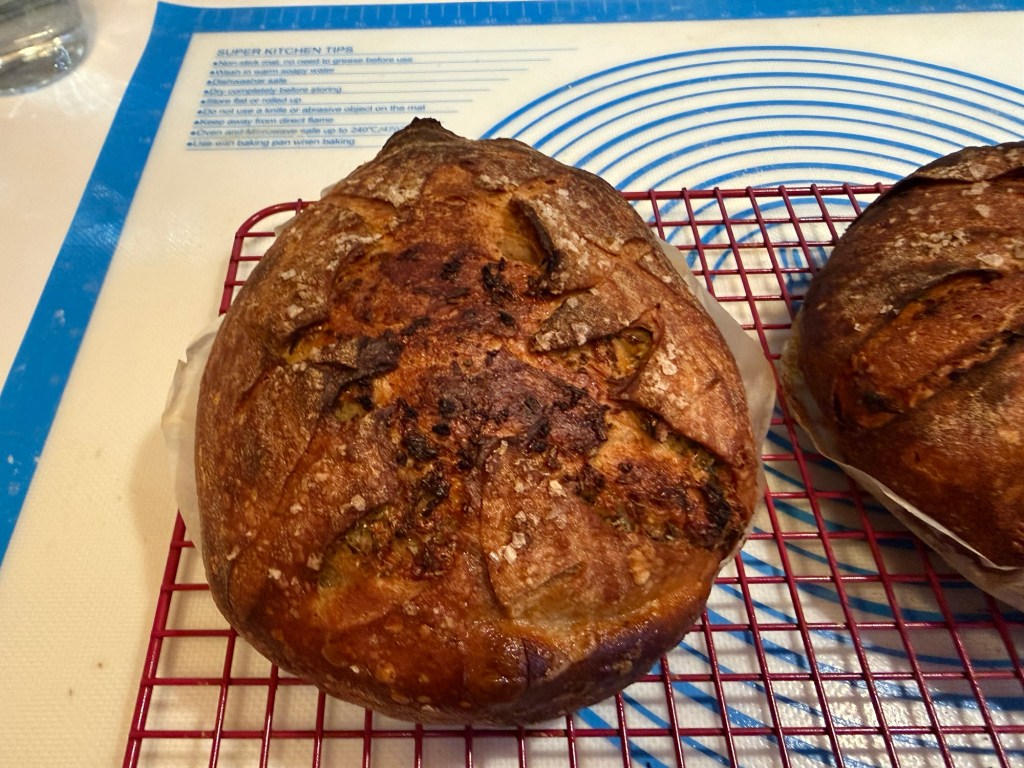
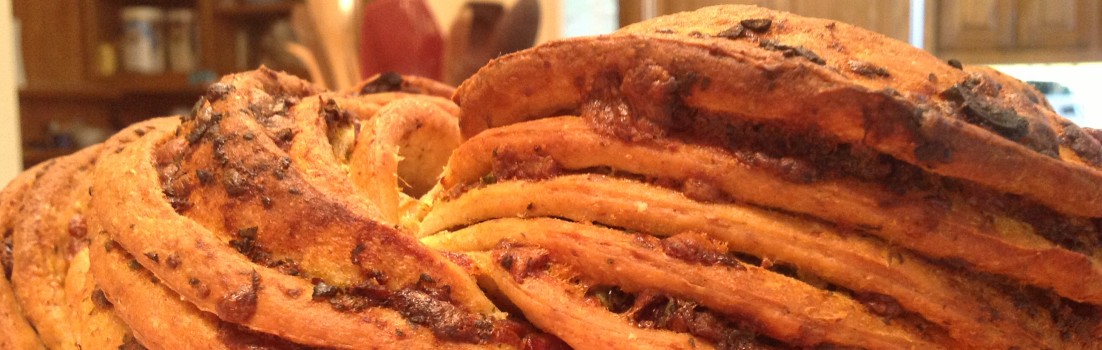
Many of our loaves have been beauties but this loaf … well this loaf is a doozy.

I first came across this recipe in the book “Richard Hart Bread”.

This is his introduction:

“This is a variation on the most famous bread made at Della Fattoria (in Petaluma, California), where I got my start as a baker. After you have been working at Della for a while, you are totally over this bread. They make bloody hundreds of them a week, and you need to chop a ton of rosemary on a daily basis. We never had enough, so we used to drive around town, nicking rosemary from everywhere and anywhere we could find it. I’m sure the poor bakers who are working there still have to do this. So this goes out to you rosemary choppers and the local gardeners wondering about your stunted rosemary bushes. But it is really here as a tribute to my original mentor, the lady who started my baking career, Kathleen Weber. I’ve made the dough formula my own, but the method I learned from Kathleen. This recipe uses a beautiful technique that adds a spoonful of a flavored oil to the dough. In final shaping, it is worked to the top of the crust, which makes the bread pop up into a crown.”

Well, when you read that, you really just have to go to the source. I already had Kathleen Weber’s Della Fattoria Bread in my library. Her introduction gives us a lovely story of how this bread came about.

“A request from Thomas Keller right after he reopened The French Laundry in 1995 got me into making pain de campagne. So I asked Thomas lots of questions. (How do you envision serving this bread? Do you like lots of crust? What shape would look best on your bread and butter plate?) In the end, I created the bread he was looking for. For Thomas, I shaped the dough into bâtards. Here we make both a bâtard and a boule.”

In her book, Weber created a base recipe and then gave numerous variations in shaping and flavoring. I think I’ve seen look-a-likes many times and always felt there was no way to get those fine looking tips of crust like show in both the above mentioned books. That is what most spooked me about trying this.

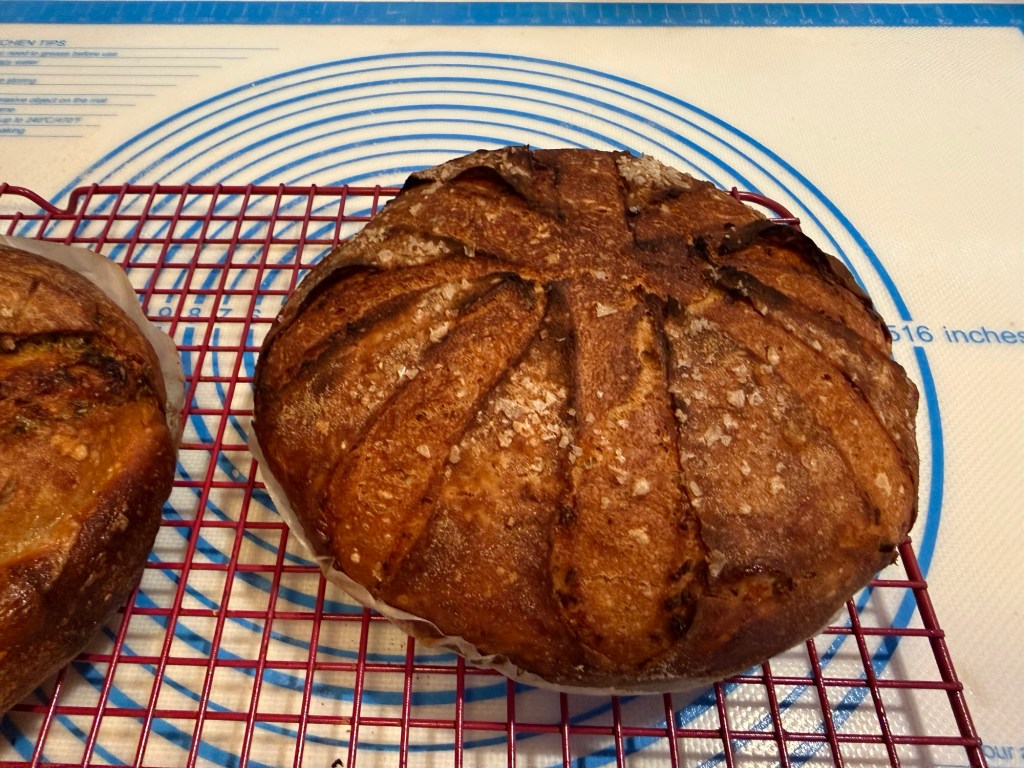
I look at this as not only a flavor opportunity but a shaping necessity. Feel free to flavor however you can imagine but do try the shaping technique because … it really does give perfect tips; the more cuts you make the more tips/points and more like a crown. I am in awe.

However, my ultimate flavoring for this bread is always going to be rosemary and garlic. It is unbeatable out of this world heavenly.

P A I N D E C A M P A G N E D O U G H

150 grams (I used my 50% rye flour) starter

126 g Water at 80°F/27°C

325 g All-purpose flour

181 g King Arthur golden wheat flour

1 Tbsp Fine King Arthur pink bread salt 19 g

**Put the starter in a bowl with flour & water and mix. This is going to be a very sticky dough so be prepared if you try mixing by hand. Mix on low speed for 2 minutes to combine. Use a dough scrapper to scrap to the bottom of the bowl leaving no dry flour.

** Cover and let rest for 20 minutes.

** Scrape down the sides of the bowl with the bowl scraper and add the salt. Fit the mixer with the dough hook and mix on low speed for 6 minutes. Using the bowl scraper, turn the dough back into the bowl.

** Cover and let sit for 30 minutes.

* For the first fold, wet your hands, then loosen the dough from the sides and bottom of the bowl and fold it underneath itself from left to right and then top to bottom. I found I could use water or olive oil on my hands and either worked equally well.

*Cover and let sit for 30 minutes.

** For the second fold, repeat as for the first fold. Cover and let sit for 30 minutes.

*** For the third and final fold, repeat the folding as before. Cover and let proof in a warm, draft-free spot until there is bubbling on the surface of the dough, 2 to 3 hours.

* Fold 1 **Fold 2 ***Fold 3

* The dough is ready to be pre-shaped and shaped as a Campagne Boule.

Weber’s recipe for the Lemon-Rosemary Boule:

1 tablespoons (8 grams/0.3 ounce) grated lemon zest, preferably from Meyer lemons

1 tablespoons (6 grams/0.2 ounce) chopped rosemary

About 3 tablespoons (40 grams/1.5 ounces) olive oil

1 to 1.5 teaspoons (4 to 6 grams/1.4 to 2 ounces) coarse sea salt***I really missed the opportunity to salt the out side of my loaf … that will not happen again. **My second bake I got the salt on and it is marvelous.

I am not going to try to find Meyer lemons, I know it would be an exhausting energy search with a poor result. If I ever do the lemon it will be a regular lemon. Thinking about lemon, preserved lemon might make for an interesting flavoring.

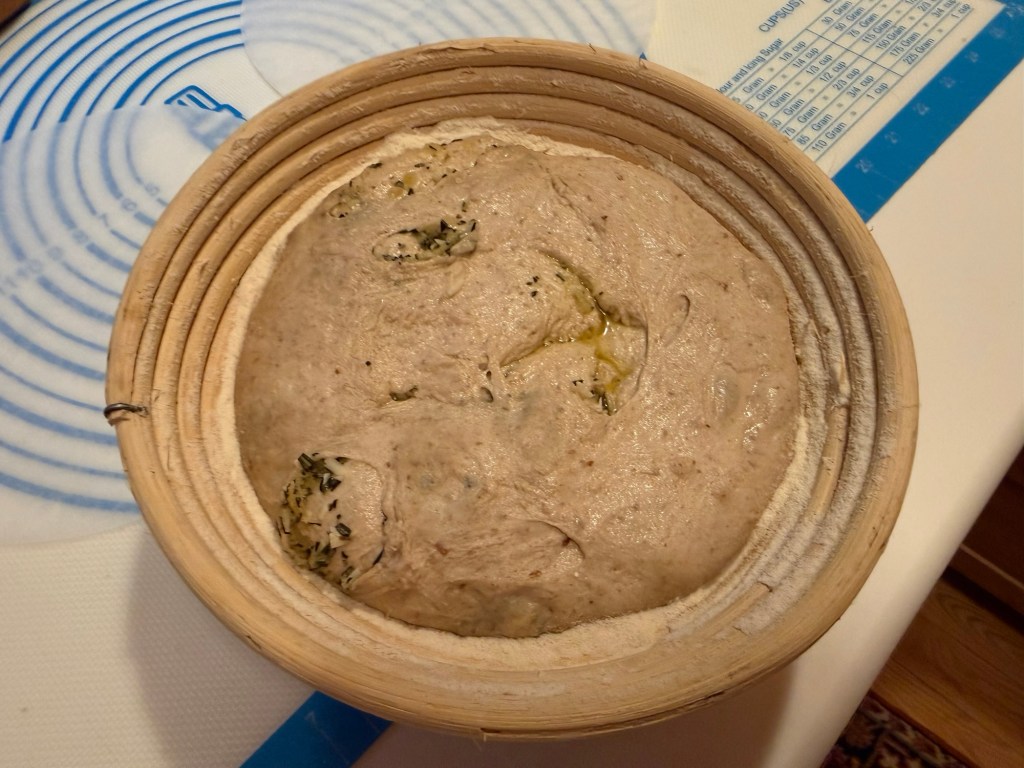
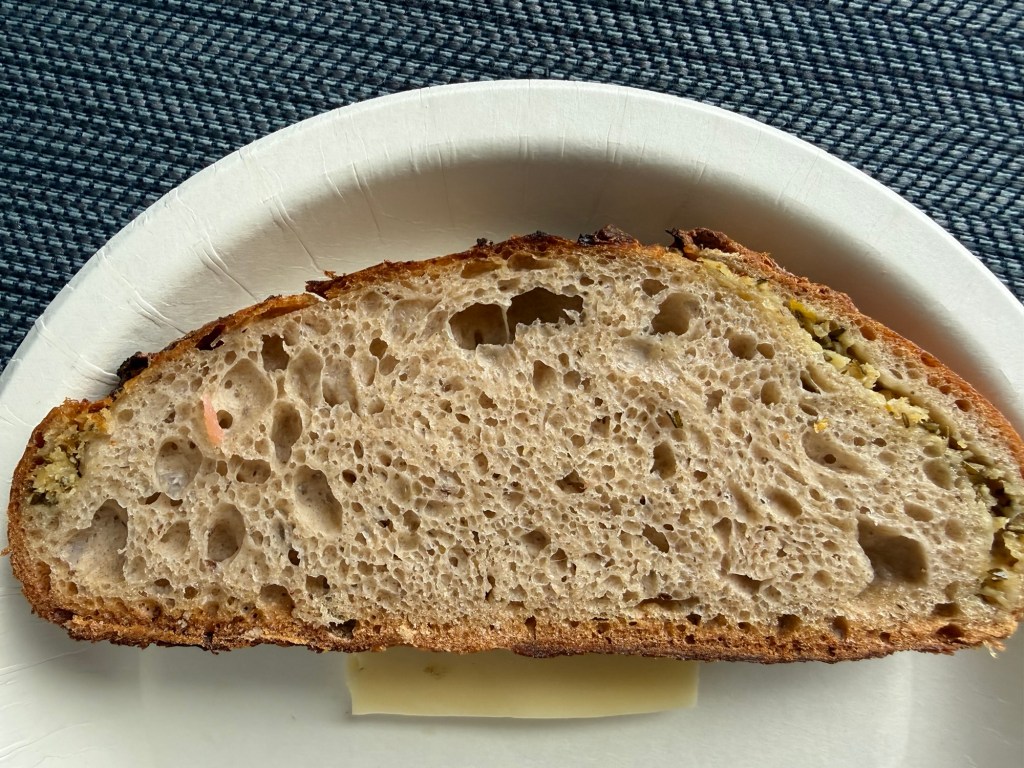
What I did use for my flavoring was dried rosemary (didn’t have fresh); 6 cloves crushed garlic cloves, and olive oil to make a paste. It was subtle but heavenly. I tried a little parmesan and almond flour with the aim being to thicken it just a little. I was pleased with the thickening I got from the almond flour but not taken with the Parmesan. The next bake my flavoring is going to be rosemary, fresh minced garlic, butter and olive oil.

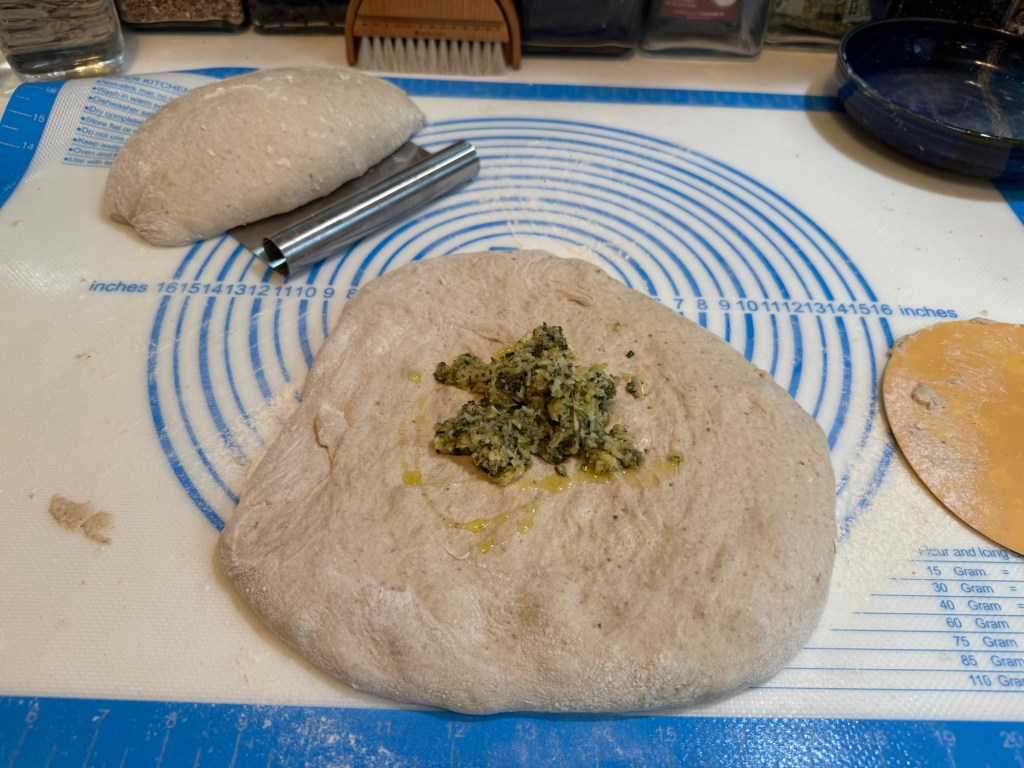
**Combine your flavoring choice in a small bowl. Add enough olive oil to create a pesto-like slurry.

** After the 10-minute rest, turn the dough over and gently press into a 9- to 10-inch round.
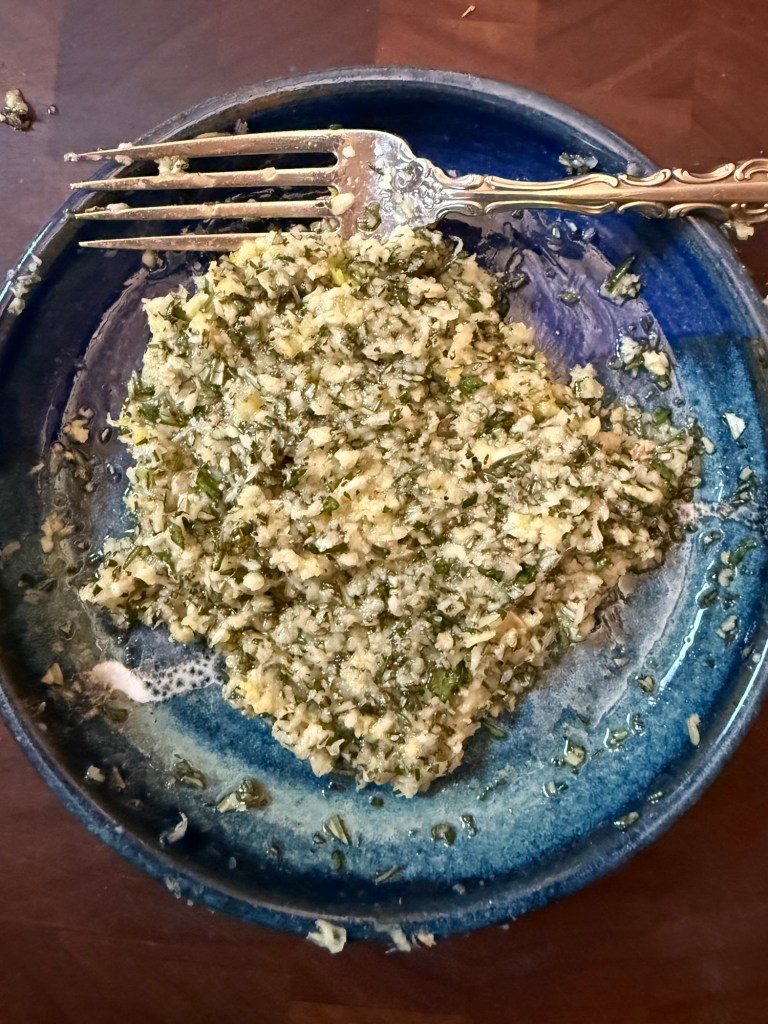
This was way more than needed for my two loaves.

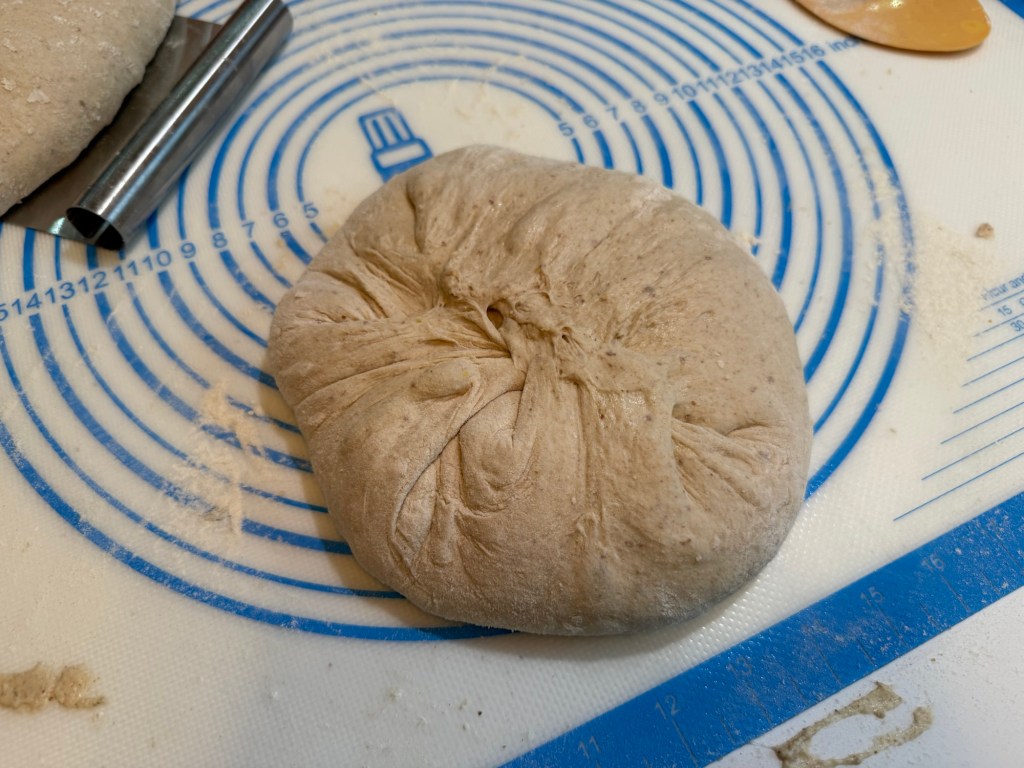
Dimple the top, make a well, and add the flavored olive oil mixture to the well. Fold the sides in, as when forming a boule, enclosing the mixture, then tighten the boule against the work surface until you just begin to see the rosemary mixture under the surface of the dough.
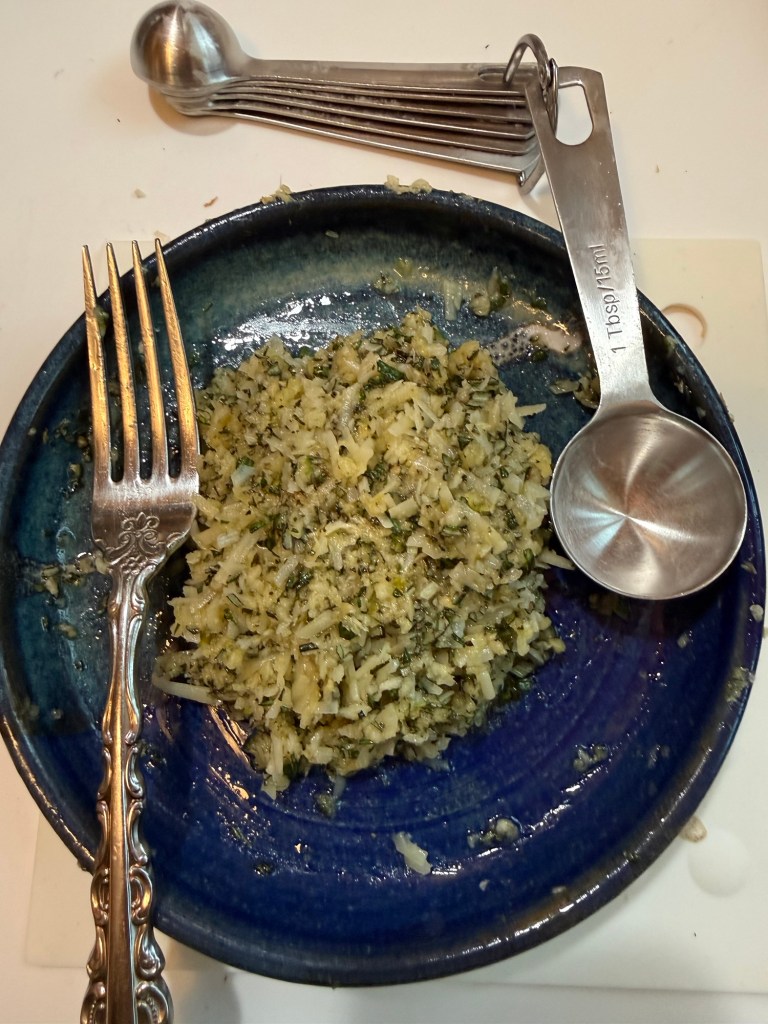
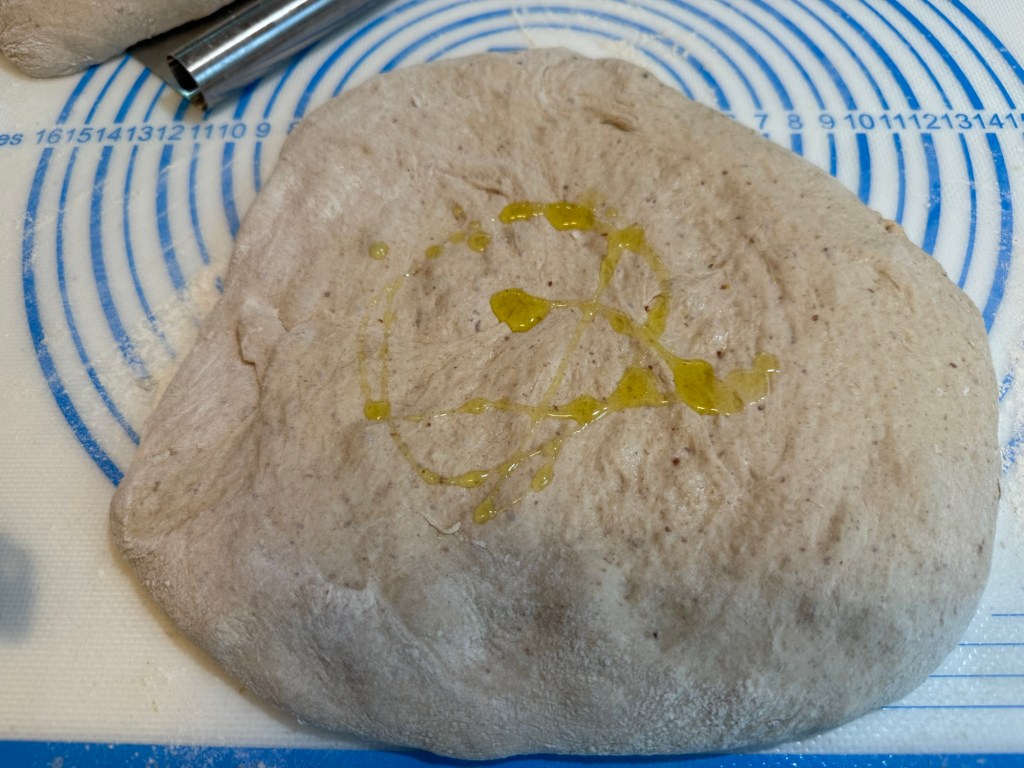
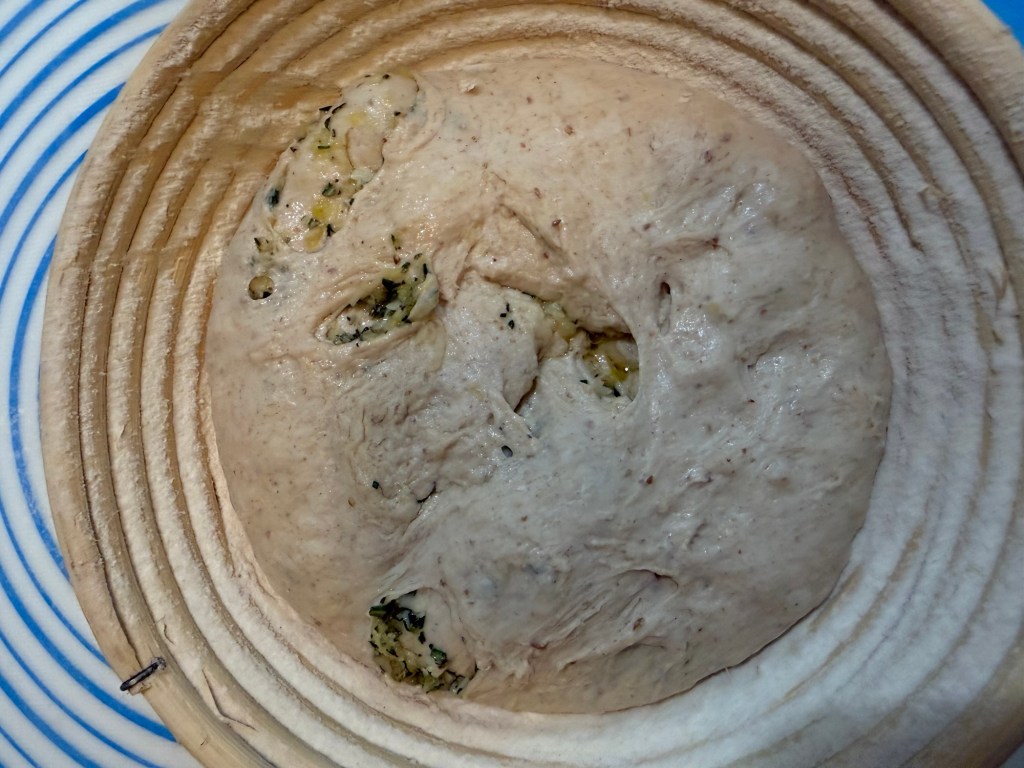
The video that the Richard Hart ‘Bread’ allows you to access is the best I have found to see what those words translate to in action. However, I will tell you I never saw the rosemary under my dough skin even though I feel I got an excellent look on the bread.

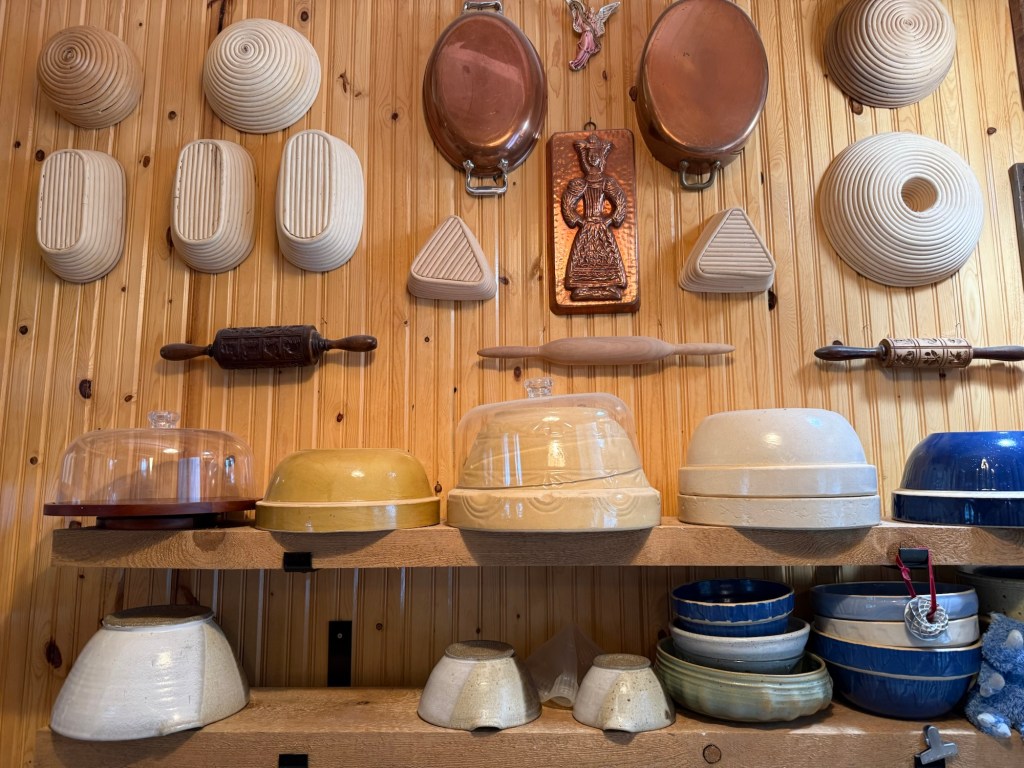
** Generously dust a 9-inch bread basket or linen-lined bowl with flour or a mixture of four and wheat bran. I always use rice flour; the wheat bran idea is intriguing and if it occurs to me some time I may try that.
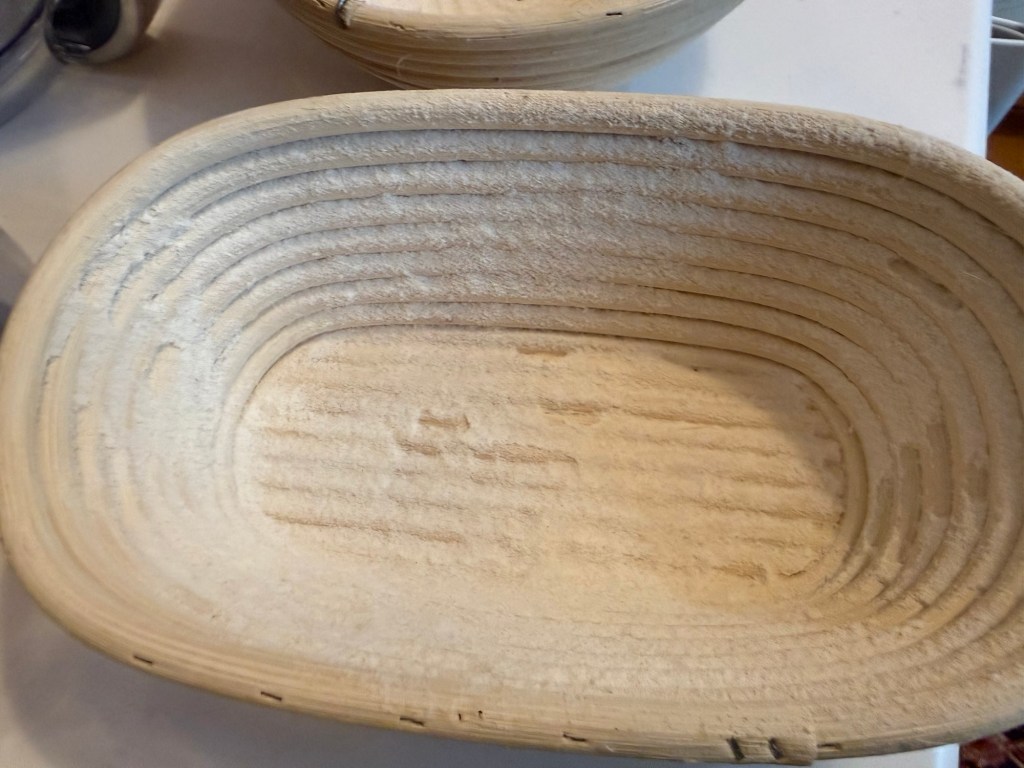
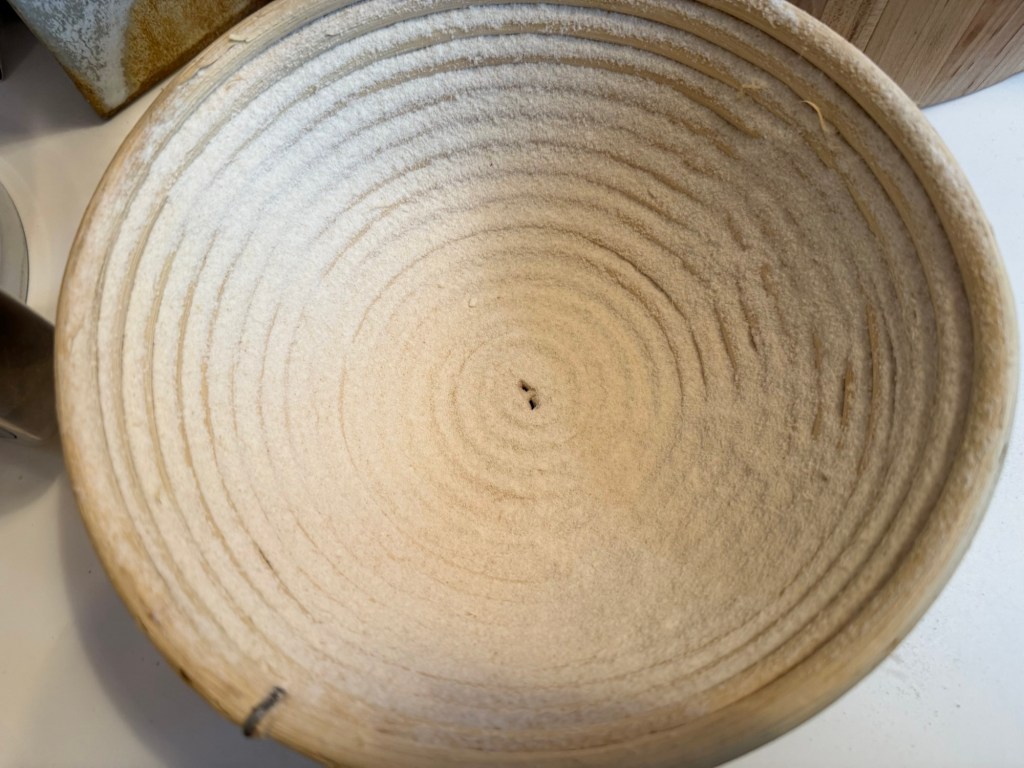
Final shape: Sprinkle rice flour into the bannetons and sprinkle a very light dusting of all-purpose flour over the tops of the loaves. Using your bench scraper, shimmy the dough into a round. Hold one hand over the center of the loaf, take your scraper in the other hand, and scrape evenly across the surface of the table toward the loaf, lifting it up and into the other hand. Put down the scraper and cradle the loaf in both hands. Now fold it inward and gently place it into the basket seam side up.

If it tries to fall back open, you can gently pinch it together at the top. That’s it. It’s safe and happy just the way it is. No need for aggressive shaping.

***** Cold retard: Lightly flour the loaves again. Leave them on the counter in your kitchen for 1-2 hours. I did not use a towel, I used my trusty shower cap to cover and placed the dough in the refrigerator and let the loaves sit overnight in the refrigerator, or up to 12 hours (at most 15 hours), to develop flavor. Then you will be ready for fresh bread in the morning.

Next morning, preheat the oven to 500°F/ 260°C for at least 1 hour, AND with the Dutch oven that you will be baking the bread in to get radiant hot. The Dutch oven will be an oven inside the oven. Put the lid on the top shelf and the bottom of the Dutch oven in the middle.

Once the Dutch oven is preheated, I usually place it on the oven door covered with two folded in half t-towels, but be careful: it’s radiant hot. Use heavy-duty oven mitts or a few layers of dry tea towels when handling it. Or you can take it out and place it on a sturdy, heatproof surface. I prefer not to move it too far from the hot oven. These vessels are designed to hold their heat, so don’t panic or rush; you have time.

When the oven and Dutch oven are fully preheated, take the dough out of the refrigerator, turn it seam side down, and score it. I mist the top with water and sprinkle the sea salt over the top.

Scoring: I made four slashes, you may chose to do fewer. I suppose if you chose to make just one loaf with all the dough you could do more slashes. That would be an over the top crown. The loaf/loaves is/are now ready for the super hot Dutch oven.
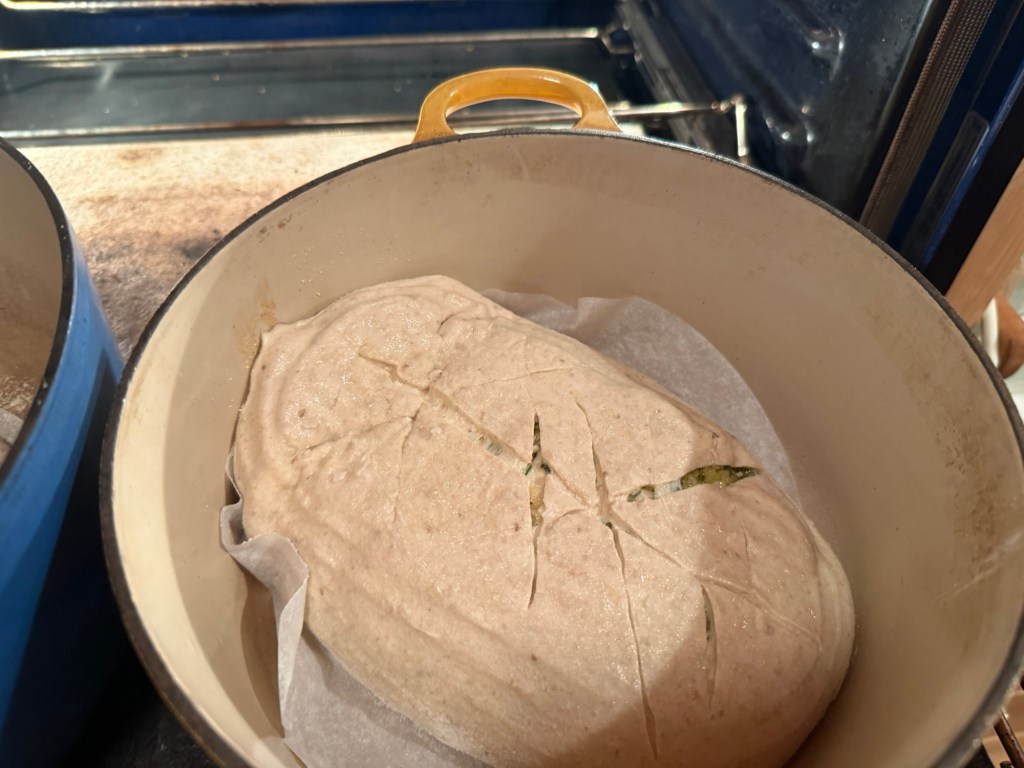
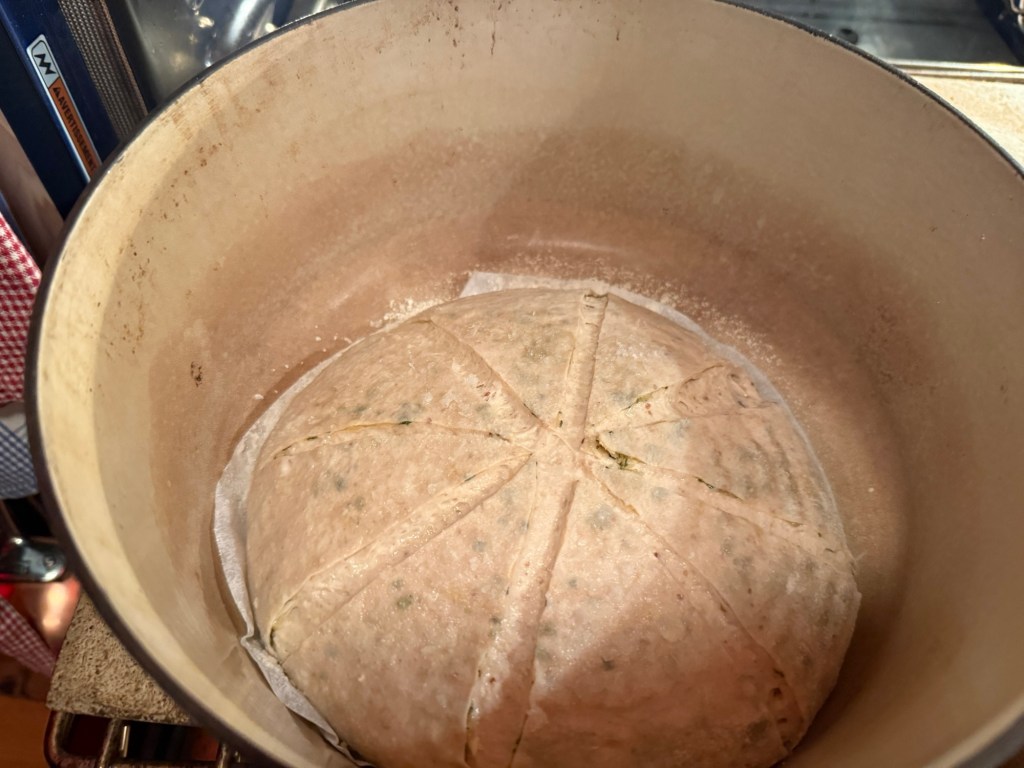
Use those heavy-duty oven mitts. Take the bottom of the Dutch oven out of the oven, drop the scored dough round into the Dutch oven, put the lid back on and place all back in the hot oven..

Bake the loaf: With Dutch oven back inside your oven, reduce the temperature to 450°F/ 230°C, and set a timer for 20 minutes. As your bread bakes, water will escape from the dough. Baking the bread in the closed environment of your Dutch oven ensures that those water vapors are trapped, steaming the bread in the process and allowing the loaf to rise fully.

After 20 minutes, that steam will have done its job. Remove the inverted pot, so the loaf is directly exposed to the oven’s heat. Set the timer for 20 more minutes and let the loaf finish baking. I baked my two loaves together. Generally speaking I bake my loaves to between 198 and 205° F internal temperature at which point I consider them baked. Since I used more whole grain than the recipe called for I baked my loaves another 15 minutes.
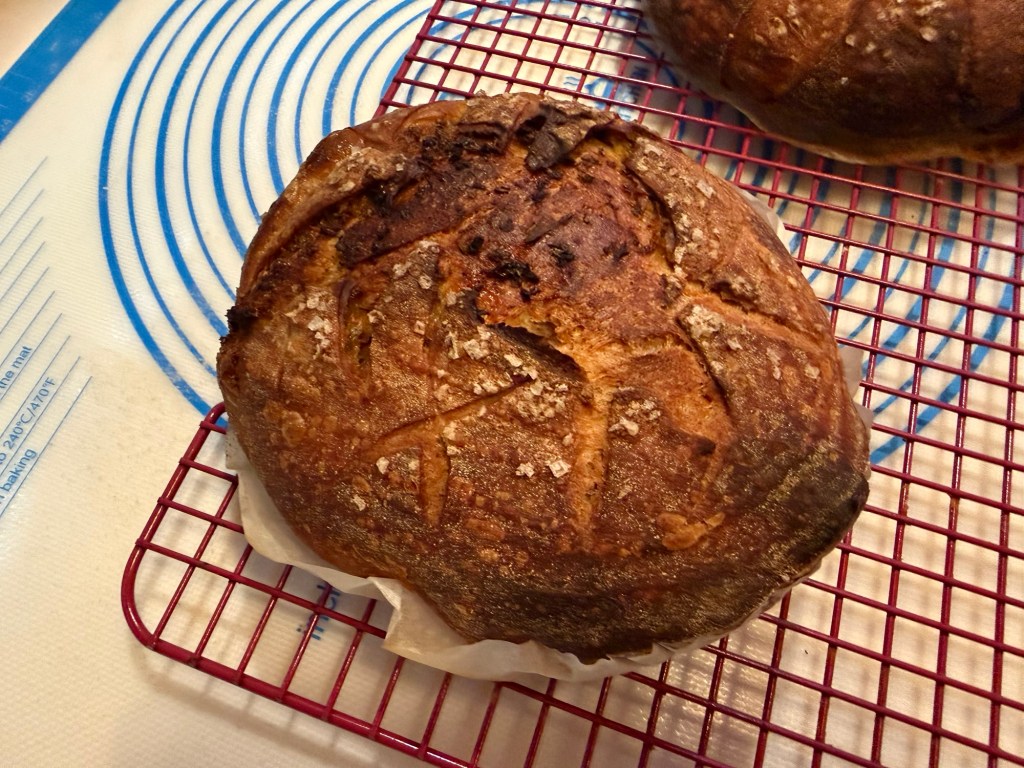
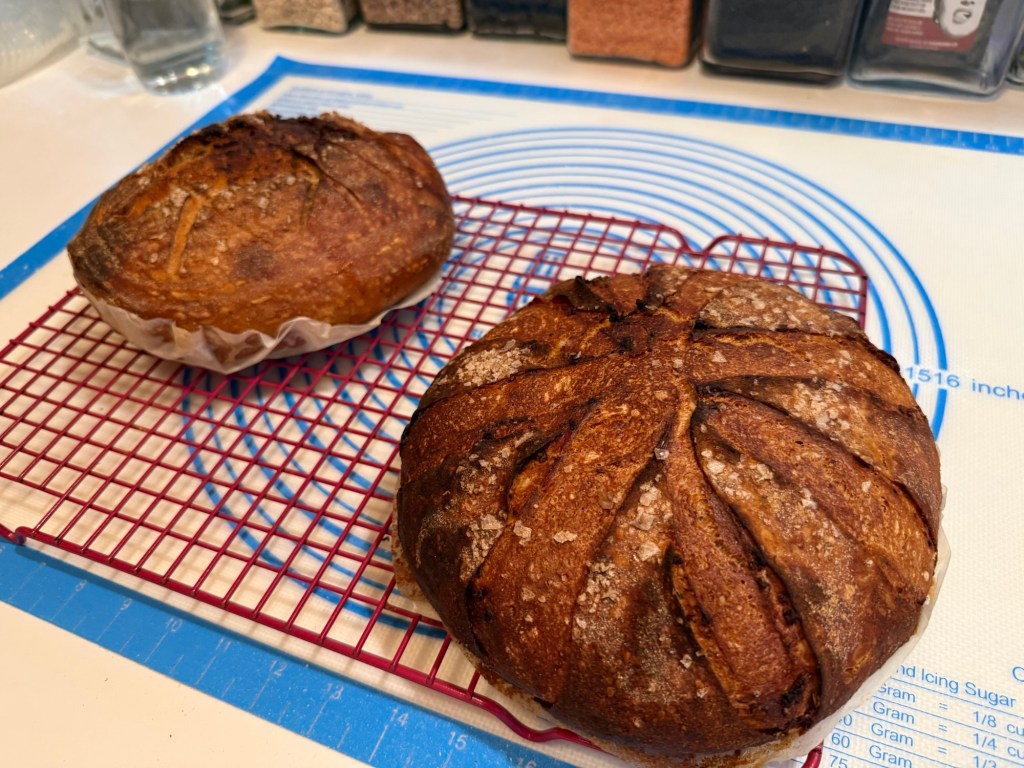
Depending upon how caramelized you want your crust, you decide when to pull it out because you are in charge not the recipe and not the oven.

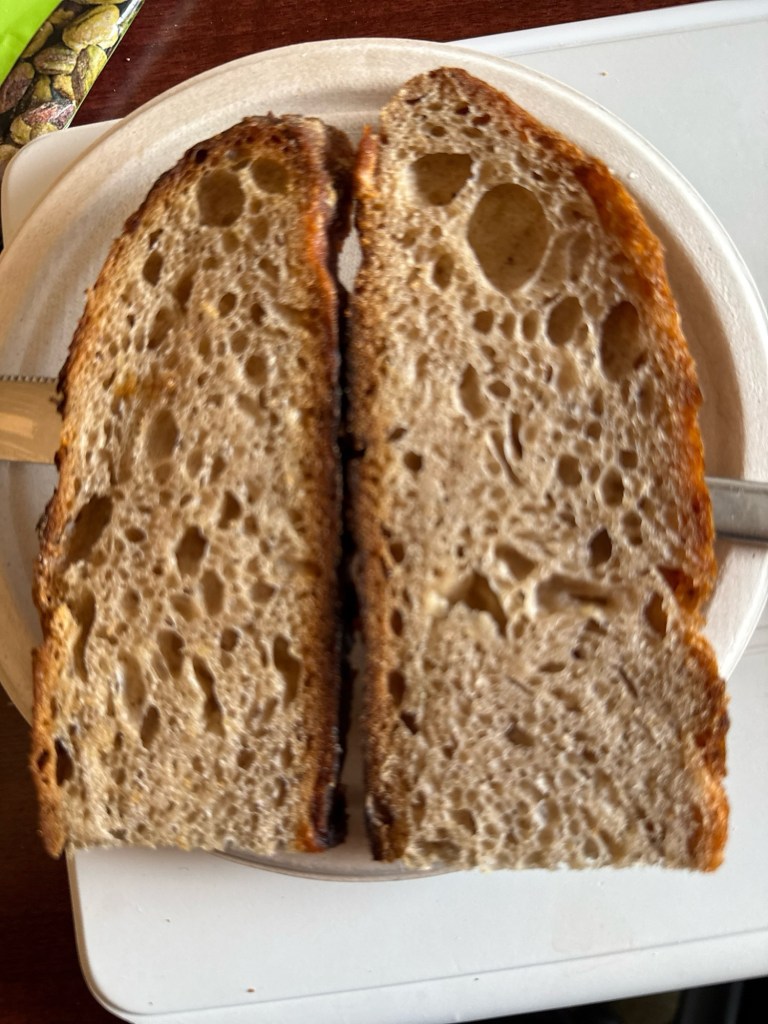
You should let the loaf cool on a cooling rack before cutting it open unless you like a gummy shiny crumb, give it at least an hour. My rule is when the internal temperature has reached whatever my room temperature is, it’s ready to slice.

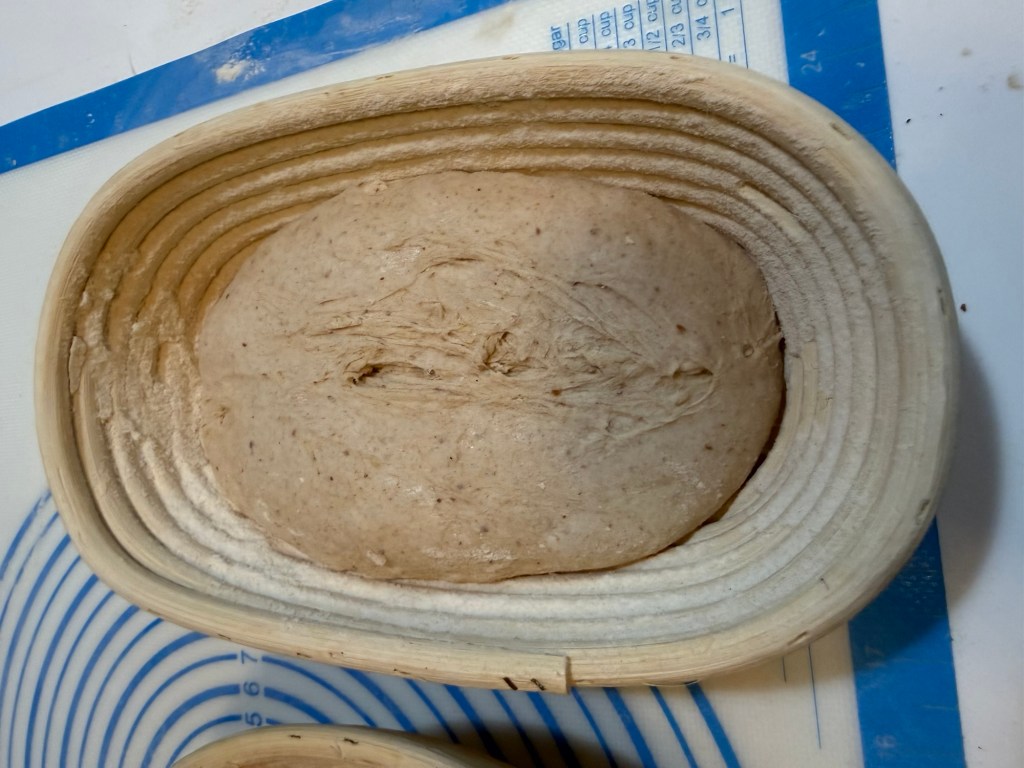
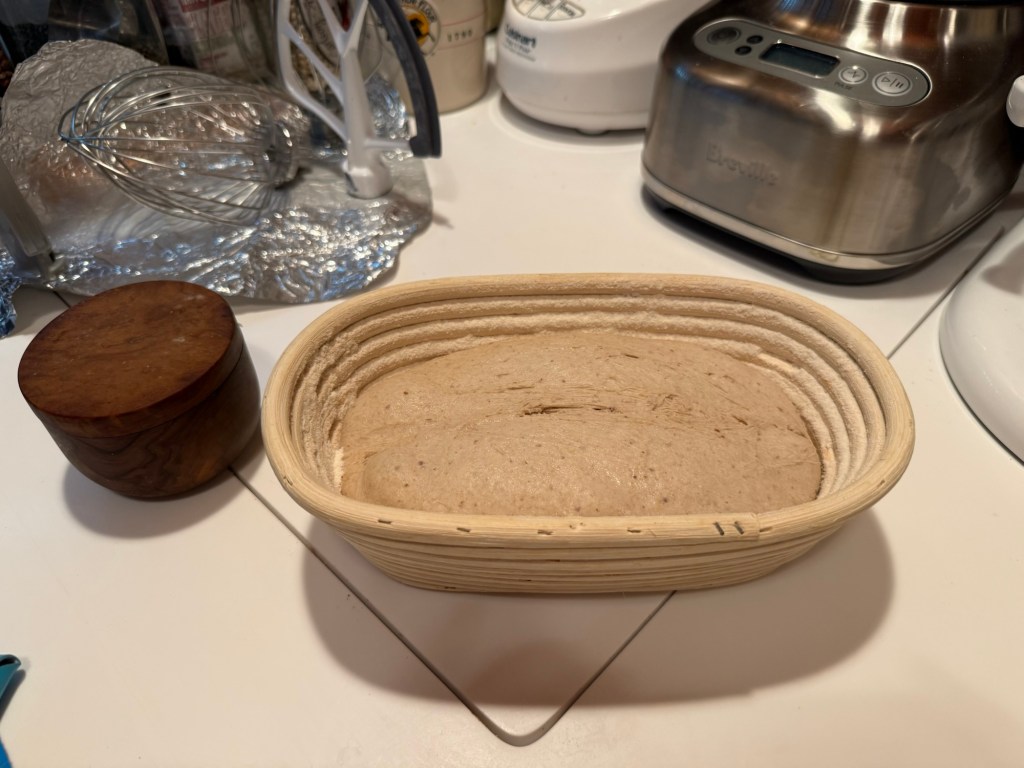
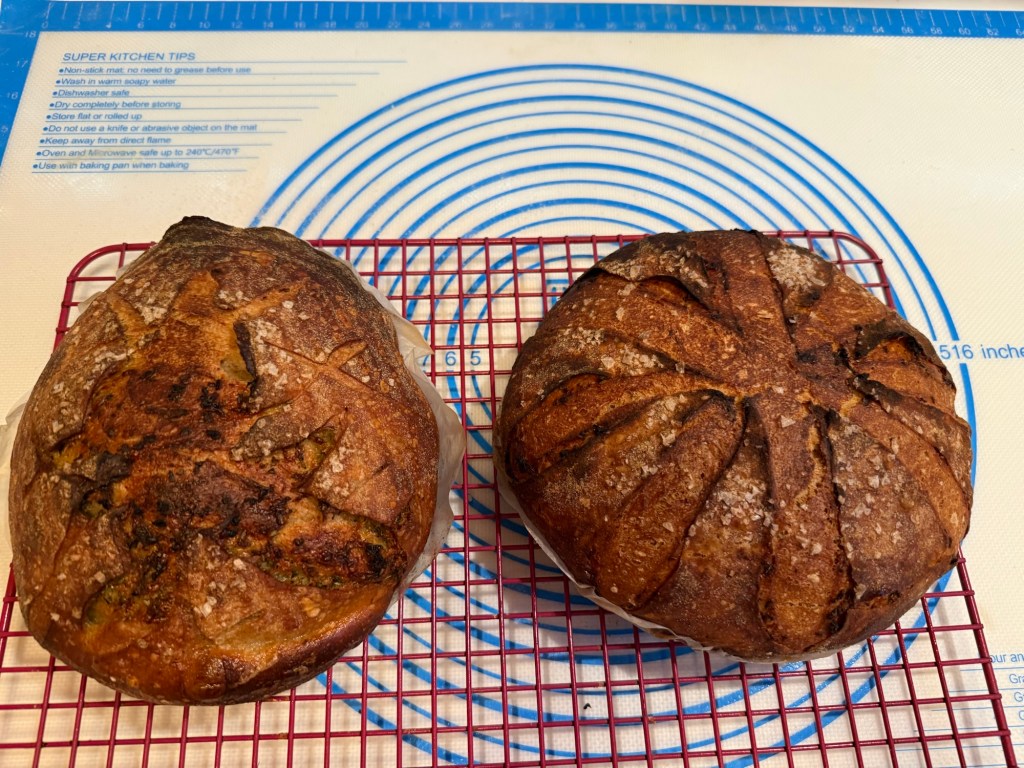
My total weight was 692 grams which I divided into two balls one slightly larger than the other because my bannetons where not equal.

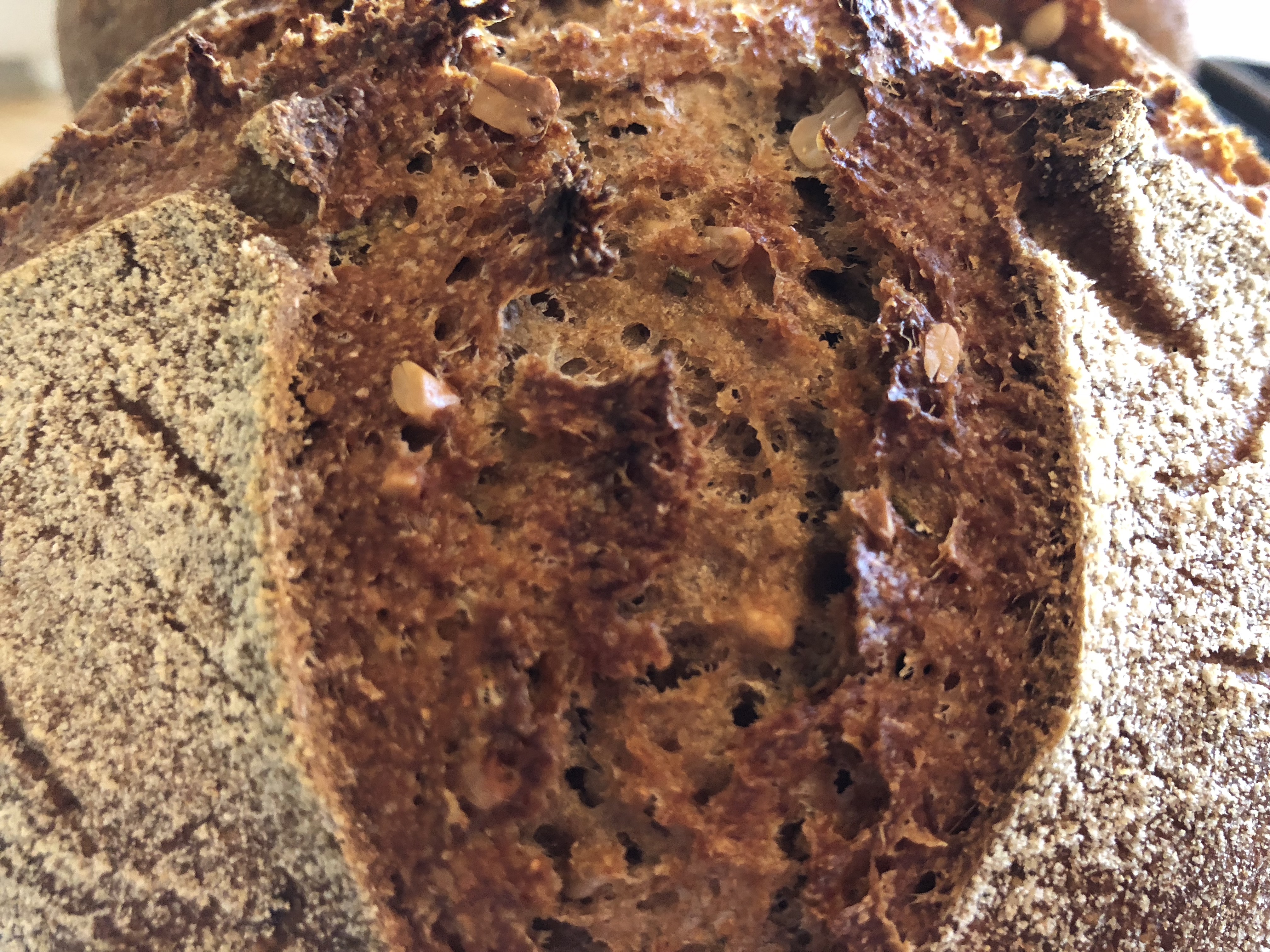
My oval/rectangular loaf did not come out with nice points. I believe if I had more carefully thought through scoring and done it as below:
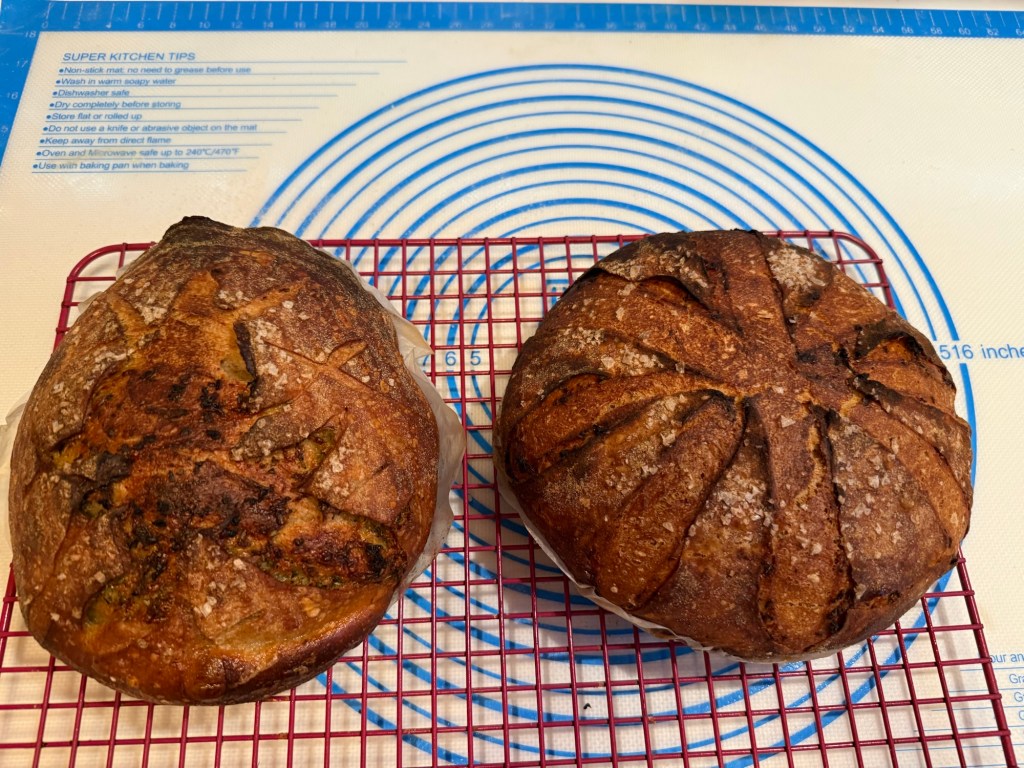
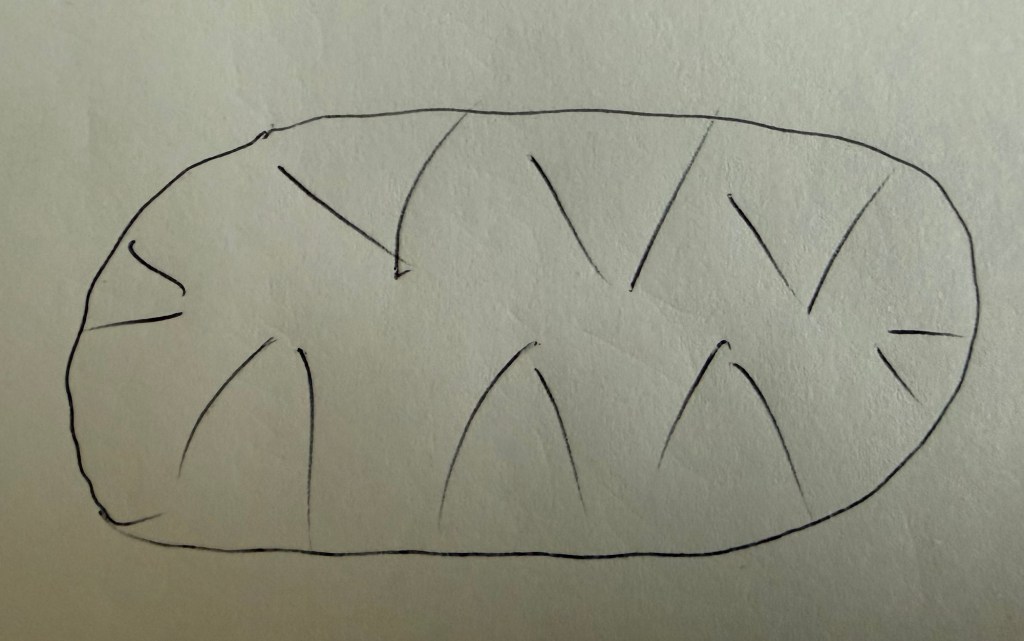
I might have gotten a much better result.

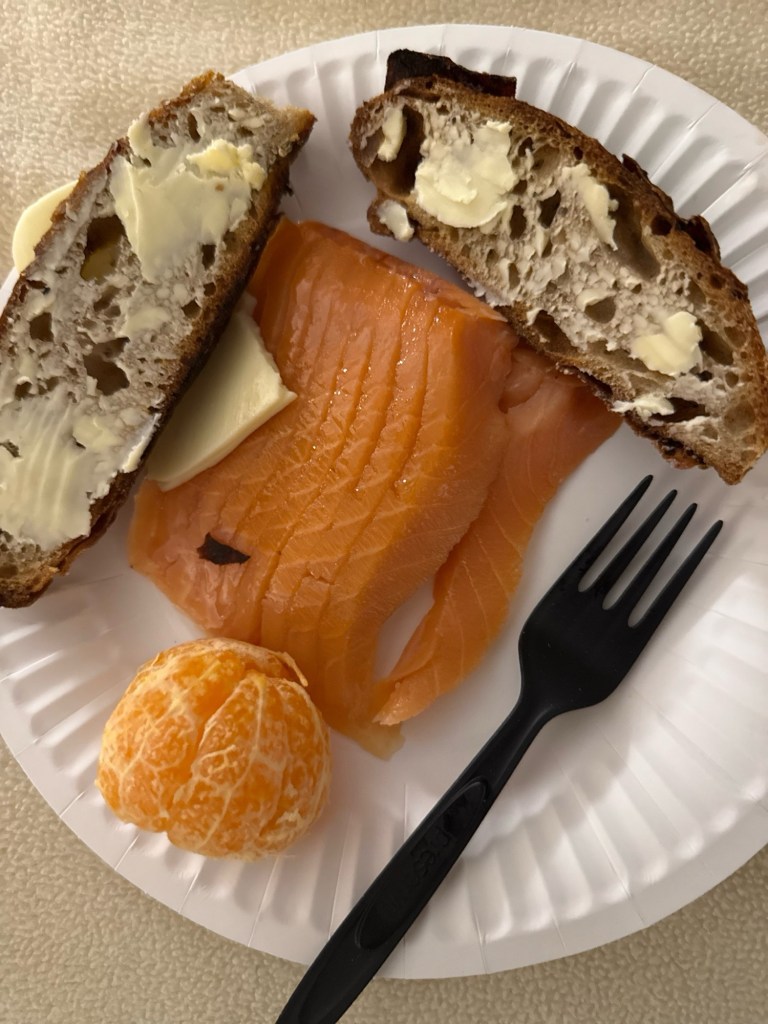
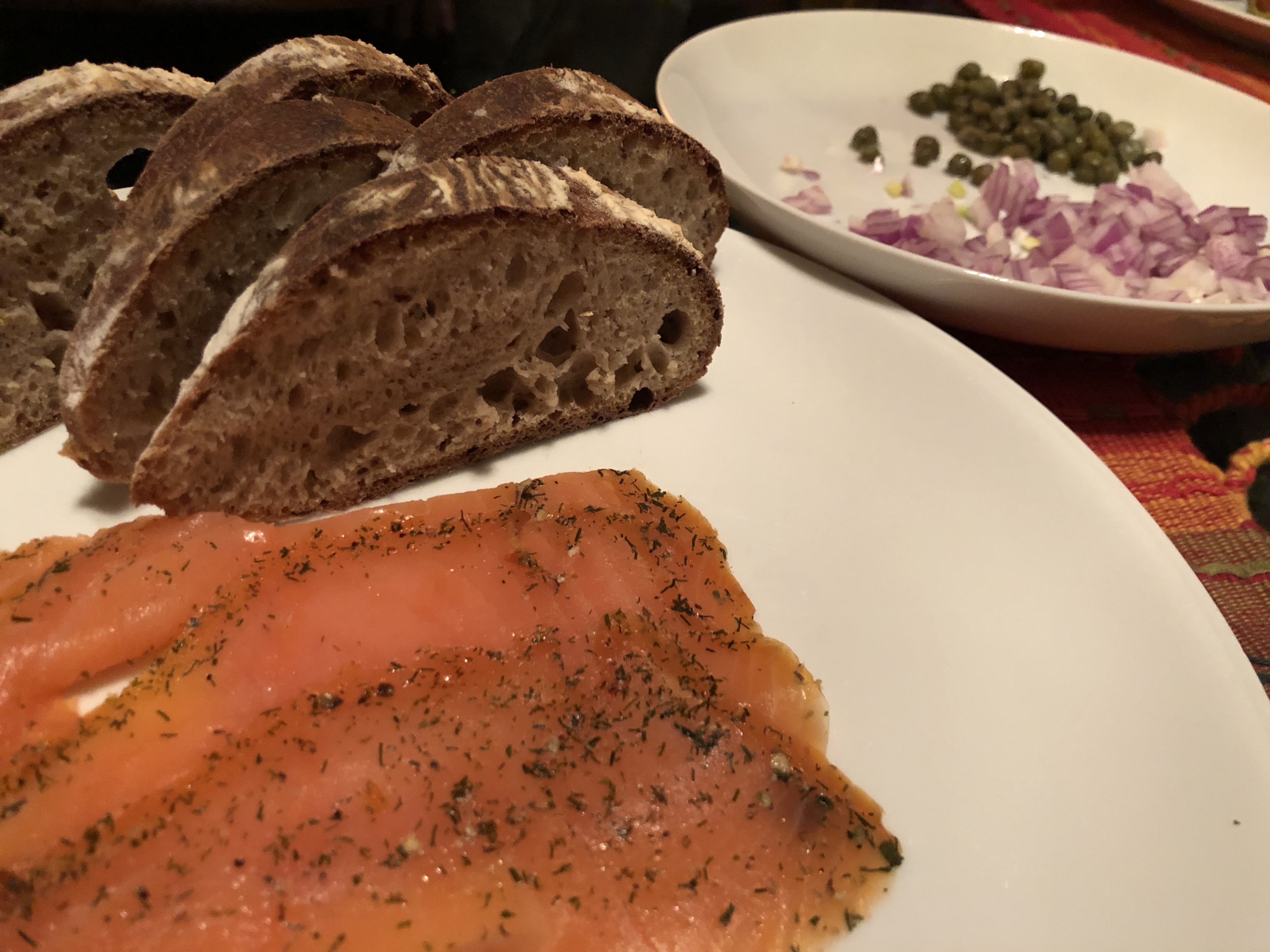
This is truly a marvelous loaf and I know it will be on my table many times in future … like in two weeks for a special occasion.
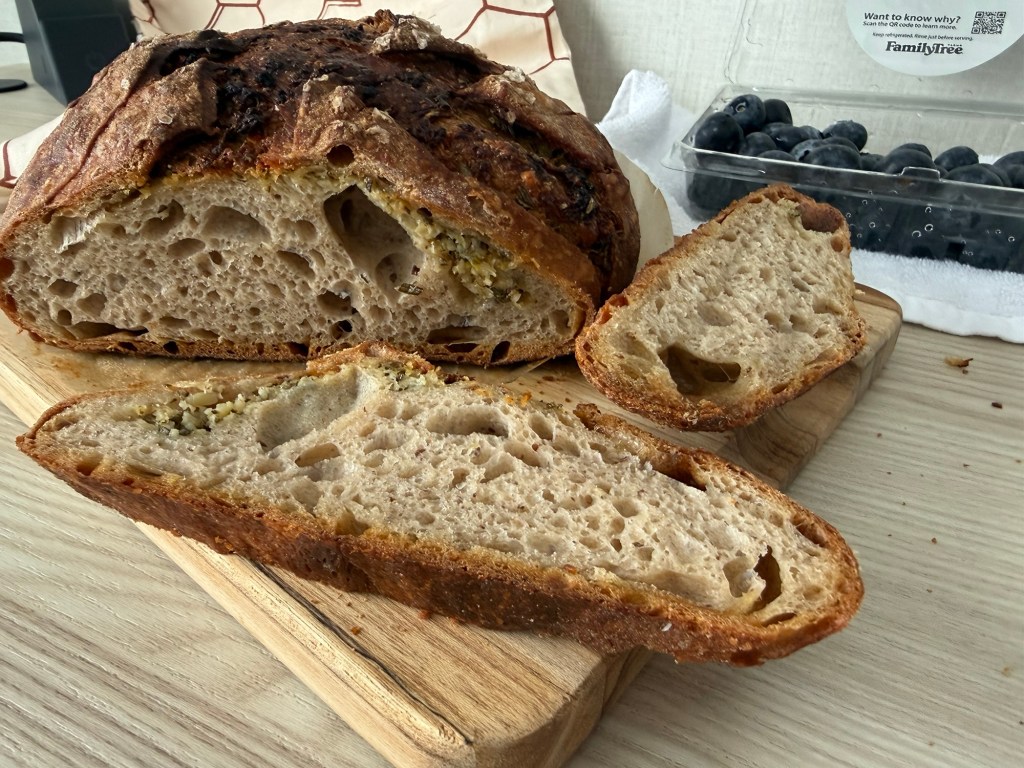
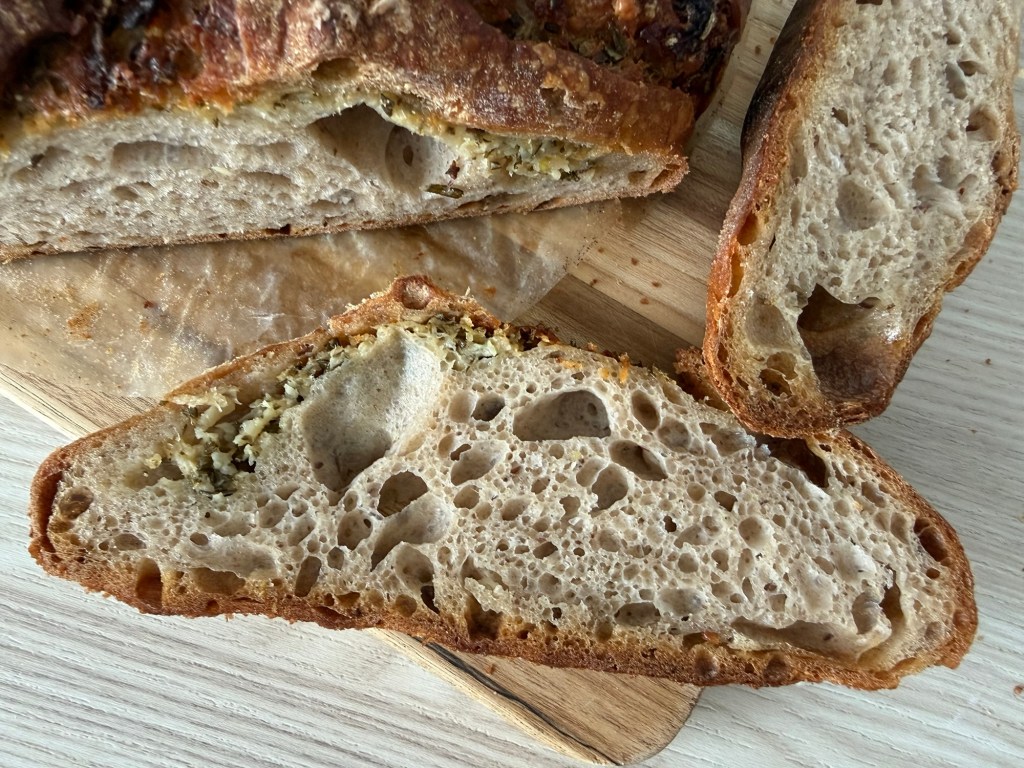
Happy Baking to all and to all the aroma of fresh bread from the oven.

MyKitchenInHalfCups
And the Bread Baking Babes are:


6 Comments

BBB ~ Rustic Pumpkin-Shaped Bread

Do you love the crisp fall air, leaf raking, fresh apples, pumpkin and spices? I’m ready for the air to be cooler and cinnamon is always welcome in my kitchen! Pumpkin has never been my very favorite but in this bread it is perfect. This is the bread of fall. Totally my new favorite with fresh home made apple butter. How can you beat that? OK, well maybe put peanut butter AND apple butter on a slice of this. Yes, maybe that would be even better.

Cathy, I can’t say thank you for my very favorite way to bake with pumpkin and gorgeous spices! Cathy, Bread Experiencehttps://www.breadexperience.com/rustic-sourdough-pumpkin-shaped-bread/, is hosting the kitchen table. Be sure to check out the other Babes baking the pumpkins!

Try not to focus on the blow out spots.

Rustic Pumpkin-Shaped Bread

Makes: 2 Loaves

Pâte fermentée:

400 grams all-purpose flour

100 grams whole wheat flour (I used semolina)

325 – 375 grams water

7-8 grams / 1 teaspoon fine sea salt

25 grams sourdough starter (100% hydration) *

Final Dough:

Pâte fermentée, all of the above

280 grams all-purpose or bread flour

32 grams whole grain rye or other whole grain flour

¾ tsp. / 6 grams fine sea salt

1-2 Tbsp. / 7-14 grams pumpkin pie spice or other spice of choice

200 grams pumpkin puree

2-3 Tbsp. / 40-60 grams maple syrup or honey (I used 40 grams of maple syrup)

Extra flour or water as needed

*Using yeast instead of sourdough.

To make a yeast version, add 1/8 teaspoon of dried yeast to the Pâte fermentée and an additional teaspoon in the final dough and omit the sourdough starter.

First Day: Make the Pâte fermentée

In a large bowl, whisk together the flours and salt.  To keep from dirtying another container, make a well in the center and add the starter.  Pour the water in gradually and mix using a large wooden spoon or Danish dough whisk until everything comes together to form a smooth ball.

Adjust the water or flour as necessary to make a dough that isn’t too sticky or stiff.  Knead the dough until it is soft and pliable and tacky but not sticky, about 4 to 6 minutes. 

Cover the bowl with plastic wrap or a kitchen towel, and ferment at room temperature for 1 hour or longer. The dough should swell to about 1 ½ times its original size.

Remove the dough from the bowl and degas it by kneading it gently. Return the dough to the bowl and cover tightly with plastic wrap. Place in the refrigerator overnight or up to 3 days. Or freeze in an airtight freezer bag for up to 3 months.

Next Morning/Afternoon: Make the Final Dough/Bake Bread

The next day, remove the Pâte fermentée from the refrigerator. Cut it into 10 – 12 small pieces using a bench knife or serrated knife. Place the pieces in the bowl of a stand mixer and allow them to warm up for about 1 hour.

In a separate bowl, whisk together the flours, pumpkin pie spice, and salt.

Add the pumpkin puree, maple syrup or honey, if using, to the Pâte fermentée and mix on low speed to break up the pieces. Gradually add in the dry ingredients and continue mixing on low speed until everything comes together to form a coarse ball. Add extra water if necessary to form a soft and pliable dough.  ***In retrospect, next time I would add 30-60 grams of water.

Mix on medium speed using the dough hook and adjust with flour if necessary to make a soft, pliable dough that is tacky but not sticky.

Transfer the dough to a clean large bowl and cover with plastic wrap or a kitchen towel.

Let the dough ferment at room temperature for 2 hours. Stretch and fold the dough after the 1st hour, then let it rest the final hour.

Remove the dough to a work surface dusted with flour. Divide the dough into two pieces and shape roughly into rounds. Let them rest on the counter for 15 minutes.

Shape the pieces into tighter boules, and place in lined banneton proofing baskets, between the folds of a heavily floured baker’s couche, or on cornmeal-dusted parchment paper. Let them proof 2 hours or until 1 ½ times their original size.

Proceed to baking or cold ferment the loaves overnight

After the loaves have proofed in the baskets at warm room temperature, proceed to baking, or cover the baskets tightly with plastic wrap and place in the refrigerator overnight to cold ferment.

About 45 minutes before you plan to bake the loaves, place a Dutch Oven or other baking pot on the middle lower rack of the oven and the lid on the upper rack and preheat the baker to 450 degrees F. 

While the oven is preheating, cut a piece of parchment paper to fit the bottom of your baker. **** My parchment round was to fit the Dutch Oven with wings.

What has wings and flies in & out of a scorching hot 🥵 Dutch Oven?

Cut four 30-inch pieces of food-safe twine.  ****I poured olive oil in the bottom of a ramekin, coiled the twine to fit and soaked the twine in the oil.  Place the oiled strings crisscrossed on the parchment.  It should look like a pie divided into 8 wedges. 

If you cold-fermented the loaves overnight, remove one loaf from the refrigerator at this point.

Invert one of the boules from the proofing basket onto the parchment paper.  Center it on top of the string. Tie the strings on top being careful not to pull too tightly to give the loaf room to expand.

Score the loaf uses small slashes, if desired.

****Pull the middle rack with the Dutch Oven on it out of the oven. Using the parchment wings, lift the tied pumpkin loaf (on the parchment paper) and carefully place it in the pot. Pull the lid off the top rack and place on the Dutch Oven. Push the rack into the oven.

Bake for 15 – 20 minutes with the lid on and another 15-20 minutes with the lid off. The loaf should be a rich golden brown all around and register 200 – 205 degrees F in the center of the loaf. It should sound hollow when thumped on the bottom.

****I used the parchment wings to lift the loaf out of the Dutch Oven. Transfer the loaf to a wire rack and let it cool for 1 hour before removing the strings.

To remove the strings, cut them with scissors and carefully pull them a little bit at a time. If you pull too fast, the string could leave residue. A small knife works well for scraping the string off as you go. ****I had no difficulty removing the twine.

After the string has been removed, let the loaf rest on the cooling rack until completely cool.

Repeat the process with the other loaf allowing the oven and baking pot to preheat to 450 degrees F. before baking.

I gave away my pumpkin shaped loaf (yes even with that horrid explosion spot). We kept the loaf for apple butter and peanut butter! Come on, I know you want to bake this.

Bread Experience is the host kitchen this month. If you want to bake along with us and receive your Buddy Badge, please send Cathy a photo and link by October 29th to be included in the roundup.

Send an email to breadexperience at gmail dotcom and include BBB October Submission in the subject. It’s time to get baking!


13 Comments

BBB ~ Early American Cottage Loaf

Our Kitchen of the Month: Cathy from Bread Experience. Thank you for a very special loaf!

IMG_1749

This is a special bread for a special time. I felt it was the perfect time to risk baking in my grandmother’s Hall’s China/Jewel Tea Autumn leaves casserole dish.  Back in the 1920’s Hall’s China located in East Liverpool, Ohio teamed up with Jewel Tea to produce promotional items. I think the first was a tea pot (makes sense, it’s a tea company) but it was very popular and became a full line of dishes. My grandmother had a full set with service for at least 24 place settings. When I was growing up those plates and dishes were always on the table. My mom was one of seven siblings and there were eleven grandchildren.  Most years there was at least once when everyone of those immediate family were present and sat down to meals.  Often there were friends invited. Many of those dishes were broken over the years but I was the lucky one to get this casserole, the tea pot and some other pieces.  Until this bread, I’d never had the courage to put this into the oven but somehow thinking this survived the Great Depression, I felt it proper it should survive the Coronavirus.

This is a special bread. As old fashion and old world as this recipe is maybe, I can assure you it will appeal today! All the grains are a delight. It’s touched with just the perfect level of sweetness. Makes lovely turkey with cranberry sandwiches and totally perfect toast. AND is very good with just butter. I may have to bake it again soon because I know it would be a perfectly lovely peanut butter and jelly.

I got carried away with the slashing and ended up with probably twice as many called for traditionally; but I’m happy with it.

Sourdough Version:
120 grams sourdough starter
220 grams water
27 grams olive oil
63 grams honey
226 grams bread flour
120 grams whole wheat flour
9 grams salt
14 grams wheat germ
30 grams rolled oats (old fashioned)
30 grams oat or wheat bran

30 grams ground flax meal
15 grams corn meal

1. *The method is the same for sourdough except you would add the sourdough with the wet ingredients and give it a longer ferment.

2. In a large bowl, whisk together the dry ingredients, including  salt.

3. In a separate container, mix together the sourdough starter, the water, honey, and oil. Pour the wet ingredients over the dry ingredients and mix until thorough combined. Knead until smooth and elastic.

4. Cover. Let rise 1 hour; perform stretch and fold; then let rise an additional hour. Perform the ripe test. I left mine for a total of 3 hours.

5. Turn dough onto lightly floured surface; punch down to remove air bubbles. Cut off 1/3 piece of dough. Cover the dough balls with a bowl and let dough relax for 15 minutes.

6. Shape each section into a round ball. Place larger ball in greased 2 ½ -quart casserole or soufflé dish. Using a sharp knife or lame, cut a cross, about 1 ½ inches across, in the top of the larger piece of dough.

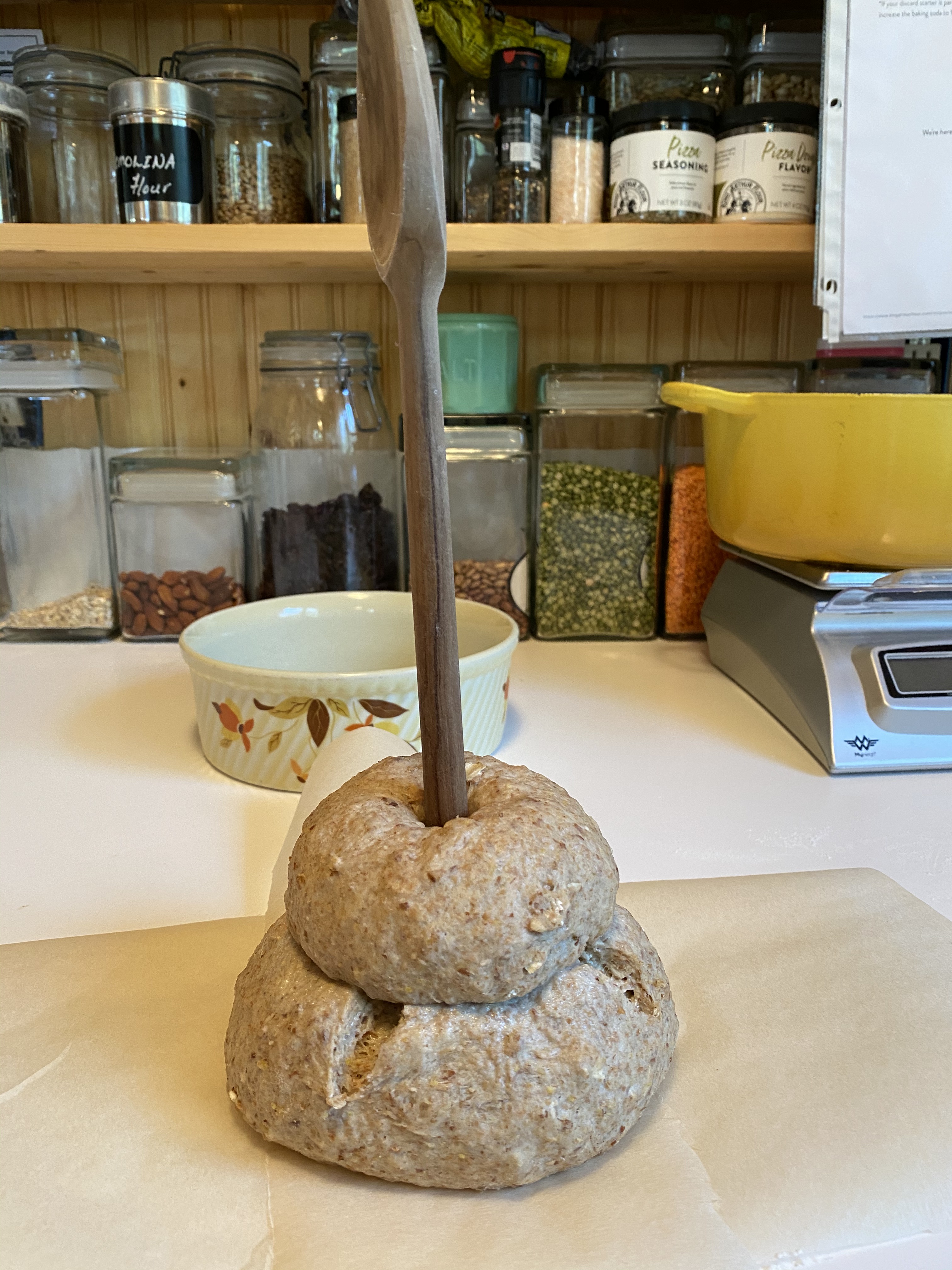
7. Brush the surface with water and then place the smaller piece of dough on top. Press through the center of both pieces of dough using the handle of a wooden spoon or your finger.

IMG_1746

8. Cover; let rise until indentation remains after lightly touching dough.

9. Just before baking, stick handle of wooden spoon or finger into hole again. And, using a sharp knife or lame, make 8 long slashes around the top and 12 smaller slashes around the bottom of the loaf.   

10. Bake in preheated 375°F oven 35 to 40 minutes. Mine took 45 minutes to reach an internal temperature of 202°. Remove from dish; cool on rack.

For straight yeast recipe, check out Cathy’s web site.

Would you like to bake with us?

Cathy is the Kitchen of the Month and would love for you to join us. This loaf is really easy and tastes great!

Bread Submission Guidelines:

  • Just bake your version of this Cottage Loaf and post about it on your blog (by May 30th).
  • If you don’t have a blog, no worries, just post a photo in the Bread Baking Babes Facebook Group
  • Mention Bread Baking Babes with a link to the Kitchen of the Month, that’s  – Cathy of Bread Experience.
  • Then send an email to breadexperience (at) gmail (dotcom) with BBB Early American Cottage Loaf in the subject line, and I will send you your Buddy badge to display on your blog.


13 Comments

BBB ~ Pain Au Levain

Cathy has been a great Kitchen of the Month with a wonderful bread but any time a Babe starts a recipe with “I do have a few ground rules…” Well, that sounds suspicious, I mean we all know Babes are always going to break the rules. Yes, we all know that.  Thankfully, Cathy’s “rule” was one whose direction I’m always looking to push so her “at least 30% some type of whole wheat flour” was very easy to go with. In fact, my calling is always to use more whole grain than called for.
Did we like this bread?  I think considering I made this bread twice within 8 days should probably tell you we loved this bread.  I used rosemary and lemon zest. I’m pretty sure we’ll be baking this one again and I will be looking for ways to use that lemon zest and rosemary again.  Heavenly aroma baking and heady when eating, rosemary and lemon zest is a heavenly combo.

BBB ~ Pain au Levain

Recipe By: Cathy (breadexperience) Adapted from From the Wood-Fired Oven by Richard Miscovich

Yield: 1 large or 2 small loaves
LEVAIN *
227 grams all-purpose flour
227 grams water
45 grams liquid sourdough starter, Used my Rye starter
499 total grams **
FINAL DOUGH FORMULA
415 grams all-purpose flour, Used White Whole Wheat
275 grams whole wheat flour (used Whole Wheat)

15 grams ground flax
375 grams water + 25 grams (to mix with salt)
2 teaspoons fine sea salt
1-2 tablespoon Citrus zest, use the full or even more 2 T
20 grams chopped herbs, I used 3 sprigs rosemary
150 grams seeds, used sunflower seeds rough chop

Cathy: If you don’t have or don’t want to use a sourdough starter, you can make an overnight poolish.  In that case, you will need to add a bit of yeast (about 2%) to the final dough.

Cathy: The total weight of the levain is 499.  You are supposed to remove 45 grams of sourdough to keep as your starter for future use which would leave 454 grams of levain.  If you choose to use all of the levain, just adjust the final dough accordingly.

Me: reading deficit here, missed that about keeping out 45 grams. I baked it all and both times used my rye sour dough starter as it was the only starter I had and it was ready to go.
l4YYrJmqSF2uWLo5sbdkyw

Day 1: Evening – Mix the Levain or Poolish
Mix the water and starter together in a large bowl. Add in the flour and mix until completely hydrated. Cover with plastic wrap and let rest at room temperature for 8 – 10 hours.

Day 2: Mix the Final Dough/Shape Loaves:
Pour the water over the levain and mix thoroughly with a wooden spoon or whisk to disperse.
Whisk the flours together and add on top of the water/levain mixture. Hold the salt until after the autolyse.

Mix thoroughly using a Danish dough whisk or wooden spoon to begin developing the gluten.
Add the citrus zest, seeds and/or herbs. Mix thoroughly using your hands. Cover and let rest (autolyse) for 20 – 30 minutes.

Sprinkle the salt over the top and dissolve it with the 25 grams of water. Use your fingers to pinch the dough to incorporate the salt evenly throughout.
Cover and let the dough bulk ferment for 120 minutes. Stretch twice, every 40 minutes.

Divide the dough, pre-shape, and then allow it to rest (covered) for 20 minutes before final shaping to allow the dough structure to relax.
Shape the dough into an oval or round shape and place it seam-side up in a heavily floured, lined banneton basket or seam-side down on a parchment-lined baking sheet.
My first bake: a loaf pan and the banneton. Second bake: used the banneton and a stainless steel bowl lined with T-towel. Proof for about 30 minutes at room temperature.  I won’t use the loaf pan again. Nothing really wrong, the round shape but seemed a better fit.
Cover the loaves and place in the refrigerator to cold ferment overnight, 8 – 10 hours.

Day 3: Bake the Loaves
Place a baking stone or steel on the bottom shelf of the oven and preheat to 450 degrees F. for at least 45 minutes. If you plan to use steam, place a steam pan on the top shelf.
If you shape the loaf round, you could bake this in a bread cloche, a Dutch oven or a Dutch oven combo baker instead of using a baking stone.
When the oven is sufficiently preheated, remove the loaves from the refrigerator. Carefully invert the loaves from the banneton proofing baskets (if used) onto parchment paper or a heavily dusted peel.  I’ve found that using a lined basket aids with this process.  You just carefully peel it off after flipping it over onto the parchment.
Score the loaves in the pattern of your choice. Slide them onto the preheated baking stone or steel and bake for 35 – 45 minutes. A larger loaf will take longer.
Since I only had one banneton I used a stainless steel bowl, lined it with a well dusted T-towel, stabilized the towel around the top of the bowl with a rubber band. That didn’t give me the indents from a banneton but it gave me the shape and it worked easily.
On my second bake, I baked the banneton first and stainless bowl second as I only had one cast iron baker.

Can't see it but you smell the rosemary and the lemon zest.
Remove to a wire rack to cool completely before slicing and serving. Since I used extra whole grain, I allowed mine to cool overnight.

As the host kitchen this month Cathy and all the Babes would love for you to bake along with us!  

  • Just bake your version of this bread and post about it on your blog (by June 30th).
  • If you don’t have a blog, no worries, just post a photo in the Bread Baking Babes FB Group
  • Mention Bread Baking Babes with a link to the Kitchen of the Month, that’s  Cathy of Bread Experience.
  • Then send an email to breadexperience (at) gmail (dotcom) with BBB June Pain au Levain, and Cathy will send you your Buddy badge to display on your blog.
  • Cathy will also do a roundup with a list of all the Bread Baking Buddies and showcase your breads.


12 Comments

10 Years Bread Baking Babes

The Bread Baking Babes have a cloudy past. You have your choice as to where and who all the histrionics originated with. There could be some case made that it started with Karen of BakeMyDay. There could be some case made that it started with Ilva. And there could be some case made that Ilva put a name to it while we were baking a Daring Baker challenge over what was then Skype. Out of those clouds the Babes emerged. We’re Beautiful, Boisterous, Brilliant, Bold, Buxom, Busy, Bewitching, Brash, Bourbon Basted, Bread Baking Babes, that’s 12 B’s. And, as you know, B-12 is one of the essential nutrients that’s found in….bread! (I believe Lynn put those altogether for us.) We’ve rallied at the opportunity to be called Babes. I mean, when you get to be my age, you never pass up an opportunity to be called Babe!
fullsizeoutput_8095

That’s how my first post for this bread started 10 years ago.   And since then?  We have been baking, oh Babe have we been baking! This month’s recipe was chosen by Karen from BakeMyDay 10 year ago.  I believe Lien is the only Babe to have managed every bread we’ve bake, one every month.  Yes, even I think I can do the simple math on that one 10 years times 12 months gives you 120 loaves of bread.  I’ve missed several but I’ve tried not to count.  Even so, it’s a lot of bread but the fun has been so much more than the bread.  I’ve loved every minute AND I’ve loved ever Babe.

IMG_0124

Over those 10 years, we’ve all baked a LOT of bread. A number of Babes have retired for many and varied reasons. But, once a Babe always a Babe.

Dark

Karen, golly wow 10 years, so many breads, so many good times. This bread was a stunner to me 10 years ago and it’s still a thrill to take it out of the oven.  Many folds, LONG rises but so glorious.  Thank You so many times for so Much.  Check out Karen’s BakeMyDay for the recipe write up because I’m not going to put it up here just right yet.

Lien, gracious what can I say. You are a wonder. 120 breads and all our badges for Babes and Buddies. Never forget.  You can retire, take a break BUT: Once a Babe, Always a Babe.  Thank you for everything.

I am so happy you baked again with us Sara.  I understand entirely that the flour on the top matters not because this is just wonderful bread.  It was a joy and stunning the first time around 10 years ago and is again every time I’ve baked.  Yes, I loved that Dan’s Garlic as well!

Cathy. Awe struck I am. Yeast water and grows her own grains.

Karen yes we have two. Karen talks about being a newbie and this being a surprise. I agree this is always a glorious surprise when I take it out of the oven but you know by the holes in the crumb Karen is not a newbie, she’s a Babe.
Judy this bread wants/tries to be lazy but the oven seems to give it that oven spring go and you get those lovely holes! Babe Success.

Elizabeth Truly for the Babes this has proven to be an iconic bread. I thought is thrilling the first time and then every time since taking it from my oven. Pinto Bean soup and this bread buttered, glorious breakfast! Really Elizabeth you were a Babe from the start and only became more so after the invite ;-). Glorious bread, lovely color. Wonderful times, glorious bread.

Pat Oh, Pat I love the anniversary photo with the dough streaking down. Your bread is glorious. Now I need another loaf to make avocado toast with! Super to have you with us Babe.

Kelly Only with us 2 years! Ha, from the looks of your bread it’s been forever and you did it without bread flour? Oh, only part Spelt and Kamut, more challenging flours. That’s definitely a Babe.

Aparna Great crown for our 10th! Difficult to know how different flours will behave until we try them all. I appreciate that only two to eat the breads is tricky, I found it much easier when there were more friends and family around to share.

The hardest part about this bread is to know where to start telling you about it. You see I baked it three times in the last three weeks (10 years ago). In the last ten years I’ve baked this bread I would guess at least once a year and some years more. This time around I’ve only baked it once …  But the year is young.

I will follow tomorrow with the recipe here but you can know I used sprouted whole wheat for 30% of my flour and of course I added some flax 30 grams.

fullsizeoutput_8097

If you would like to become a Bread Baking Buddy, here’s how it works:

  • The Kitchen of the Month (Tanna this time!).
  • Email me with BBB 10th anniversary in the subject line, with your name and the link to the post.
  • Post your “baking the bread” experience on your blog mentioning Bread Baking Babes with a link to the MyKitchenInHalfCups.com.
  • The Kitchen of the Month will put up a list of our Bread Baking Buddies at her site and send you a neat BBB award for this bread that you can then add to your post on your blog.

YMkzuTQbRue3I0DKa37DGA

I need to bake again so I can dip it in olive oil and pepper.


9 Comments

Eight Years ~ BBB Caramelized Onion Bread

Can you believe EIGHT years?  I can not.  Eight years times twelve months equals ninety-six breads!  Even missing a couple, it has been an incredible journey.

I think I felt pretty good about baking bread back then.  I wasn’t a total novice; yeast didn’t bother me any more.  But I realized in the big picture, I’d hardly baked much bread.

Eight years and about ninety breads later plus more than that in-between Babe breads how is it with me?  I still find the mystery in yeast, water and flour ever fascinating and the challenge of bread enthralling.  Shape may always be a fascinating challenge.  I love new techniques but I don’t always push myself to them; I should try harder in that area.  Reading … I love reading with my 8 year old grand son.  I see how we read words without needing to know anything like an exact definition.  I see how we can read and skip big parts of a sentence and how it can then be nonsense and still we push right on.  Read, yes, I see that is often how I read recipes and miss key elements.

When I presented this recipe to the Babes I copied it exactly as it had been written.  I’ve rewritten all but two parts of it below.  I’ve tried to put in “alerts” where one of us missed seeing something.  I’m not saying I wrote it better, I’m saying I tried to change somethings that would allow me to read the recipe better and follow the direction more completely the next time.

Next time: yes this bread is good enough and interesting enough to bake again.  I want to aim for that scoring pattern on the book cover one day.  I hope you like it and want to bake along with us in our journey finding good breads.


CARAMELIZED ONION BREAD

Recipe By: Bien Cuit by Zachary Golper, Peter Kaminsky & Thomas Schauer
Yield: 2 medium loaves
Total Time: about 3 days (but most of that is dough resting)

IMG_0358

STARTER
125 grams (3/4 c + 21/2 tbsp) white rye flour (I only had dark rye)
0.3 gram (generous pinch) instant yeast
125 grams (1/2 c + 1 tsp) water at about 60°F (15°C)

DOUGH
425 grams (3 c + 21/2 tsp) white flour, plus additional as needed for working with the dough
75 grams (1/2 c + 11/2 tsp) buckwheat flour

35 grams ground flax seed
15 grams (21/2 tsp) fine sea salt
1 gram (generous 1/4 tsp) instant yeast
350 grams (11/4 c + 31/2 tbsp) water at about 60°F (15°C)
50 grams (21/2 tbsp) honey
25 grams (13/4 tbsp) unsalted butter, at room temperature
50 grams (1/4 c) Caramelized Onions (you know how to caramelize onions, yes?)
DUSTING MIXTURE for the linen liner and shaped loaves
1 part fine semolina flour
5 parts white flour

1.   STARTER: ROOM TEMPERATURE 10 TO 12 HOURS

Whisk flour and yeast together.  Pour water over.  Using wooden spoon or your hand mix carefully to insure all the flour is wet.  Cover the container and allow to sit on the counter at room temperature for 10 to 14 hours.  The starter will peak around 12 hours.

2. THE DOUGH
Whisk together white and buckwheat flours, salt and yeast.
Use approximately a third of the water to pour around the starter edges to release it from the sides of the bowel.
Mix remaining water and honey in large bowl and add the starter; mix starter into water with wooden spoon.
Because you may not need all of the flour, reserve a small amount (arbitary, maybe 1/2 cup).  Mix the dry ingredients into the starter to combine then switch to a plastic bowl scraper.
The dough will now be sticky to the touch.
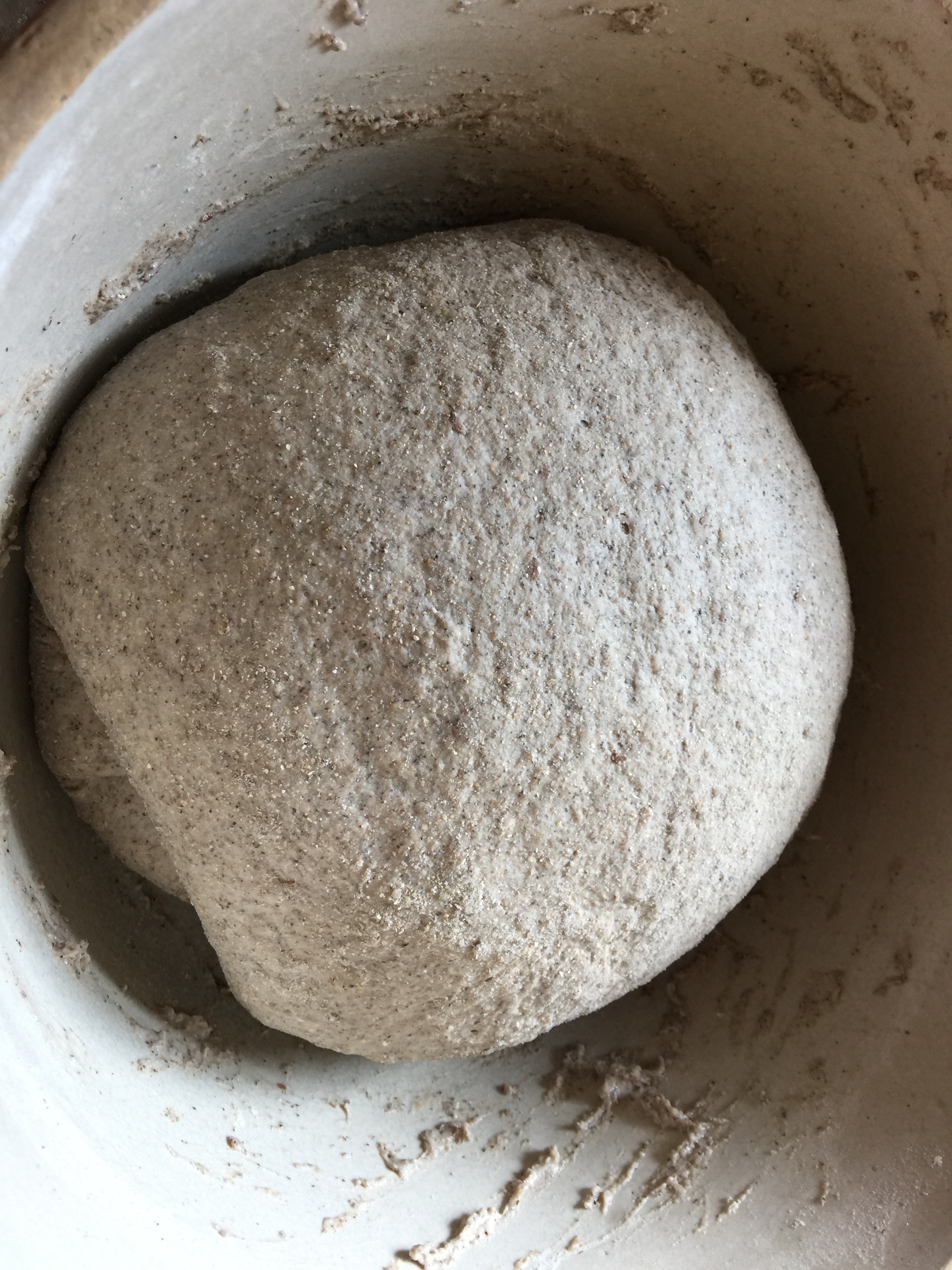
Note: At no point in this process of resting did my dough double in size.
3.  ROLL AND TUCK
Some Babes, like some Buddies, are sticklers for following directions and amounts.  Perhaps, over the years I’ve become jaded by too many crazy mis-reads and just down right mistakes and breads that are just good.  When I read this recipe roll and tuck just morphed into stretch and fold for me which is what I did.  You’ll find several Babes who were very particular and followed the technique.
*** TUCK in my experience has always been cupping hands around a dough and tucking/pulling the dough under.  The result you’re looking for is a strong smooth finish.

“Push the dough to one side of the bowl. Roll and tuck the dough (see Rolling and Tucking), adding the reserved flour mixture and a small amount of additional flour to the bowl and your hands as needed. Continue rolling and tucking until the dough feels stronger and begins to resist any further rolling, about 10 times. Then, with cupped hands, tuck the sides under toward the center. Place the dough, seam-side down, in a clean bowl, cover the top of the bowl with a clean kitchen towel, and let rest at room temperature for 45 minutes.”

IMG_0363
4.  FIRST STRETCH AND FOLD ~ TOTAL OF 4 times

Dust the counter and your hands lightly with flour.  Release the dough from the bowl and place it seam-side down on the counter.  Stretch into a rough rectangular shape then, as you would fold a letter to place into an envelope, fold the rectangular into thirds.  Using cupped hands again tuck the sides under toward the center of the dough ball.  Give the ball a slight turn with each tuck and work your way around the ball at least once.  Return the dough ball seam-side down back to the bowl and cover again with the towel.
Allow to rest again for another 45 minutes.
5.  SECOND STRETCH AND FOLD
Repeat the step 4 and return the dough to the bowl, cover with the towel, and let rest for 45 minutes.

IMG_0366
6.  THIRD STRETCH AND FOLD ~ ADDING ONIONS AND BUTTER

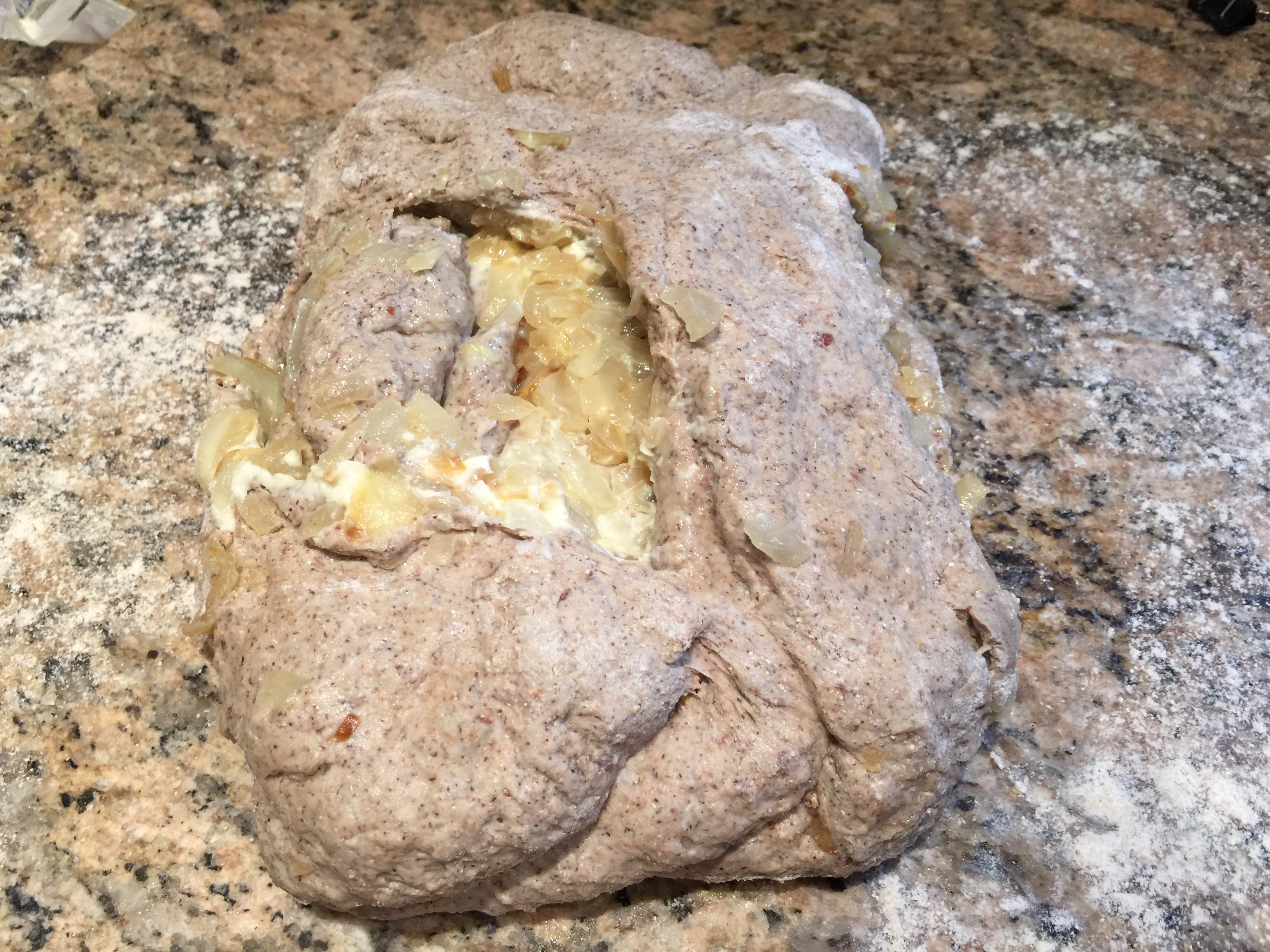
Third stretch and fold encorporates butter and onions.  Stretch the dough into a rectangle.  Drop small pieces of butter across the top the rectangle.  Spread the butter across the top then top the smeared butter with the onions.
Roll the dough tightly and press to flatten slightly.  Turn seam side down.  Fold into thirds and roll again; roll and fold until the butter and onions are completly incorporated into the dough.  Mine took about 7 times.
Turn the dough seam side down and tuck around the ball.
Cover with the towel and let rest another 45 minutes.
IMG_0369
7.  FINAL STRETCH
Fourth and final stretch, repeat step 4, then return the dough to the bowl, cover with the towel, and let rest for about 20 minutes.

8.  SHAPING  ~  12 TO 18 HOURS REFRIGERATED

Lightly dust the work area and hands with the dusting mix.
Divide the dough in half.  I divided mine unequally as I wanted one loaf larger than the other.   Roll into two loose tubes.
Let rest 5 minutes.  Press each again and shape how you choose.
Quote from Bien Cuit:  “Transfer to the lined pan, seam-side up, positioning the loaves lengthwise. Dust the top and sides of the loaves with flour. Fold the linen to create support walls on both sides of each loaf, then fold any extra length of the linen liner over the top or cover with a kitchen towel.
Transfer the pan to the refrigerator and chill for 12 to 18 hours.”
I placed my shaped loaves (seam side down – oh dear … ) onto parchment paper and covered.  Let them rest for 15 hours in the refrigerator.
IMG_0378
9.   PRE-HEAT OVEN WITH BAKING STONE
Pre-heat oven with baking stone and cast-iron inside to 500°F (260°C).
Cast-iron skillet is for creating steam with ice cubes; it really works well.

IMG_0398
10.  SCORING  ~  OVEN

Because my loaves were on parchment I simply lifted the parchment onto the baking peel. If you followed Bien Cuit directions above you’ll need to turn the loaves seam side down at this point.
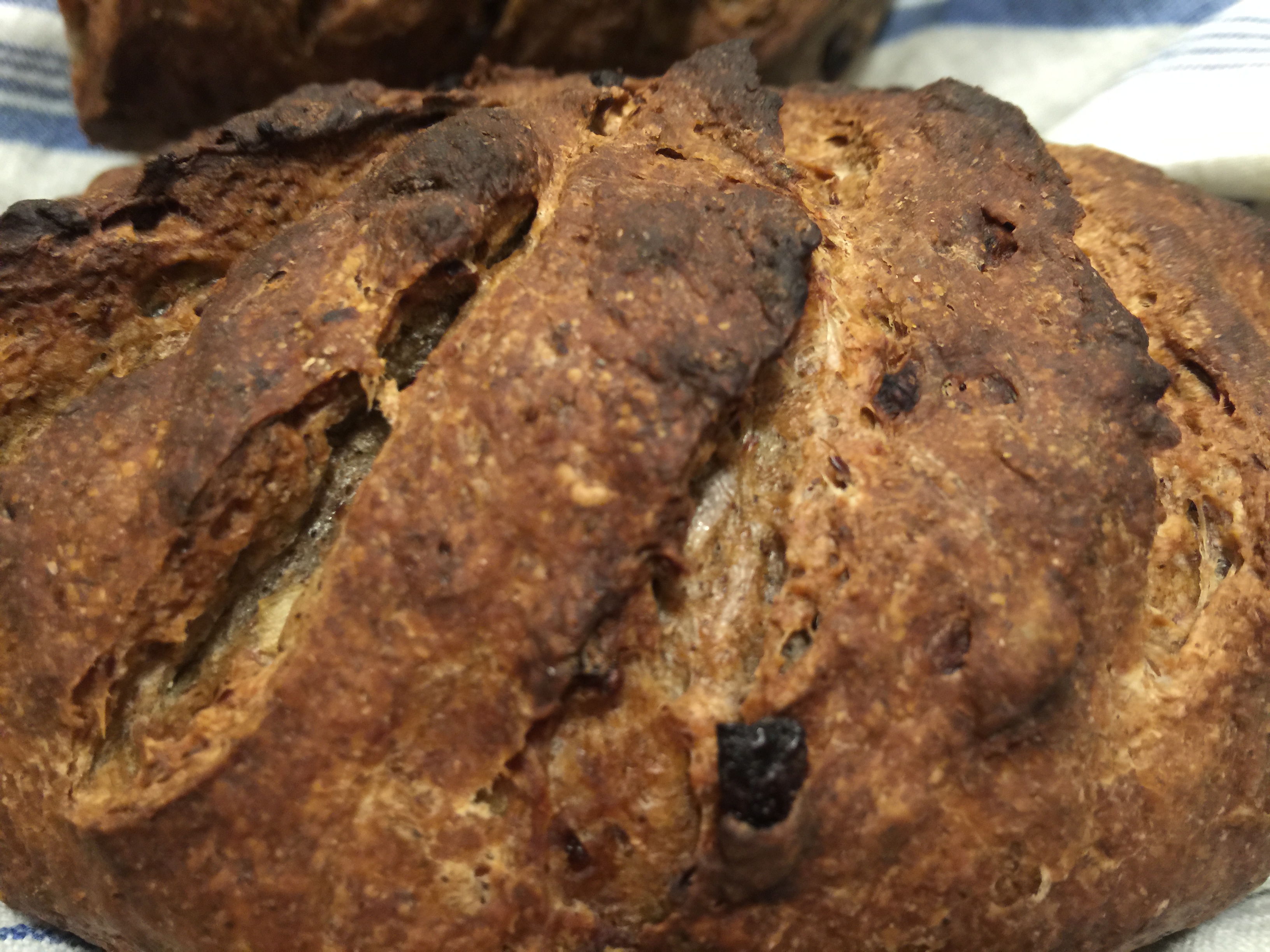
Score the top of each loaf.  The cover of this book pictures a gloriously scored loaf that I hope to one day truely capture, until then this is a good try.
Transfer the loaves to the baking stone.
Add 3 cups ice cubes to the hot cast iron skillet.
Immediately lower the oven temperature to 460°F (240°C).
Bake, rotate the loaves 3/4 way through the baking time, until the surface is a deep, rich brown, with some spots along the scores being very dark (bien cuit), about 25 minutes.  My loaves registered 205° at that time.
IMG_0383

11. Using the baking peel, transfer the loaves to a cooling rack. When the bottoms of the loaves are tapped, they should sound hollow. If not, return to the stone and bake for 5 minutes longer.
IMG_0394
Let the bread cool completely before slicing and eating, at least 4 hours but preferably 8 to 24 hours.

About this book:  I understand this book has a very unusual binding and the pages are printed on black paper.  Since I am currently on the road, I ordered the iBook.  I’m very happy with it.  There are many fabulous looking recipes I look forward to trying.  This recipe turned out excellent.

I hope you’ll want to be a Buddy with us.  This bread won’t disappoint.  If you want to be a Buddy, we’d be overjoyed to have you join us.  Bake the bread, post it to your blog (no blog: send we a photo of your bread (my e-mail is comments my kitchen at mac dot com) and what your experience was) before the 29th of this month, I’ll send you a Buddy badge and put you in the round up on as close to the 2nd of March as I can manage.
IMG_0399
You will find Kelly is now a Babe.  I think you’ll find her to be a very enthusiastic Babe.  She’s baked a beautiful loaf this month as have many of our other Babes listed in the right column.  We’re without our link tool this month but I’m going to try and get that back into operation as soon as possible.
Happy Bread Baking to all!