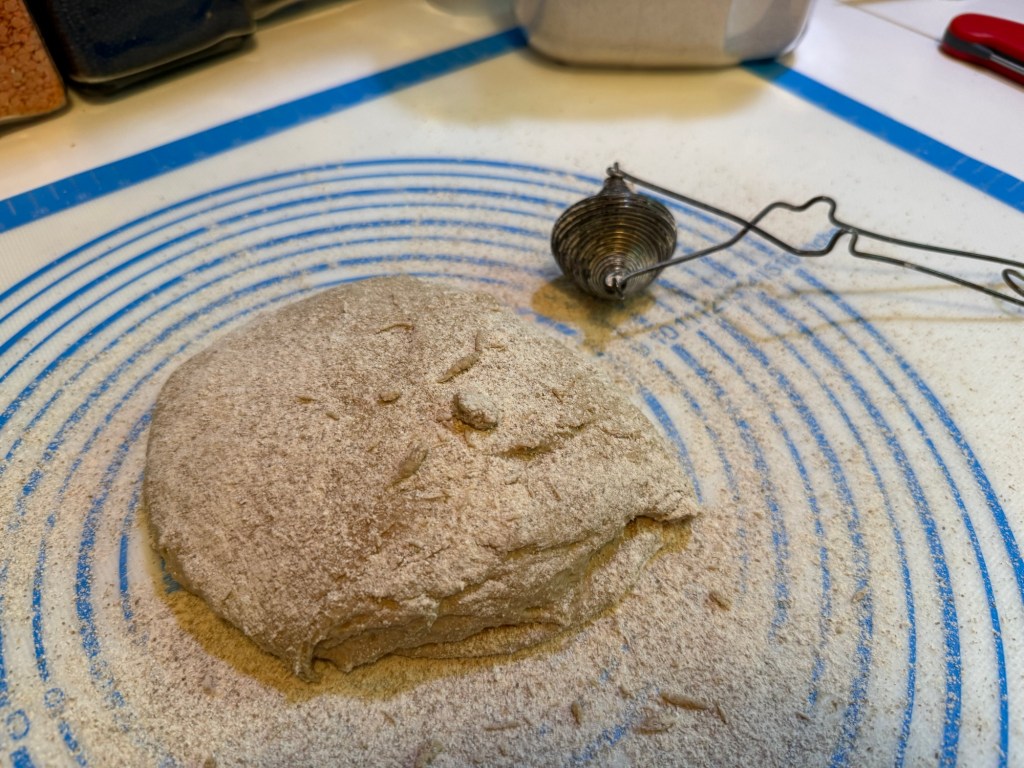
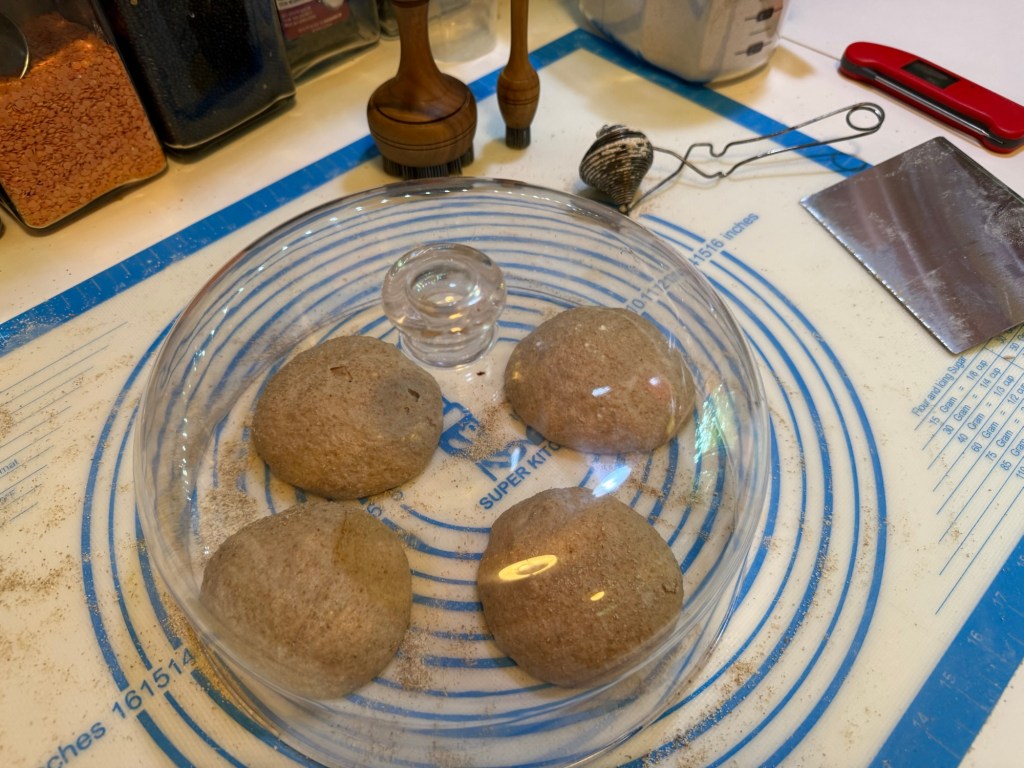
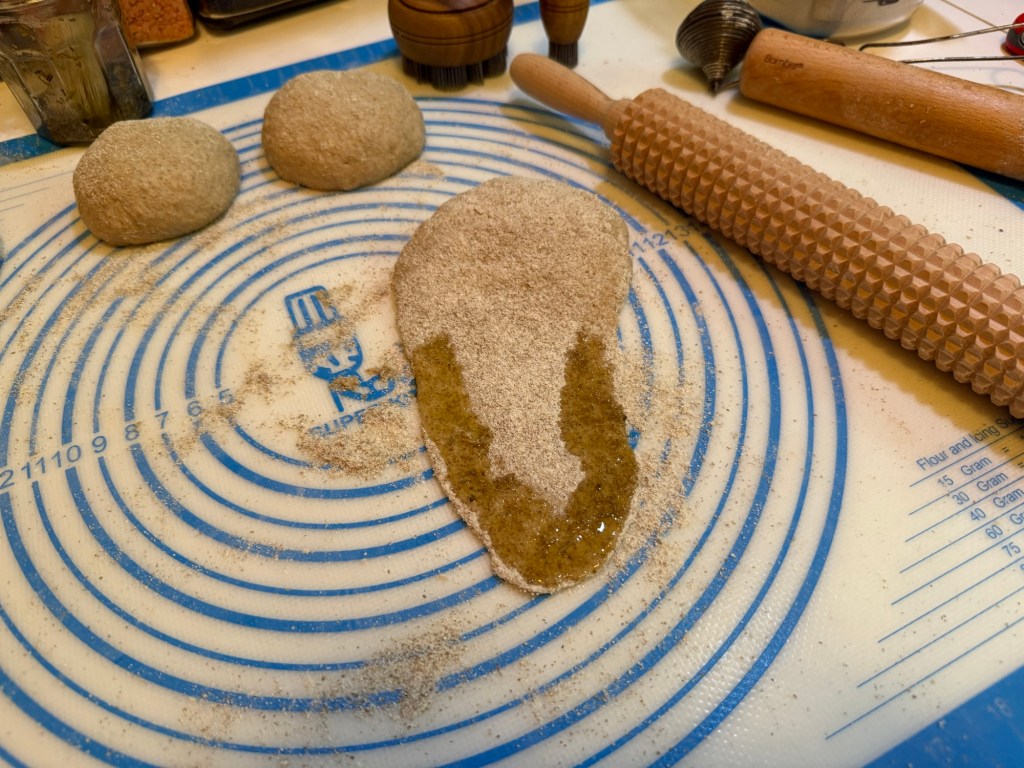
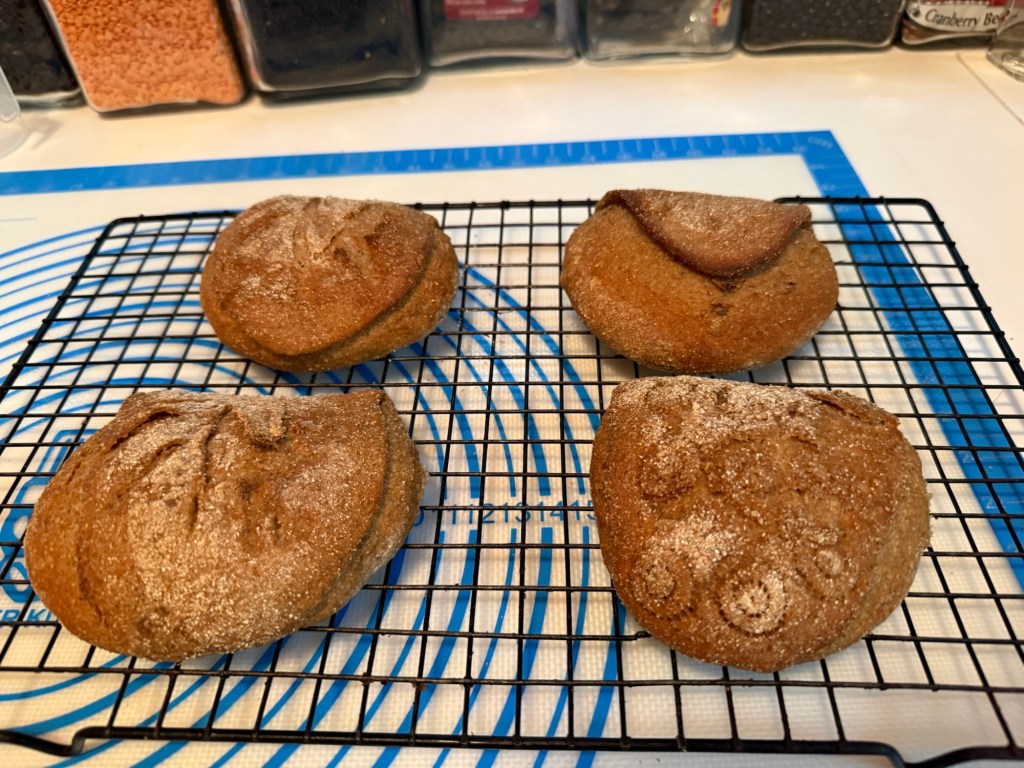
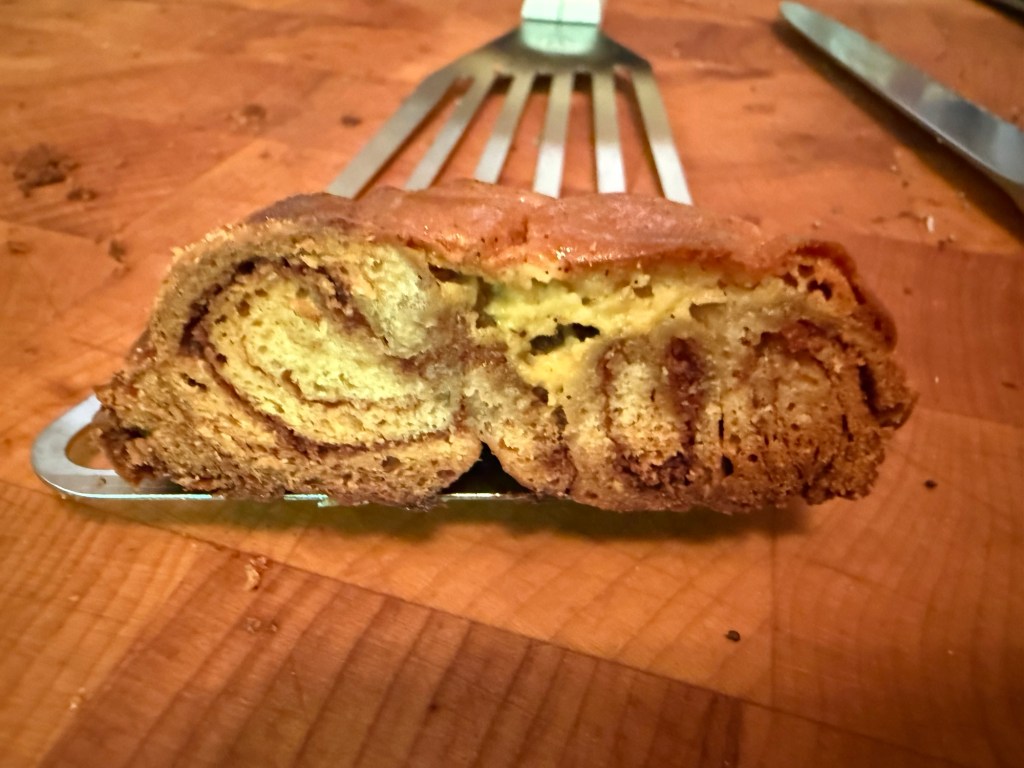
Any time to add oil (or butter) and eggs and substitute some whole wheat flour for AP, you run the risk of a very heavy bread … and if you proceed to omit the yeast … DON’T LAUGH SO LOUD you’ll wake the baby.
How do you omit the yeast when it’s sitting right there on the counter: the older I get the easier it is to distract me and the first time I was mixing this bread I was interrupted fully 22 times.
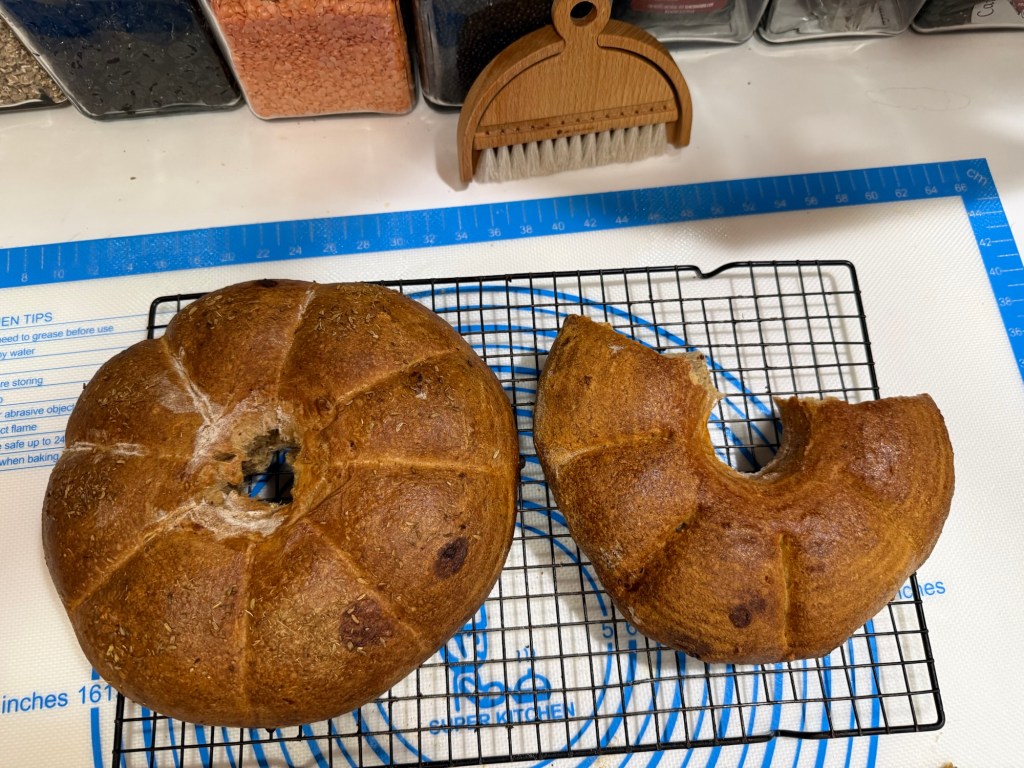
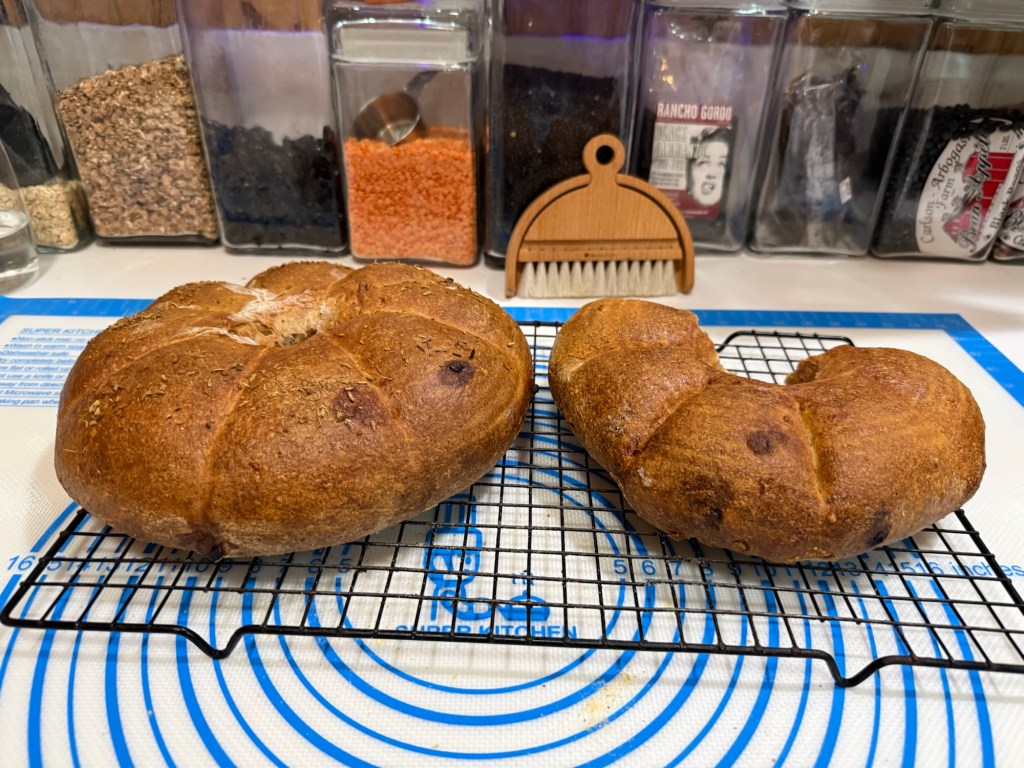
I tried to knead in a yeast slurry after it was rested but it didn’t work well. Couple that with under baking and this was only something my husband and the birds would eat.
Next day I had much better luck.
Elizabeth our Kitchen of the month suggested using Patricia Wells recipe, you will find the recipe on her site blog from our kitchen.
In true babe fashion, I did not follow the exact recipe. For the 600 grams of AP flour I used: 100 grams AP, 230 grams bread flour, and 333 golden wheat flour. Because I was using whole grains flour I used 290 grams warm water.
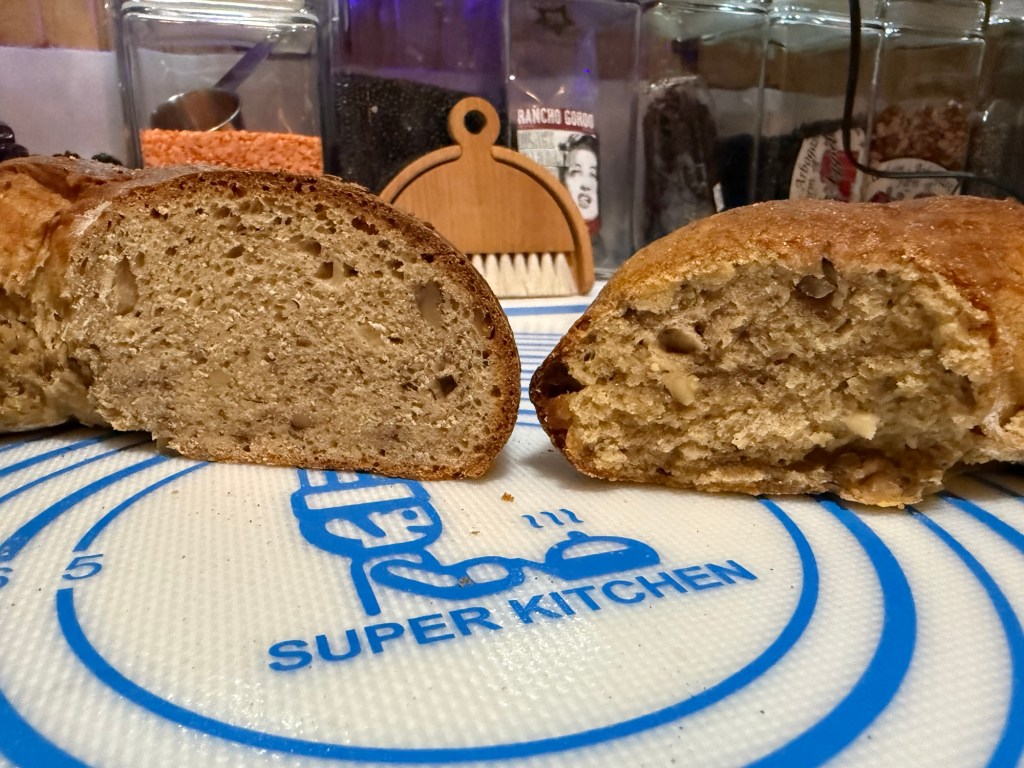
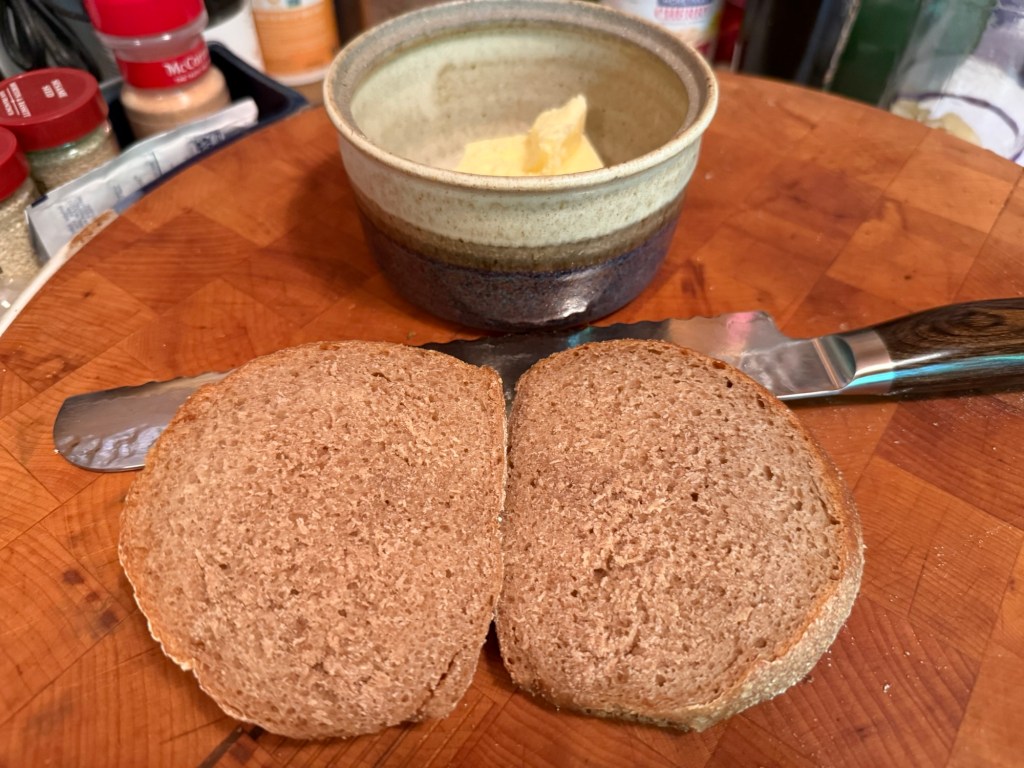
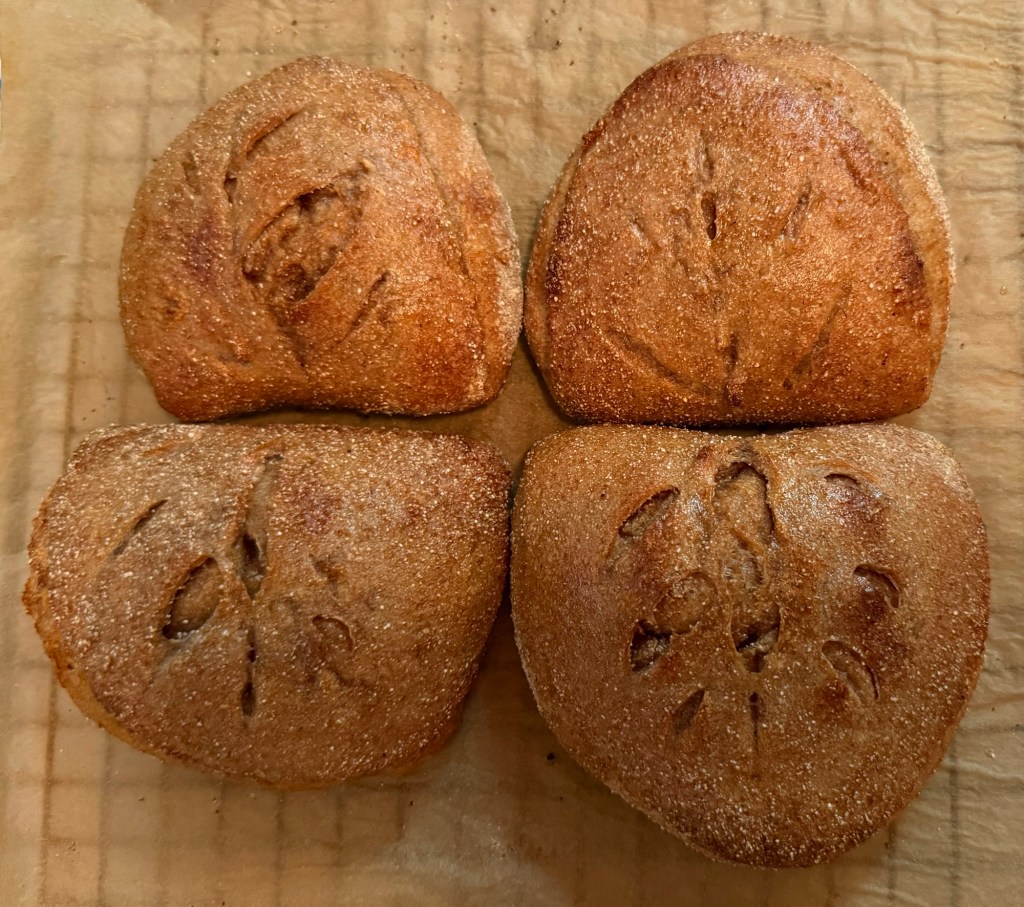
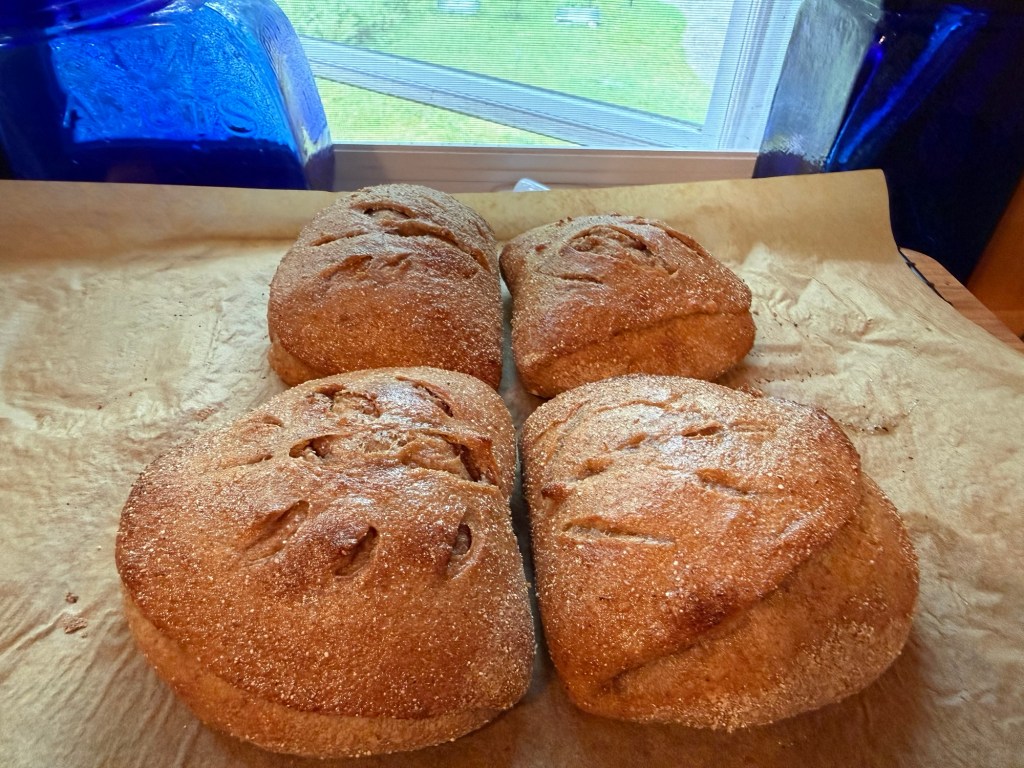
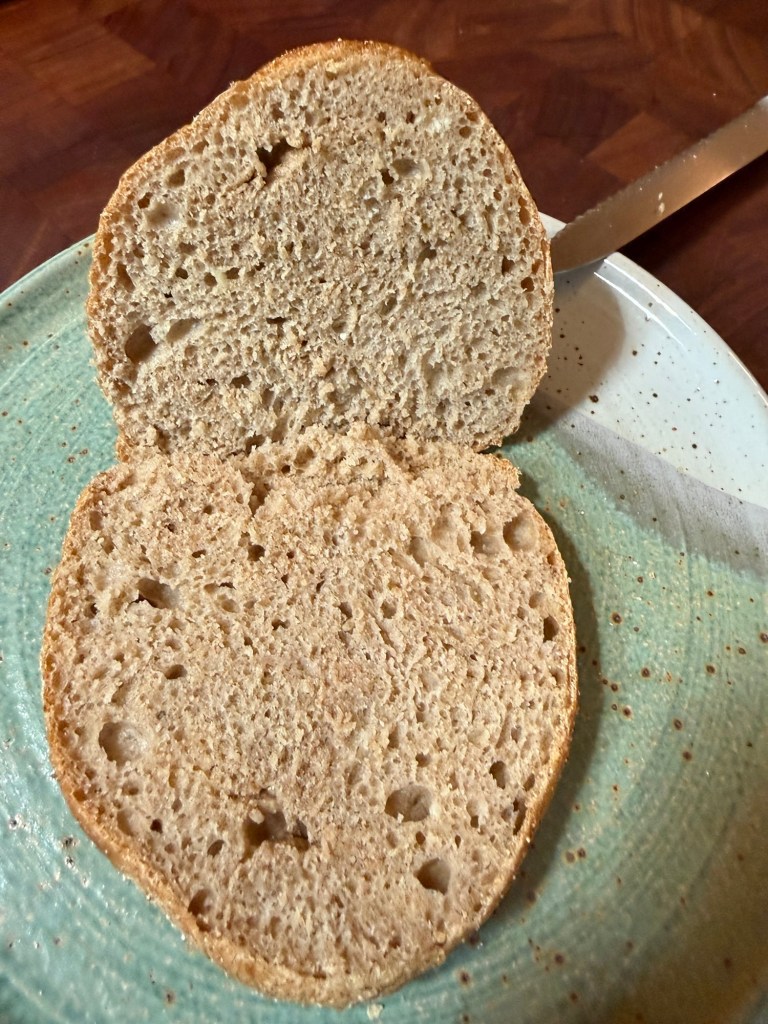
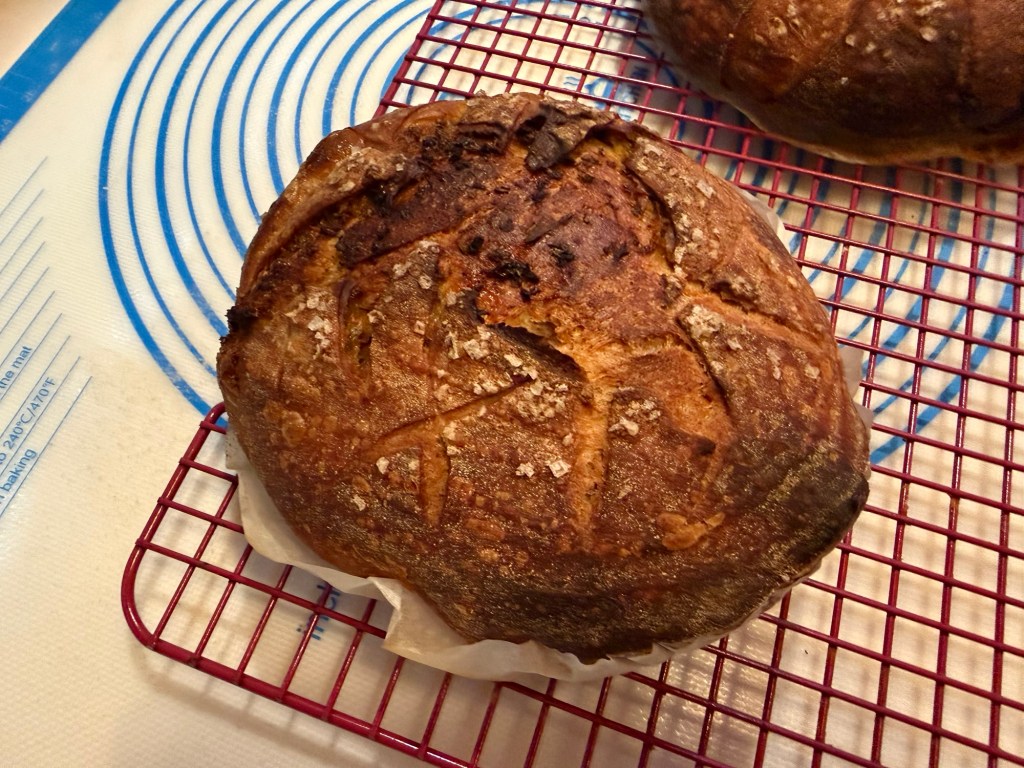
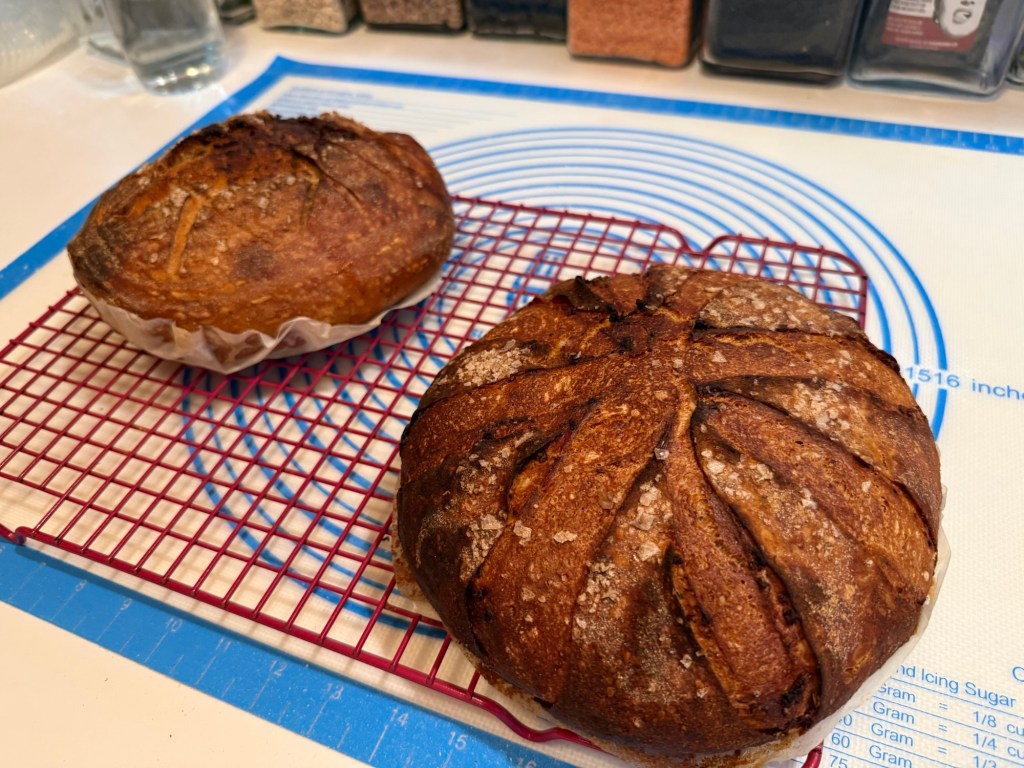
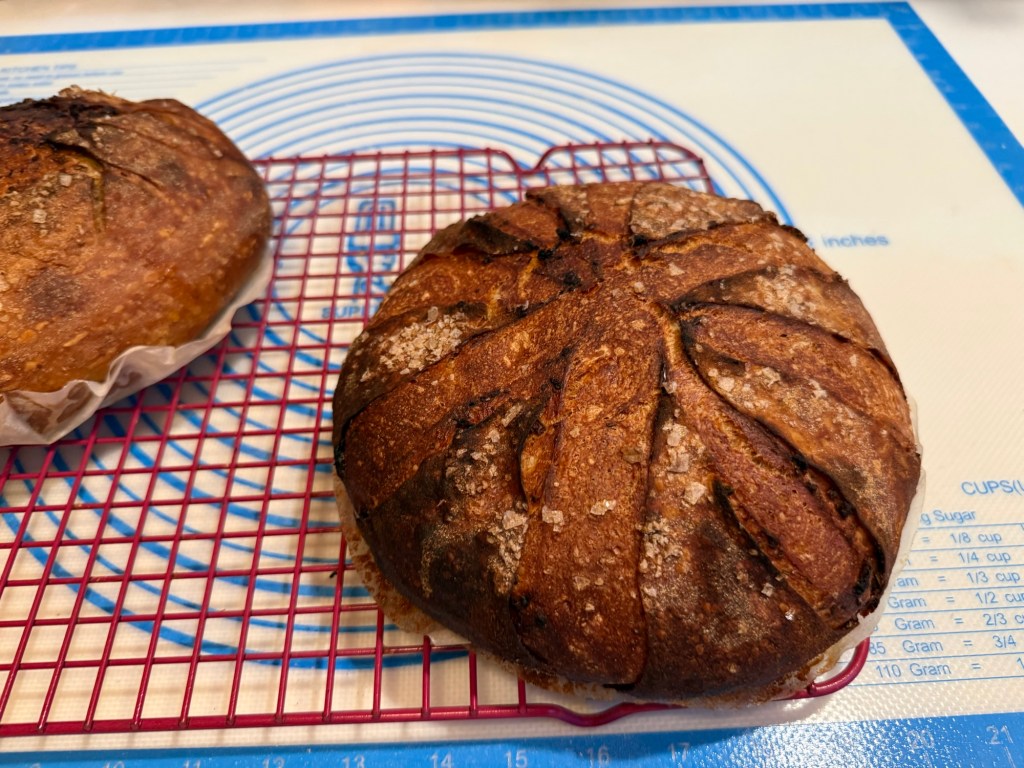
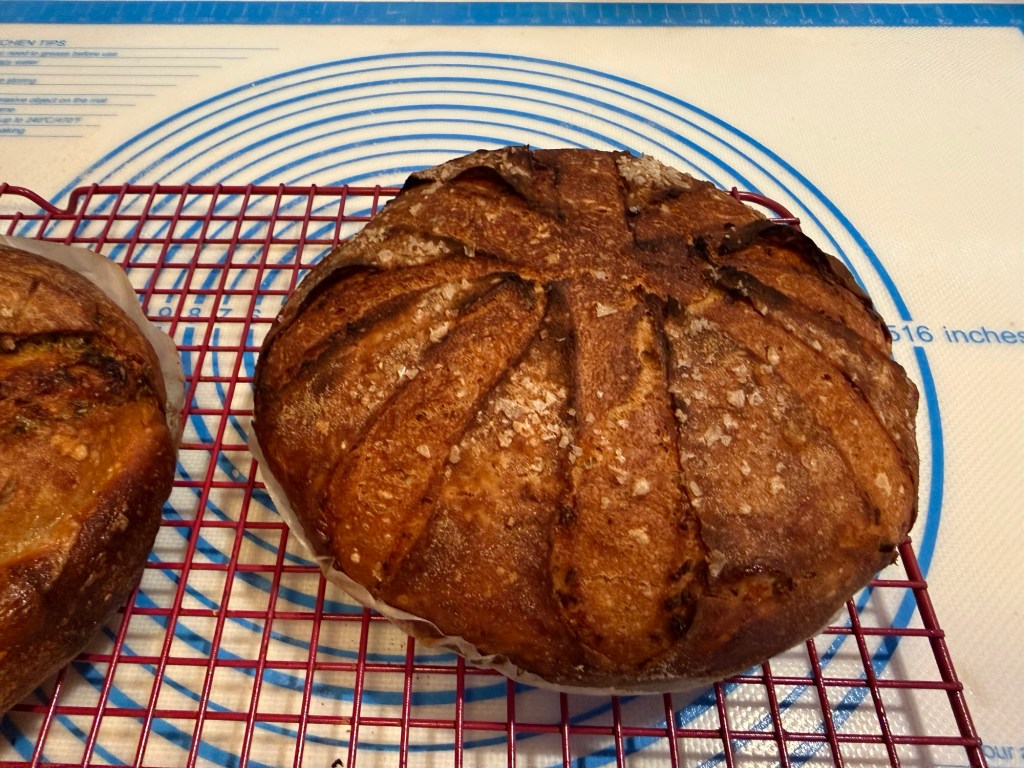
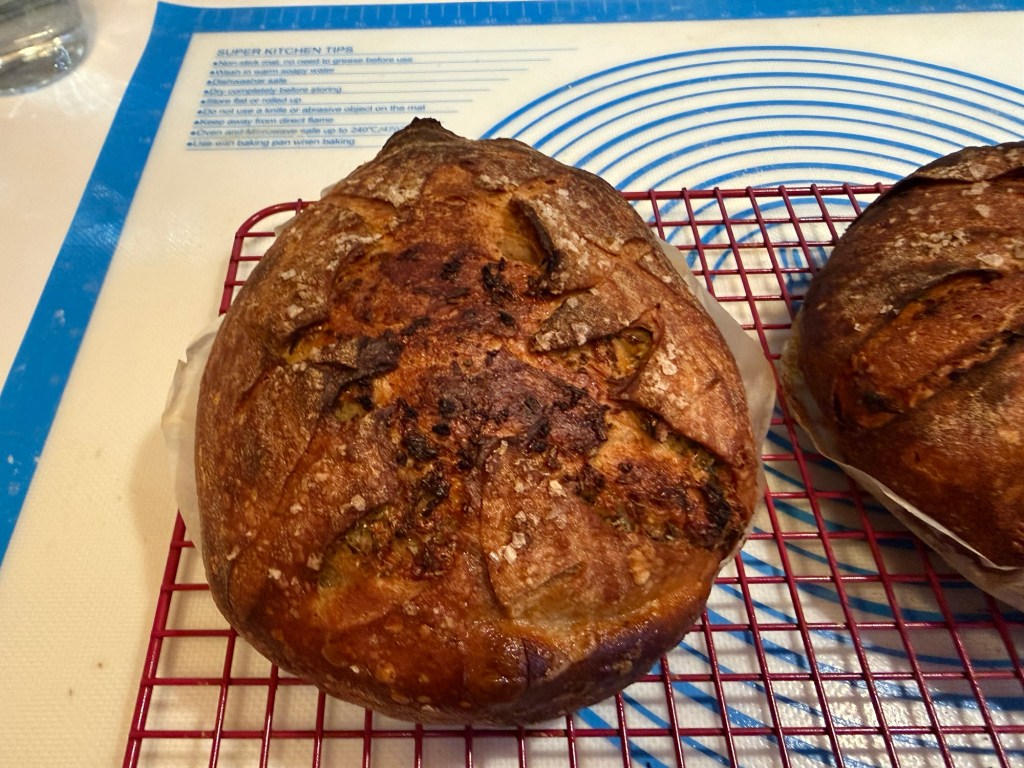
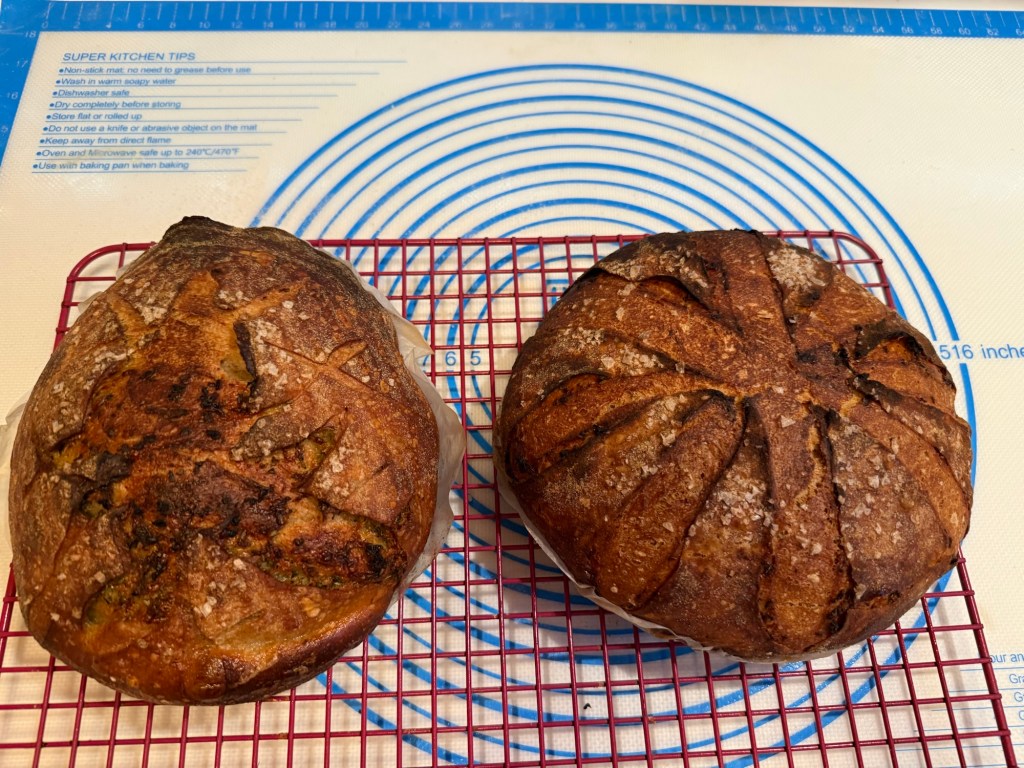
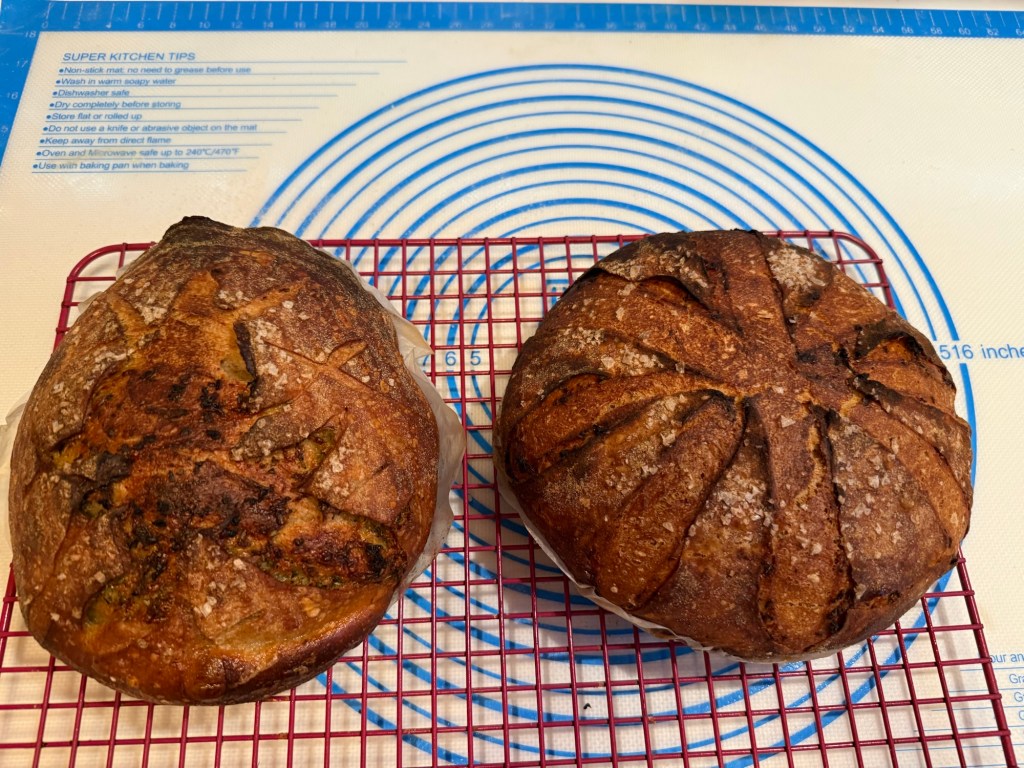
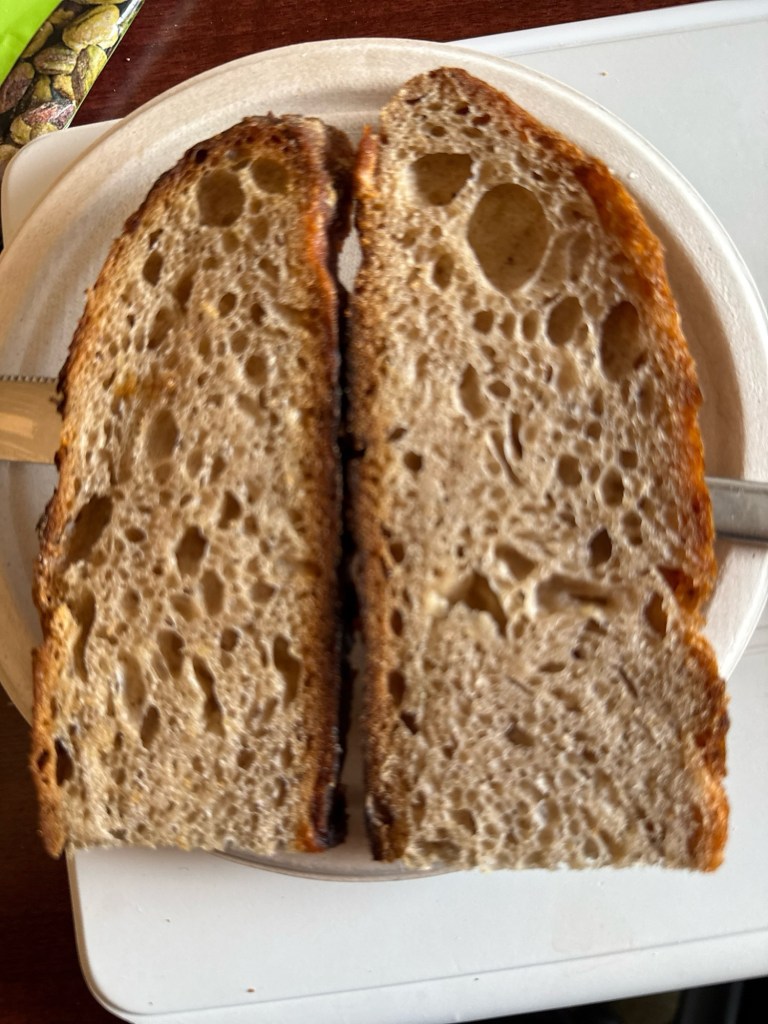
Loaf on the left used yeastLoaf on the right is under baked and no yeast.Loaf on the left made with yeast and baked 50 minutes.
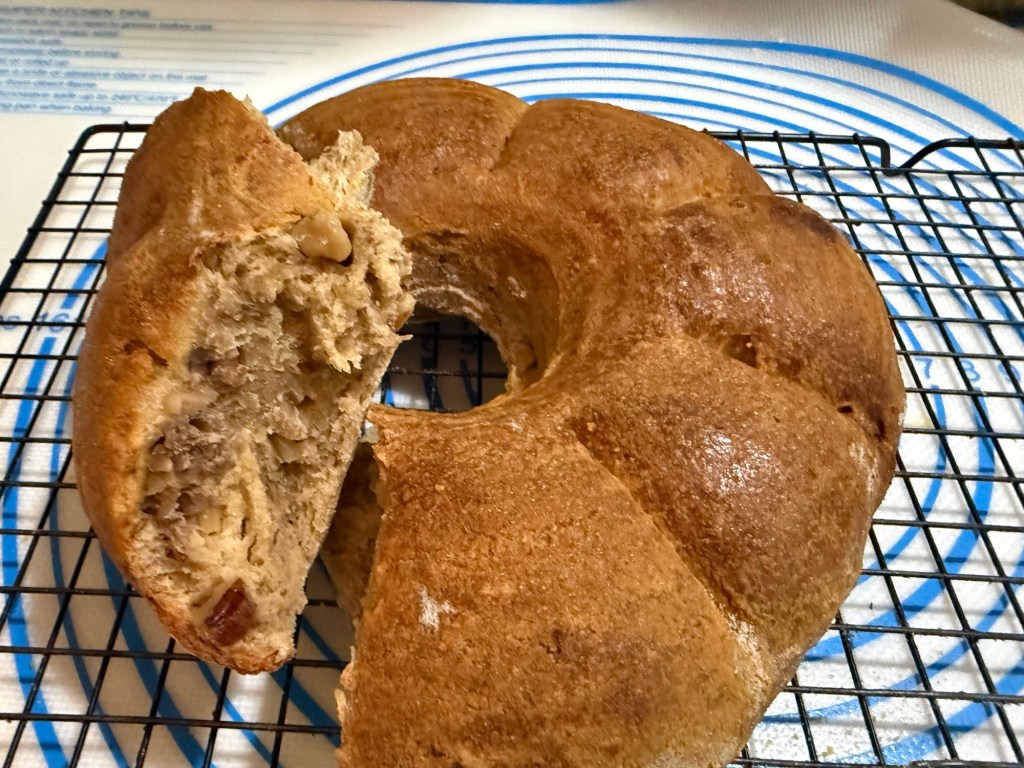
Now, the other BIG change I made is I found Fiori di Sicelic on my shelf. Now I know this is supposed to be a Christmas bread from Provence but this Italian seasoning just screamed Christmas to me and it was the most fabulous aroma ever. Because it’s a Christmas bread I also through in some walnuts and candied ginger.
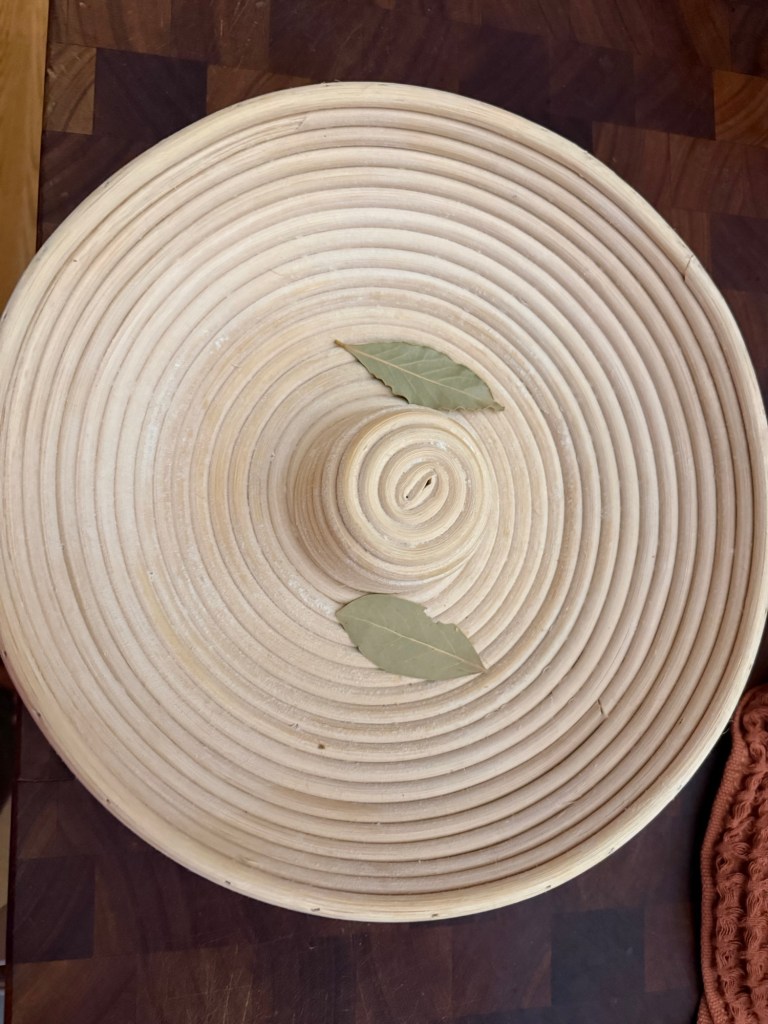
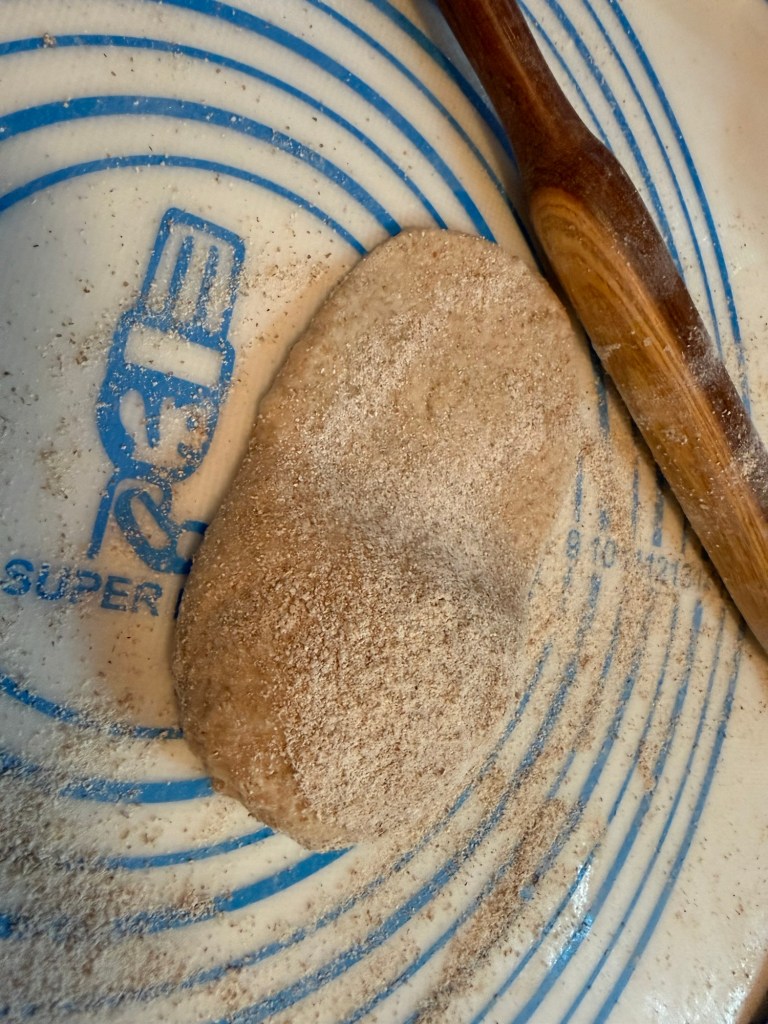
I shaped the loaf in the above dusted liberally with rice flour. (I put bay leaves in it to store and maybe keep out the mealy bugs.Glorious loaf!
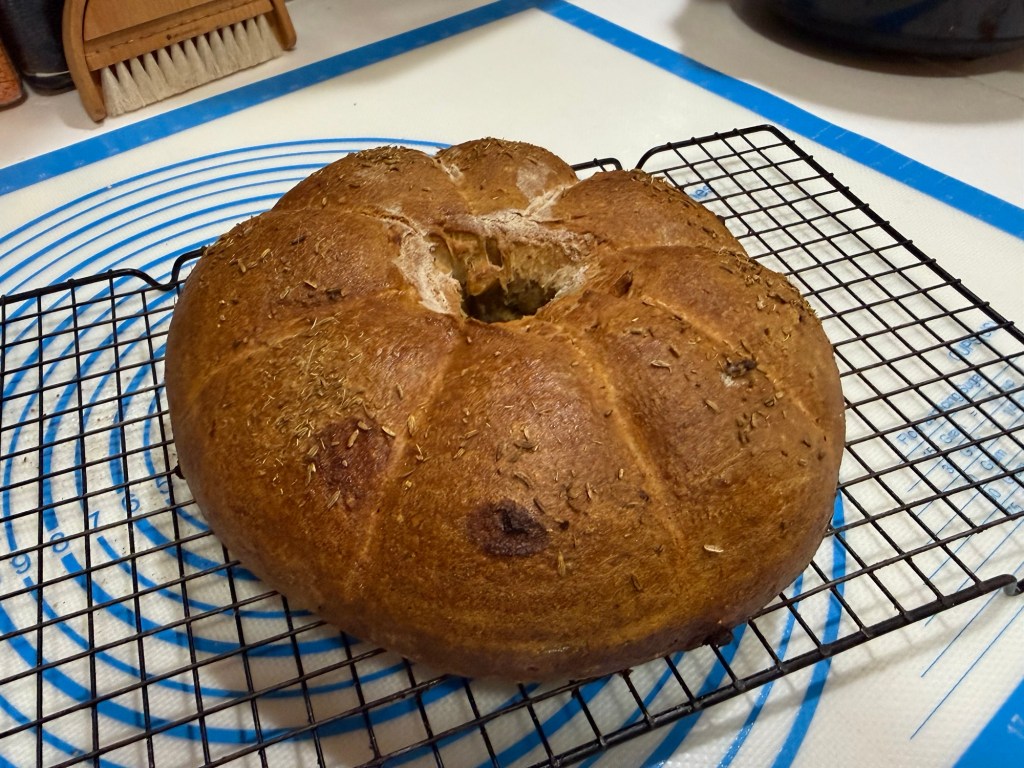
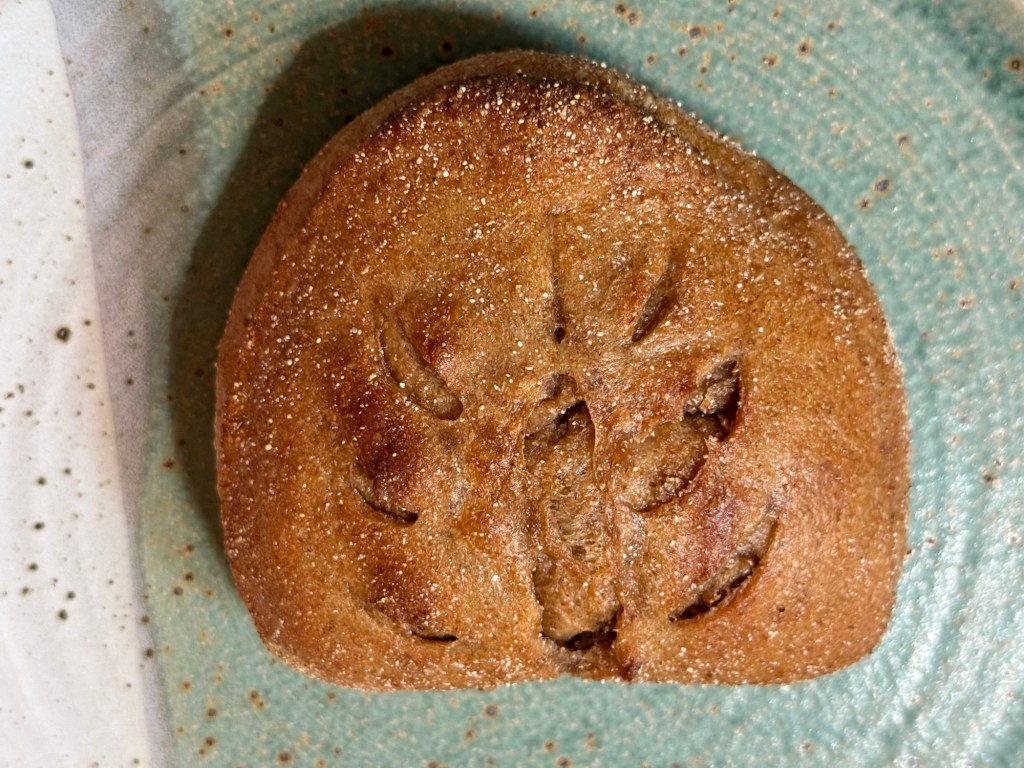
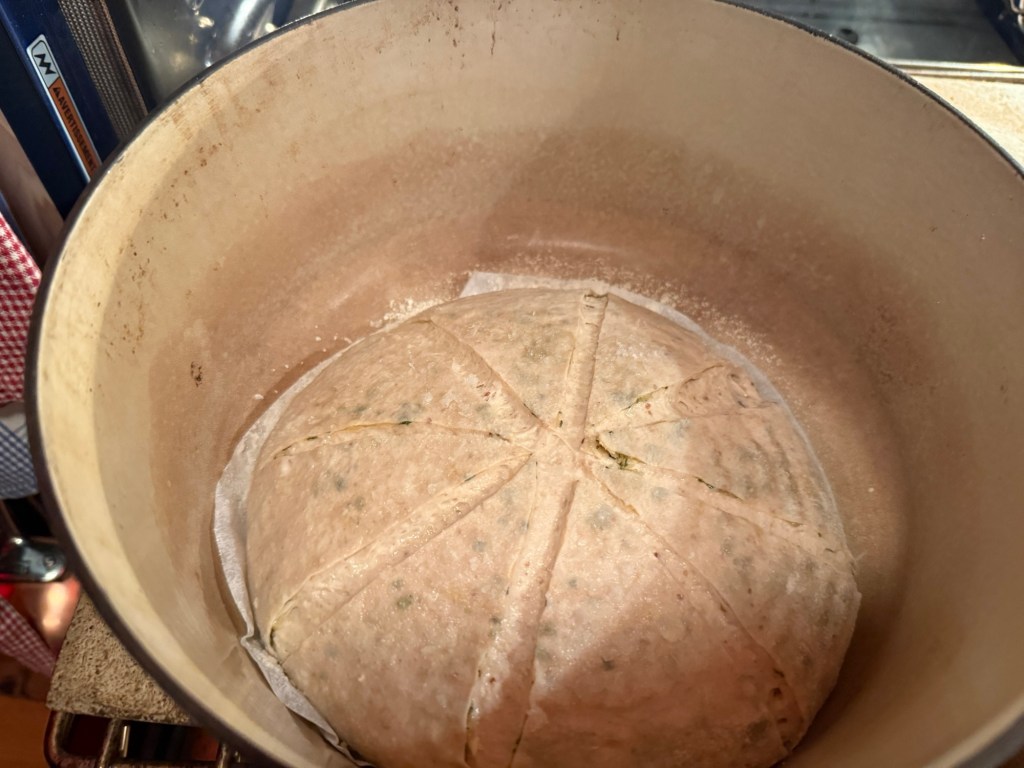
I let my loaf rise in a banneton and used a bench scraper to mark it off in sections after it was turned out.. I used an egg wash and sprinkled crushed fennel on top.
The loaf baked at 450° for the first five minutes and then another 45 minutes at 400°. Internal temp registered 211° when I took it out of the oven.
This is a marvelous loaf and I do believe I’ll be baking it for Christmas!
Check out all the babes posts if you haven’t already, they can be found at the top of this page.
Elizabeth all I can say is … somehow I got it into my mind I had baked this … then I got it into my head I thought this was for next month … today I find I have not baked this and I am out of town (in motels) until Monday. I promise I will bake next week. I love your loaf! It’s beautiful ragged side and all. I recently made the same mistake not buttering the lid on a Pullman loaf.
For Elizabeth and all the Babes baking and posting today please visit Elizabeth’s blog.
There was a time in my distant youth when I followed all the rules. In that distant youth, within my family, I had the nick name of Miss Goode Two Shoes. No one could call me that today. Follow the recipe, are you kidding. I wonder if it happened when the Bread Baking Babes invented themselves and proposed: The Rule is, there are no rules!
You will need a rolling pin for this one.
This month we’re in Cathy’s kitchen. On her blog, Bread Experience, you will find one of the best examples of how to write the perfect and easy to follow recipe you are likely to find on the internet or in a book. I absolutely LOVE the section titled “Choosing your loaf size”. Very helpful.
With such a perfect recipe/rule, how/what did the devil in me make me do? The first time I baked this I used the suggested 45 grams rye, 195 grams golden whole wheat (King Arthur), brushed the flap/tongue with a mix of olive oil, butter, garlic and rosemary. No AP flour and where did that garlic rosemary thing come from?
Now these were good…but then I thought I should try the way Cathy wrote it…
I just couldn’t do it. Cathy gave us all kinds of flour combinations but none did I follow exactly. The second time I baked these loaves I used the 45 grams spelt flour she suggested AND INSTEAD of 195 AP I used 50 grams rye, 50 grams more spelt and then oh my goodness I again used the golden whole wheat. It had really been my intent to use regular AP but I just couldn’t do it. And then to compound my lack of follow through I put 5 cloves of garlic in my garlic press and folded that into the dough with the last two folds.
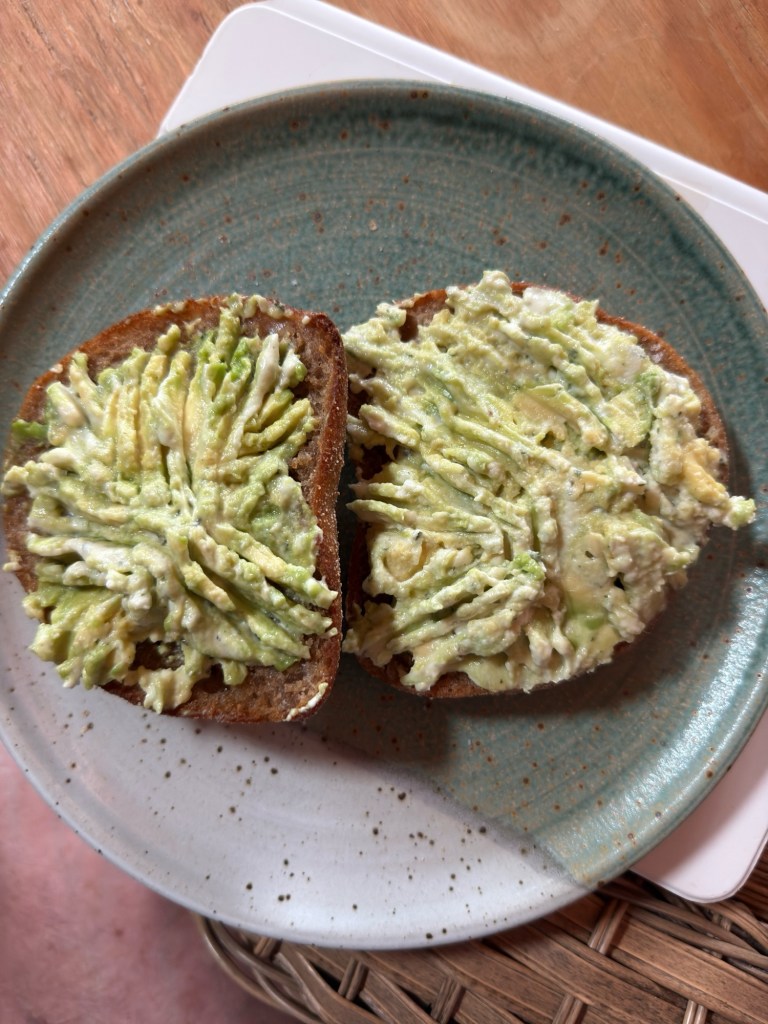
Positively amazing avocado toast!
Can you tell I’m really garlic lover? Well, the garlic in these was heavenly and that I will do again. I may roast it the next time.
Skip on over the Cathy’s for the best and proper recipe, follow the rule for glorious loaves … or not and still have glorious loaves.
Check out our Facebook group and the BBB blogs (links below) to see our baking results.
Now I love looking up ‘where did that come from’. This is what Wikipedia says about goode two shoes: The phrase “goody two-shoes”describes an excessively virtuous, self-righteous, or overly obedient person. It originates from a 1765 children’s story, [The History of Little Goody Two-Shoes] published in London, about a poor orphan girl so happy to receive a pair of shoes that she constantly told everyone she had “two shoes”.
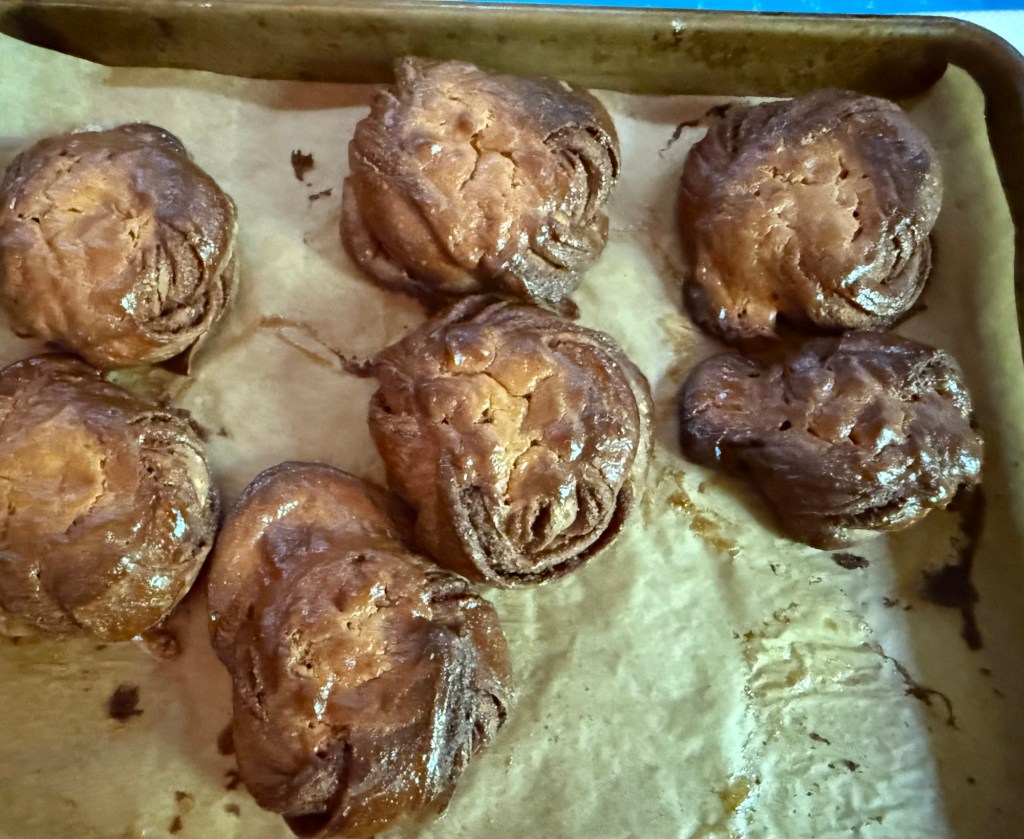
There are times, even when the sun shines, that here in the woods we lose electric power for unknown reasons. Until the day I was baking these Sun Buns, it had never happened when I had the oven on and baking. But it did happen. I’d have been ok if I’d set the timer on the phone but no, instead, I had the timer set on the oven. So when the power went out, I had no idea how long the bun had been in the oven. I left them way too long.
Please check out the right way to bake these and for the recipe at our Kitchen of the month Karen at Karen’s Kitchen Stories. I believe my would have look almost as good as Karen’s if I hadn’t burned them.
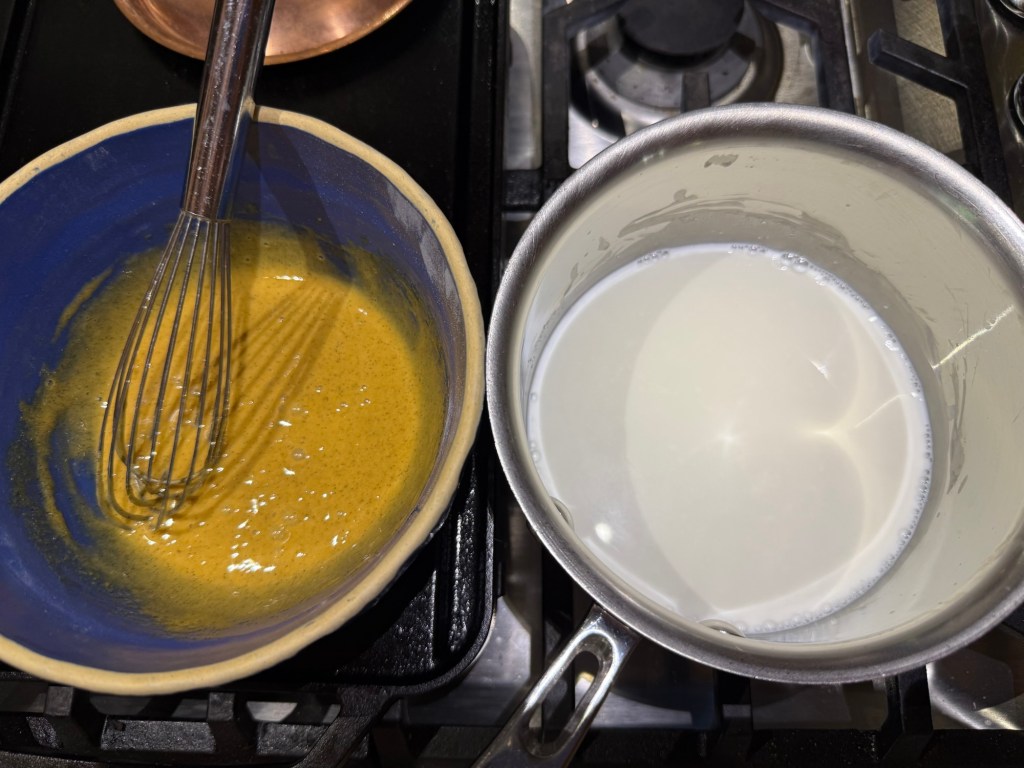
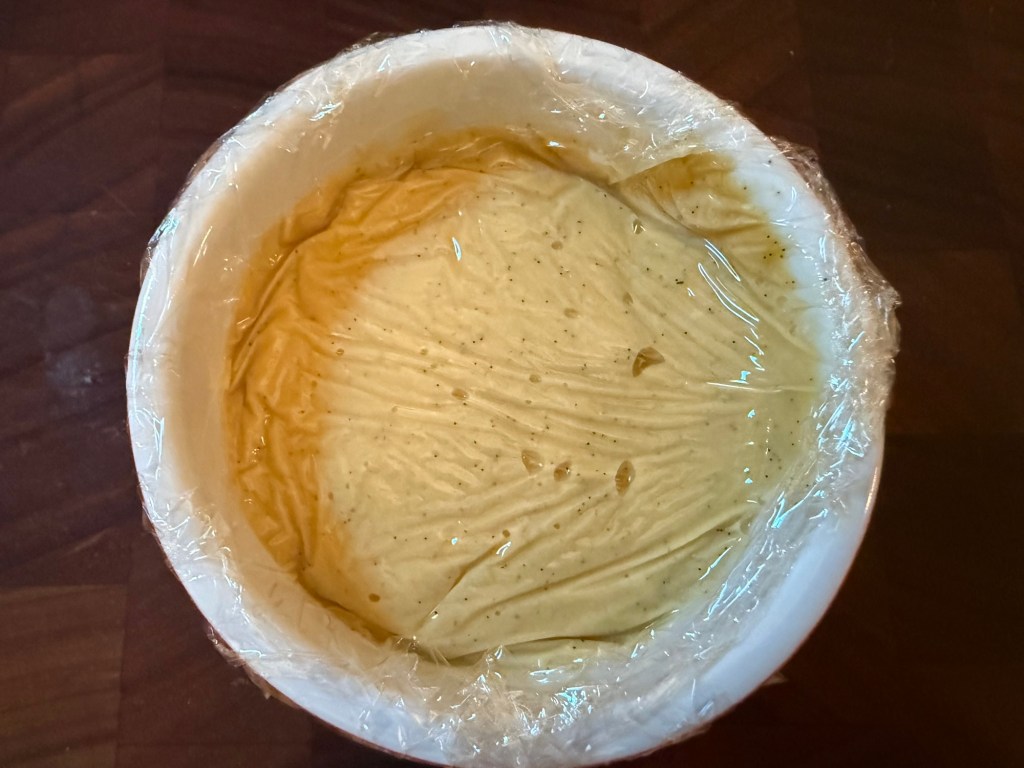
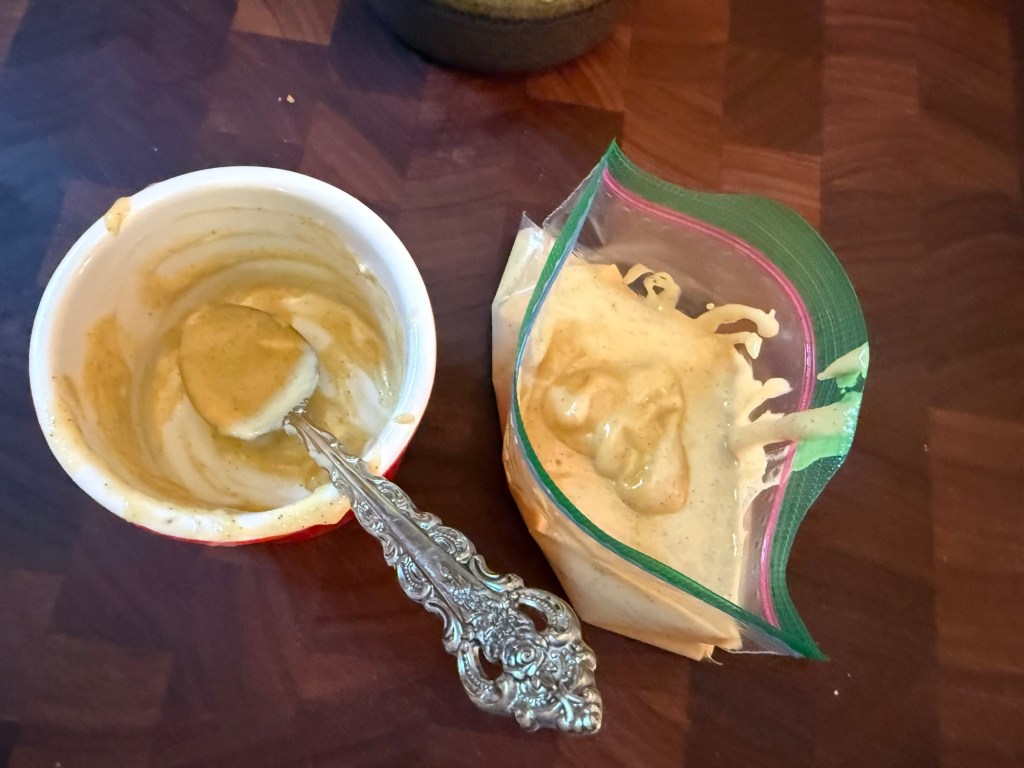
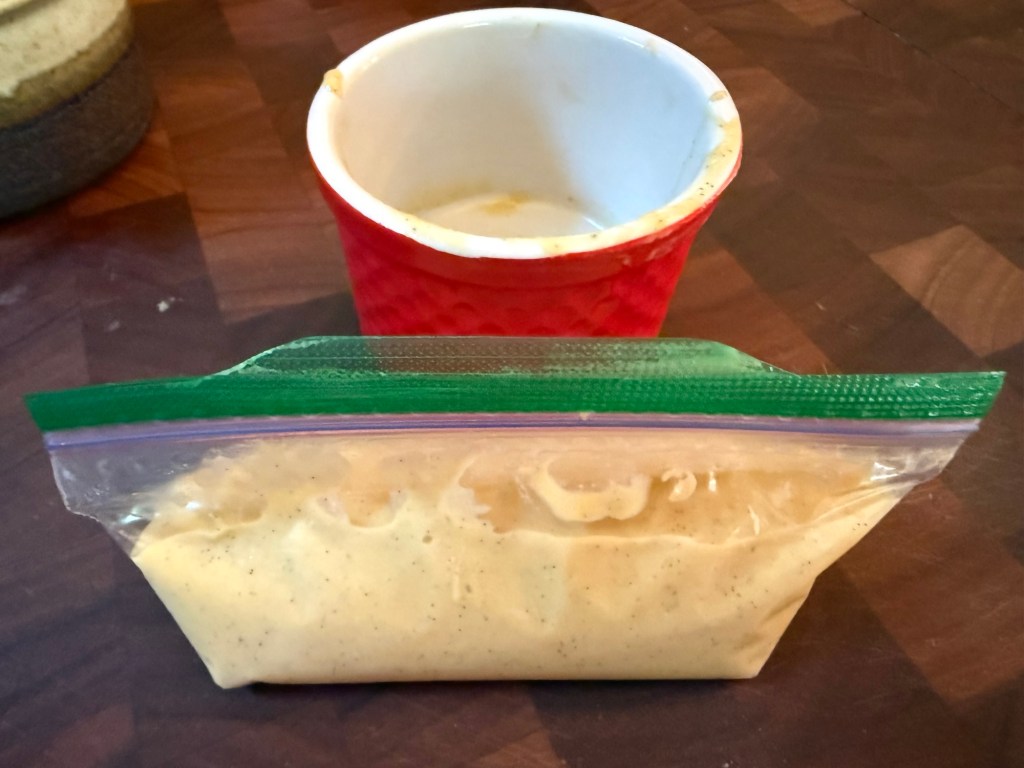
Custard.Covered custard to prevent a top film.
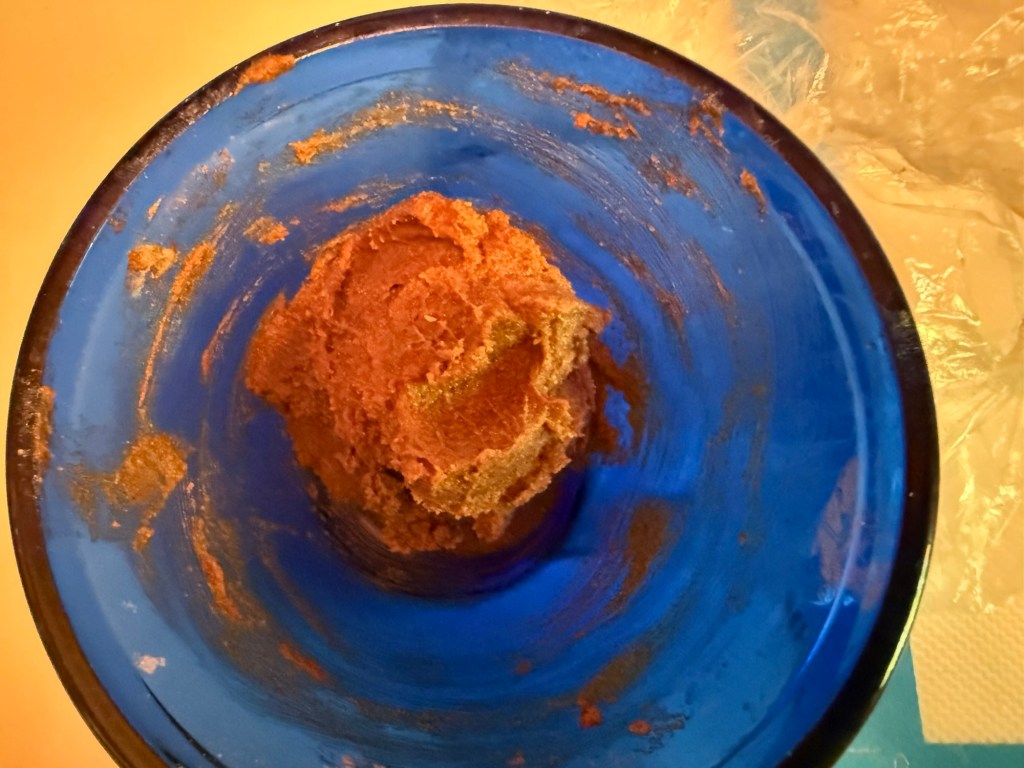
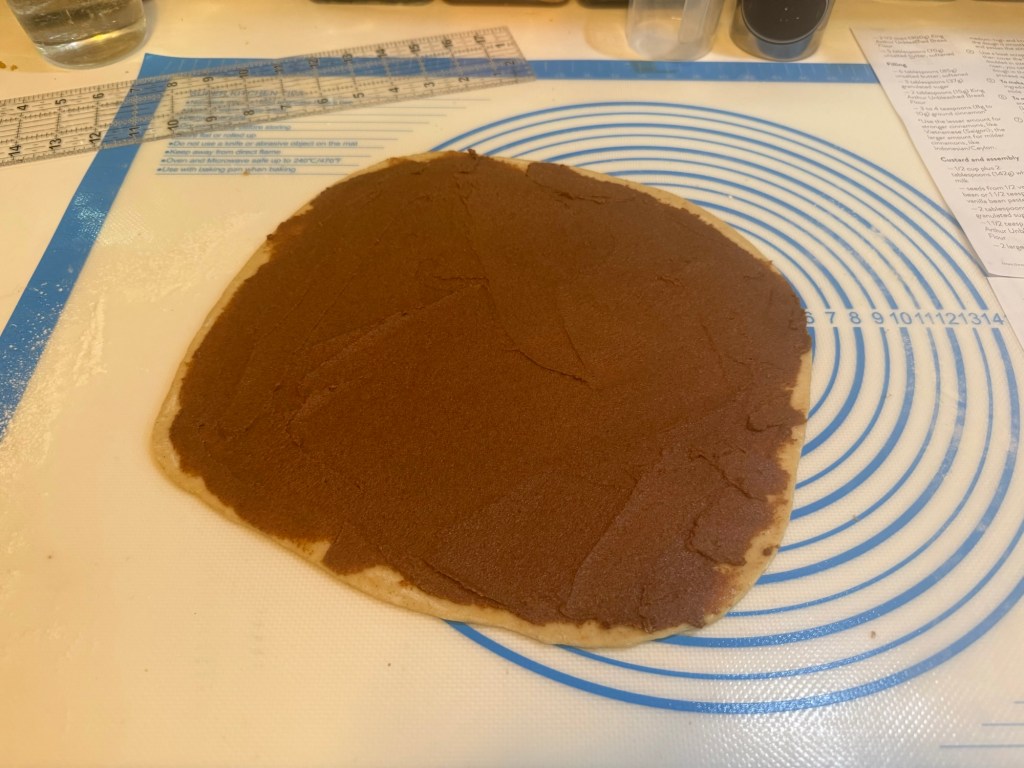
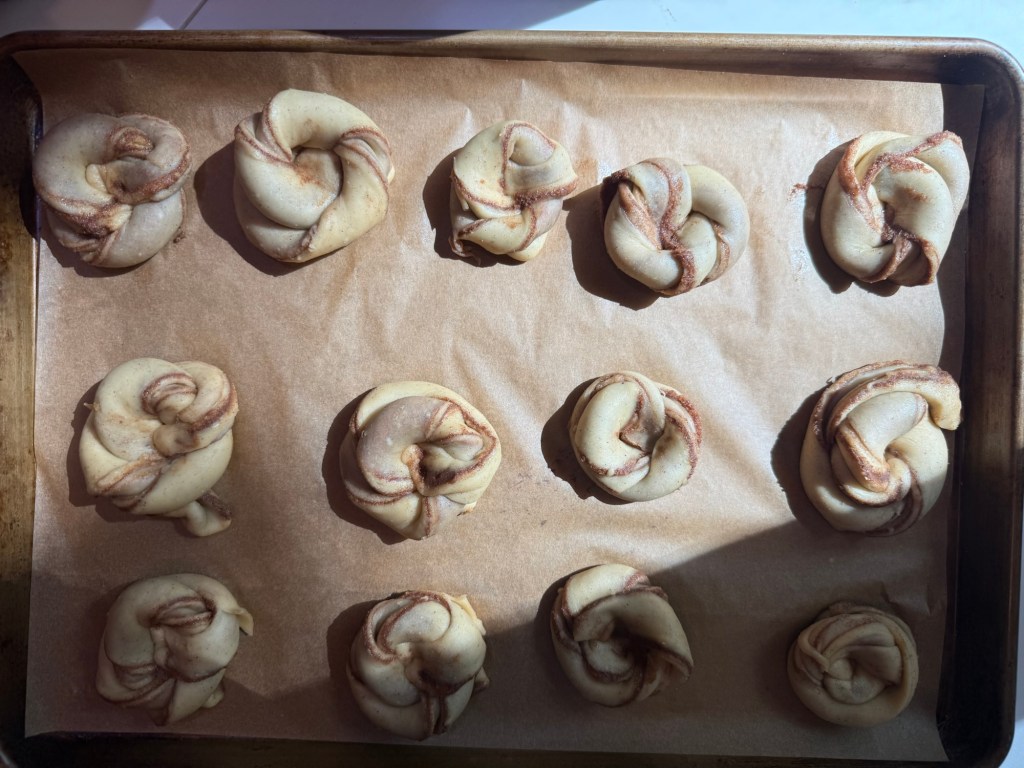
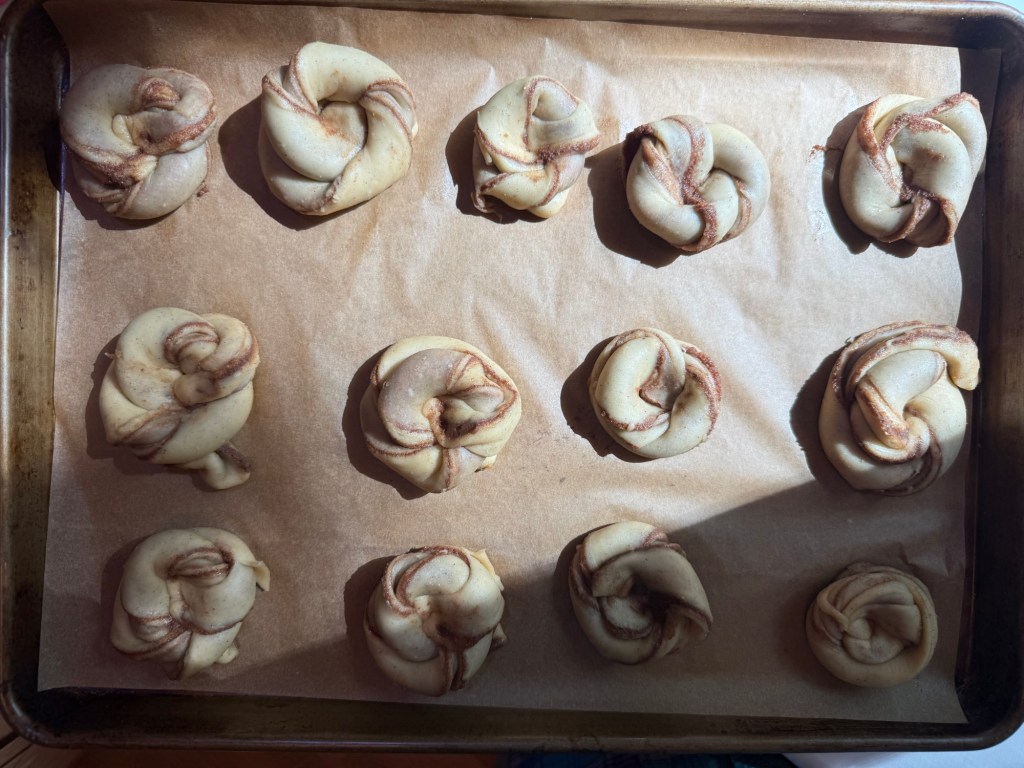
The night before baking, I made the custard and the cinnamon paste. I will say both the custard and the cinnamon paste are spectacular standalone!
This cinnamon topping is gloriously good.The dough was beautifully soft and silky.
Did I tell you that cinnamon filling/paste wad incredible. So incredible I was tempted to just spread it on toast.
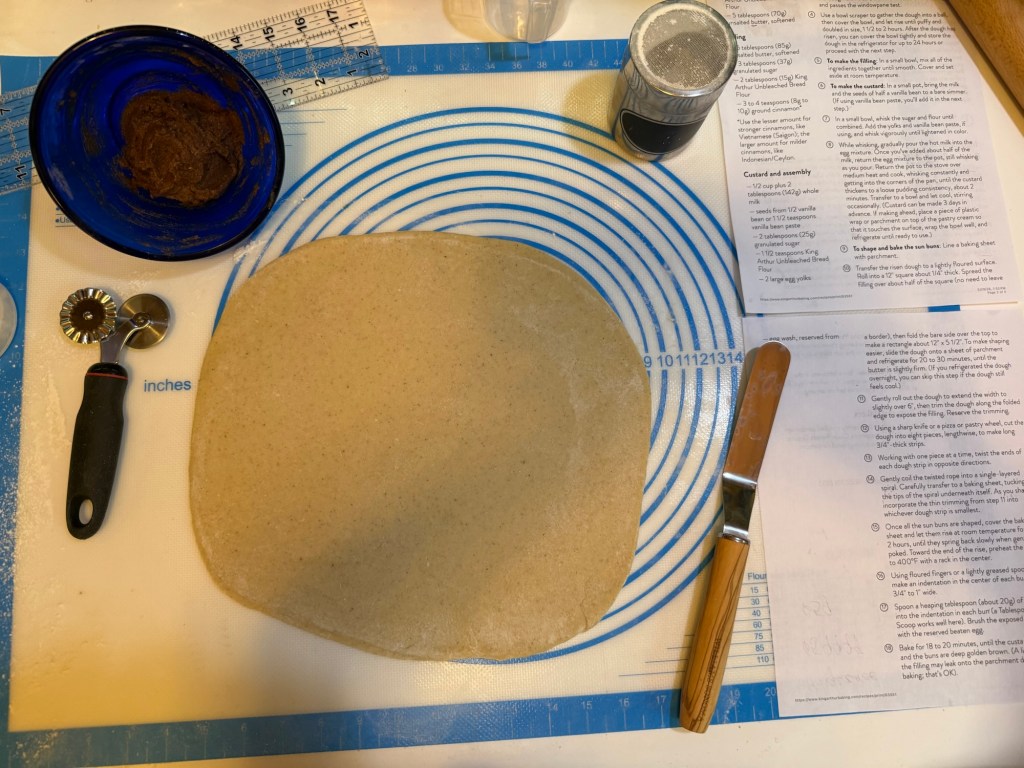
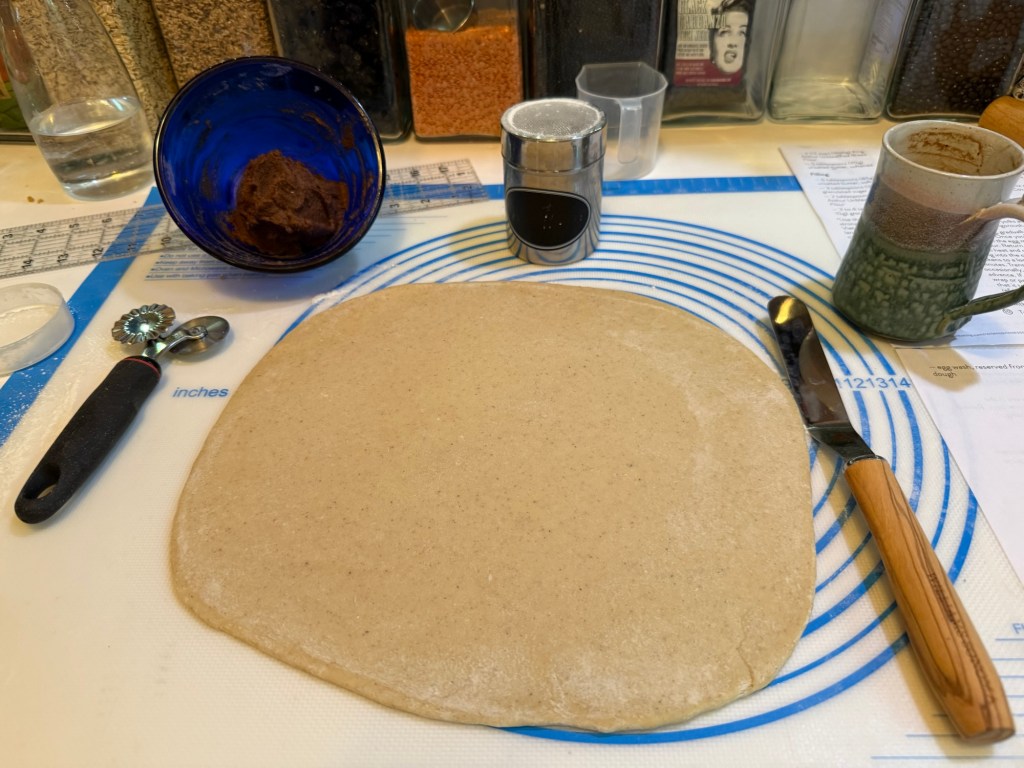
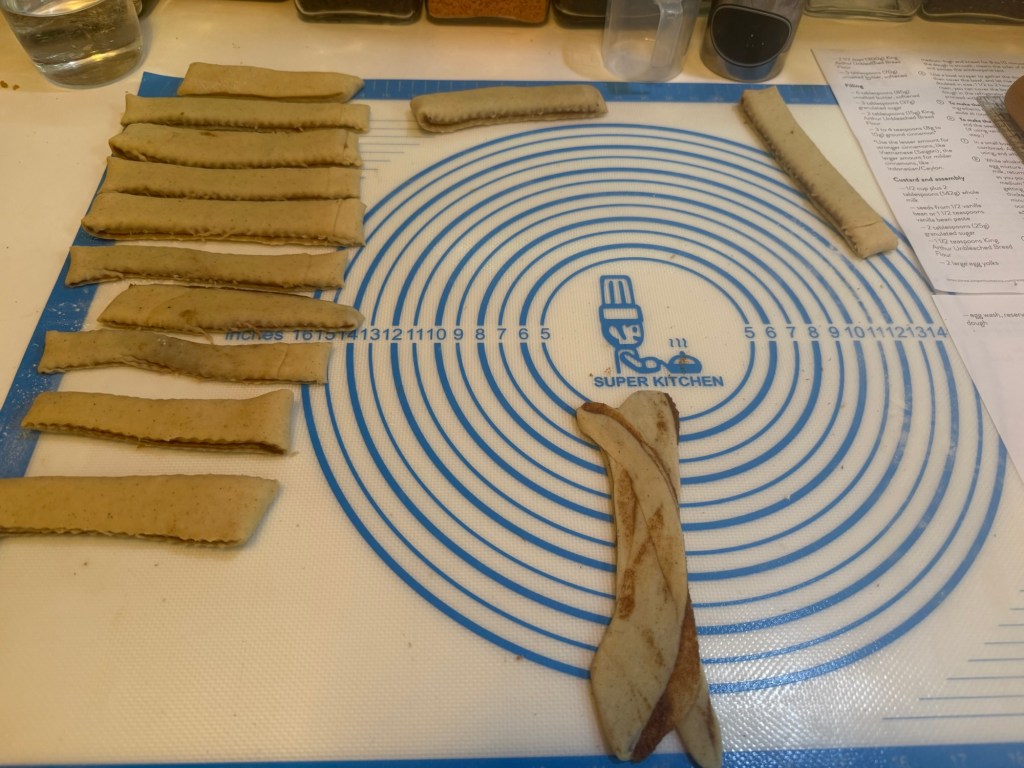
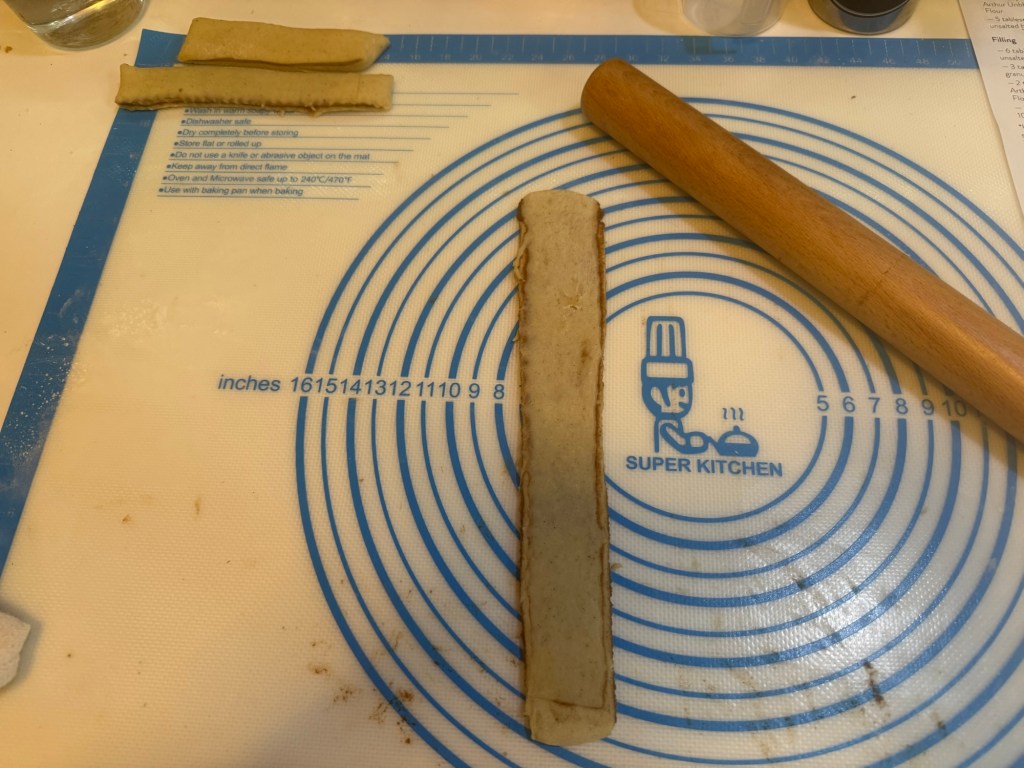
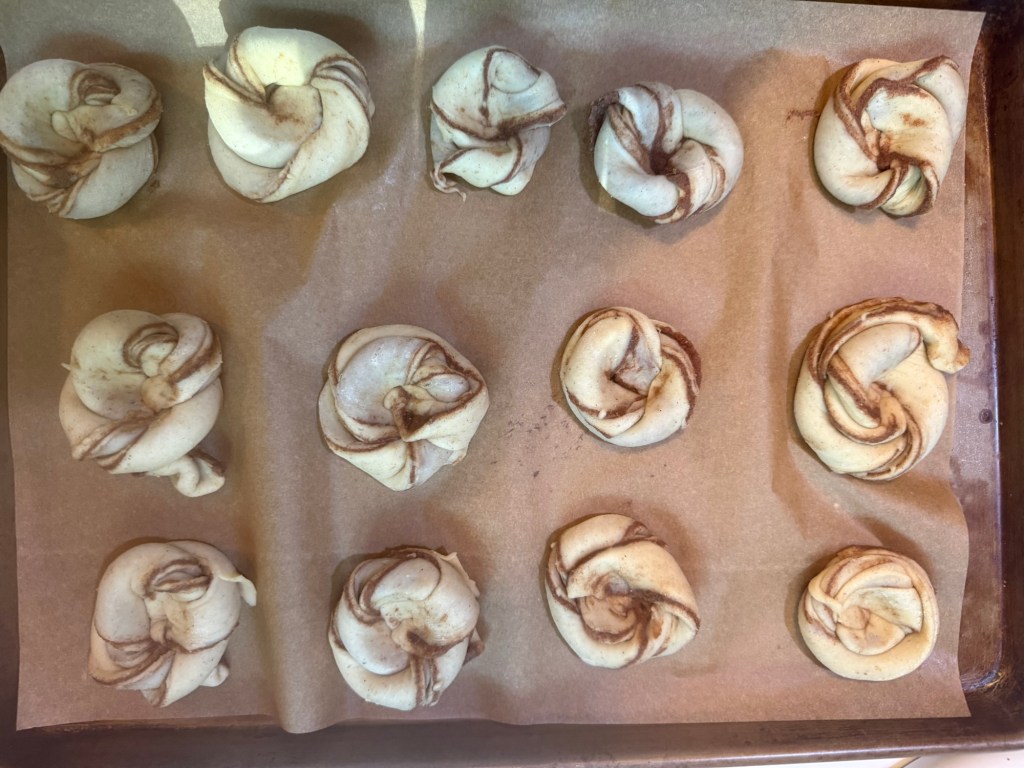
The dough was silky lovely. It rolled out exceptionally nice easy strips that tied into surprisingly easy beautiful knots.
The one and really only suggestion I could make would be to skip covering the custard and go straight to putting it into a ziplock bag because why waste plastic film to prevent a film forming on top of the custard when the neatest way to fill a dimple in a knot is by putting the custard into a ziplock bag where no film will form on any surface and all you need do to is snip the corner of the ziplock and squeeze enough to fill a dimple.
I really hate to show you what came out of my oven but that’s not the reason I’m late with my post. No, I hate admitting perhaps even more that i got my days mixed up.
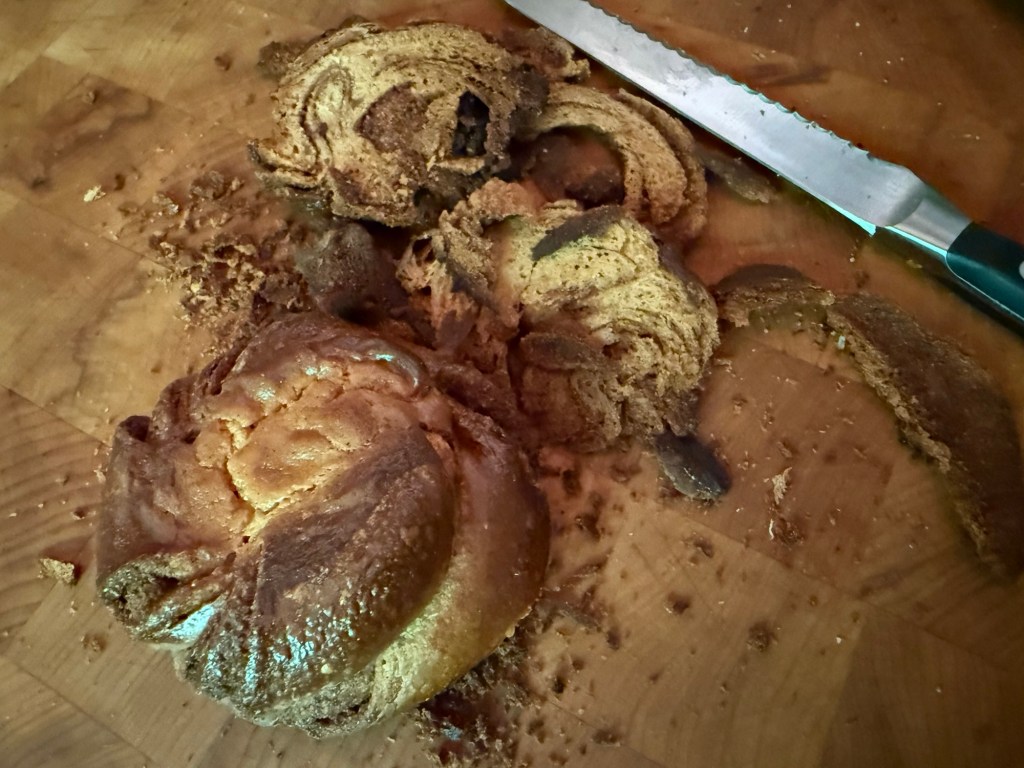
Elizabeth reminded me too late the way to clean burned or over baked bottoms is with a grater so I resorted to cutting the bottoms off the over baked buns …. You really can’t over bake the sun, it just turns brown and ugly.
The two in the left photo came the closest to being eatable, well almost.
Original recipe can be found at King Arthur. And for heaven’s sake do check out all the Babes posts as I will be doing now!!
Some may speak of water under the bridge, I speak i of loaves out of the oven. In the last 18 years I’ve been baking bread with the Babes, I’ve taken many a loaf out of any number of ovens and I hope for many more to come. But today … Today marks 18 years of the Bread Baking Babes pulling amazing fresh bread from our ovens.
Happy Anniversary 18 Years Babes!!!
Many of our loaves have been beauties but this loaf … well this loaf is a doozy.
I first came across this recipe in the book “Richard Hart Bread”.
This is his introduction:
“This is a variation on the most famous bread made at Della Fattoria (in Petaluma, California), where I got my start as a baker. After you have been working at Della for a while, you are totally over this bread. They make bloody hundreds of them a week, and you need to chop a ton of rosemary on a daily basis. We never had enough, so we used to drive around town, nicking rosemary from everywhere and anywhere we could find it. I’m sure the poor bakers who are working there still have to do this. So this goes out to you rosemary choppers and the local gardeners wondering about your stunted rosemary bushes. But it is really here as a tribute to my original mentor, the lady who started my baking career, Kathleen Weber. I’ve made the dough formula my own, but the method I learned from Kathleen. This recipe uses a beautiful technique that adds a spoonful of a flavored oil to the dough. In final shaping, it is worked to the top of the crust, which makes the bread pop up into a crown.”
Well, when you read that, you really just have to go to the source. I already had Kathleen Weber’s Della Fattoria Bread in my library. Her introduction gives us a lovely story of how this bread came about.
“A request from Thomas Keller right after he reopened The French Laundry in 1995 got me into making pain de campagne. So I asked Thomas lots of questions. (How do you envision serving this bread? Do you like lots of crust? What shape would look best on your bread and butter plate?) In the end, I created the bread he was looking for. For Thomas, I shaped the dough into bâtards. Here we make both a bâtard and a boule.”
In her book, Weber created a base recipe and then gave numerous variations in shaping and flavoring. I think I’ve seen look-a-likes many times and always felt there was no way to get those fine looking tips of crust like show in both the above mentioned books. That is what most spooked me about trying this.
I look at this as not only a flavor opportunity but a shaping necessity. Feel free to flavor however you can imagine but do try the shaping technique because … it really does give perfect tips; the more cuts you make the more tips/points and more like a crown. I am in awe.
However, my ultimate flavoring for this bread is always going to be rosemary and garlic. It is unbeatable out of this world heavenly.
P A I N D E C A M P A G N E D O U G H
150 grams (I used my 50% rye flour) starter
126 g Water at 80°F/27°C
325 g All-purpose flour
181 g King Arthur golden wheat flour
1 Tbsp Fine King Arthur pink bread salt 19 g
**Put the starter in a bowl with flour & water and mix. This is going to be a very sticky dough so be prepared if you try mixing by hand. Mix on low speed for 2 minutes to combine. Use a dough scrapper to scrap to the bottom of the bowl leaving no dry flour.
** Cover and let rest for 20 minutes.
** Scrape down the sides of the bowl with the bowl scraper and add the salt. Fit the mixer with the dough hook and mix on low speed for 6 minutes. Using the bowl scraper, turn the dough back into the bowl.
** Cover and let sit for 30 minutes.
* For the first fold, wet your hands, then loosen the dough from the sides and bottom of the bowl and fold it underneath itself from left to right and then top to bottom. I found I could use water or olive oil on my hands and either worked equally well.
*Cover and let sit for 30 minutes.
** For the second fold, repeat as for the first fold. Cover and let sit for 30 minutes.
*** For the third and final fold, repeat the folding as before. Cover and let proof in a warm, draft-free spot until there is bubbling on the surface of the dough, 2 to 3 hours.
* Fold 1 **Fold 2 ***Fold 3
* The dough is ready to be pre-shaped and shaped as a Campagne Boule.
About 3 tablespoons (40 grams/1.5 ounces) olive oil
1 to 1.5 teaspoons (4 to 6 grams/1.4 to 2 ounces) coarse sea salt***I really missed the opportunity to salt the out side of my loaf … that will not happen again. **My second bake I got the salt on and it is marvelous.
I am not going to try to find Meyer lemons, I know it would be an exhausting energy search with a poor result. If I ever do the lemon it will be a regular lemon. Thinking about lemon, preserved lemon might make for an interesting flavoring.
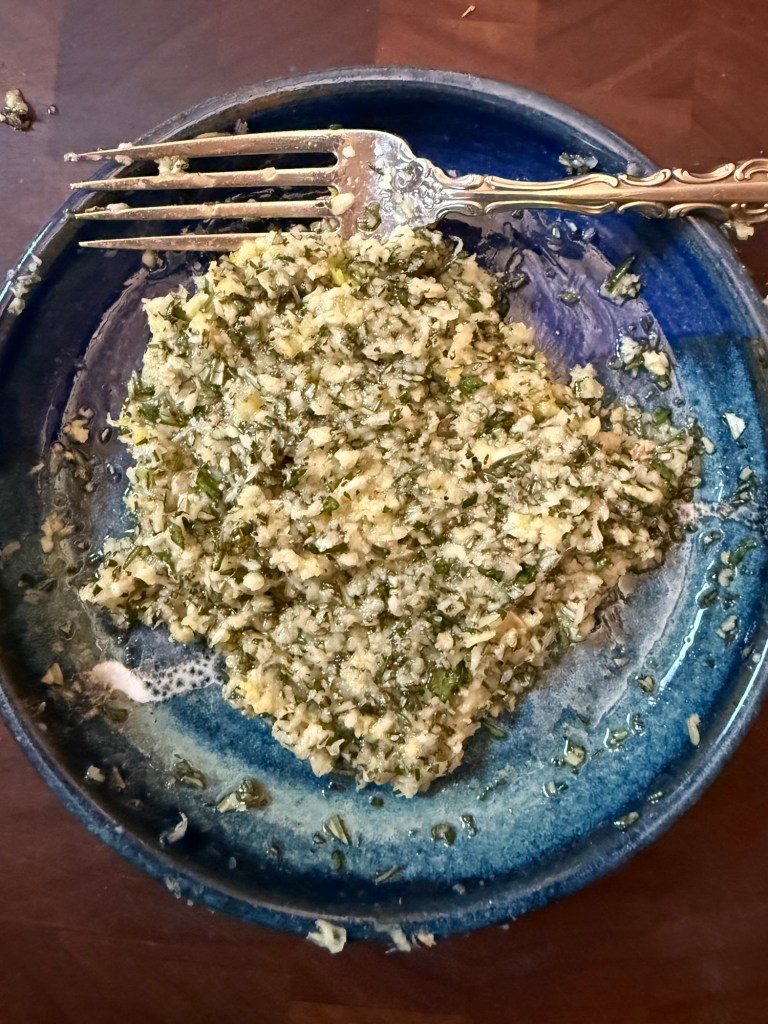
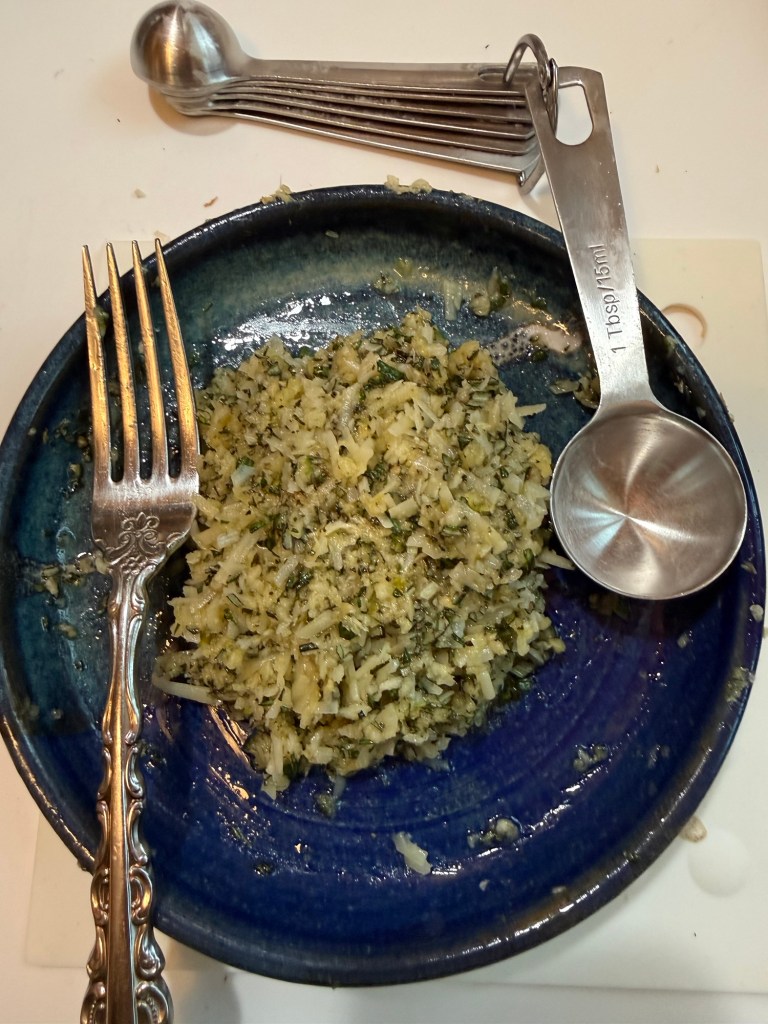
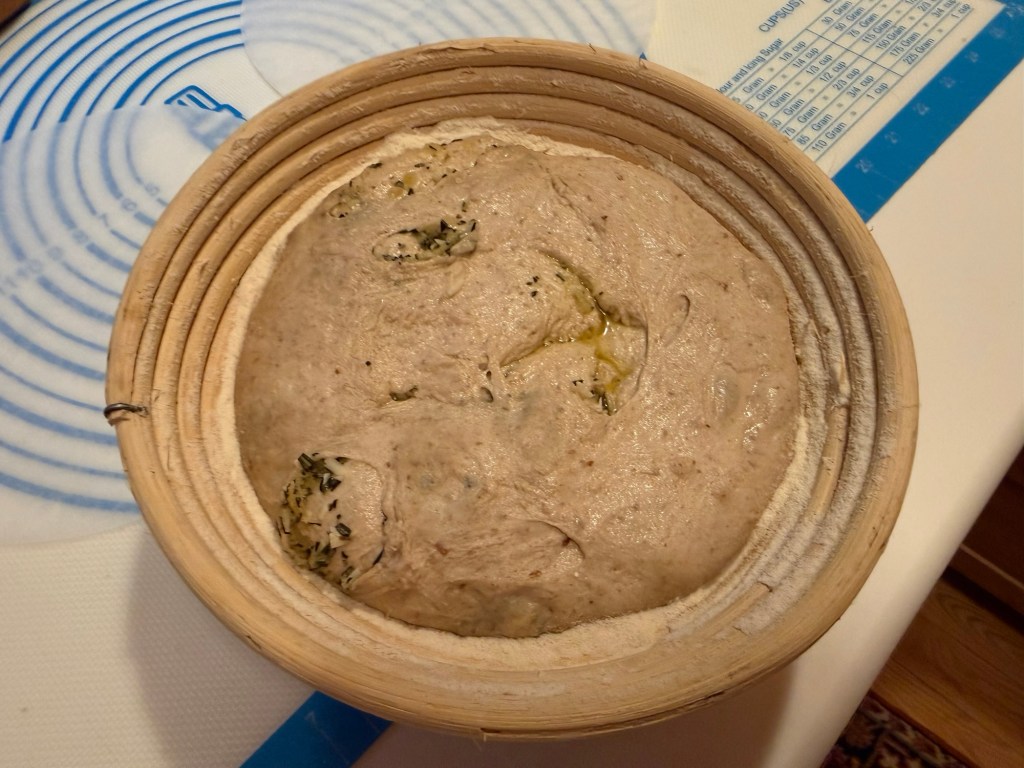
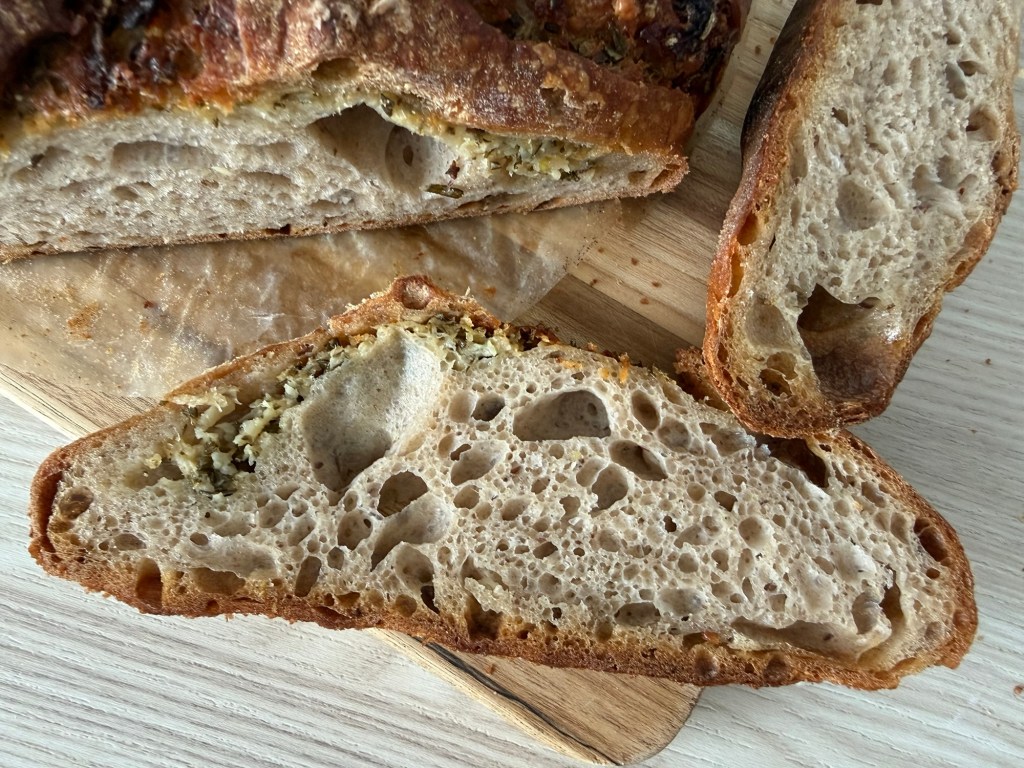
What I did use for my flavoring was dried rosemary (didn’t have fresh); 6 cloves crushed garlic cloves, and olive oil to make a paste. It was subtle but heavenly. I tried a little parmesan and almond flour with the aim being to thicken it just a little. I was pleased with the thickening I got from the almond flour but not taken with the Parmesan. The next bake my flavoring is going to be rosemary, fresh minced garlic, butter and olive oil.
**Combine your flavoring choice in a small bowl. Add enough olive oil to create a pesto-like slurry.
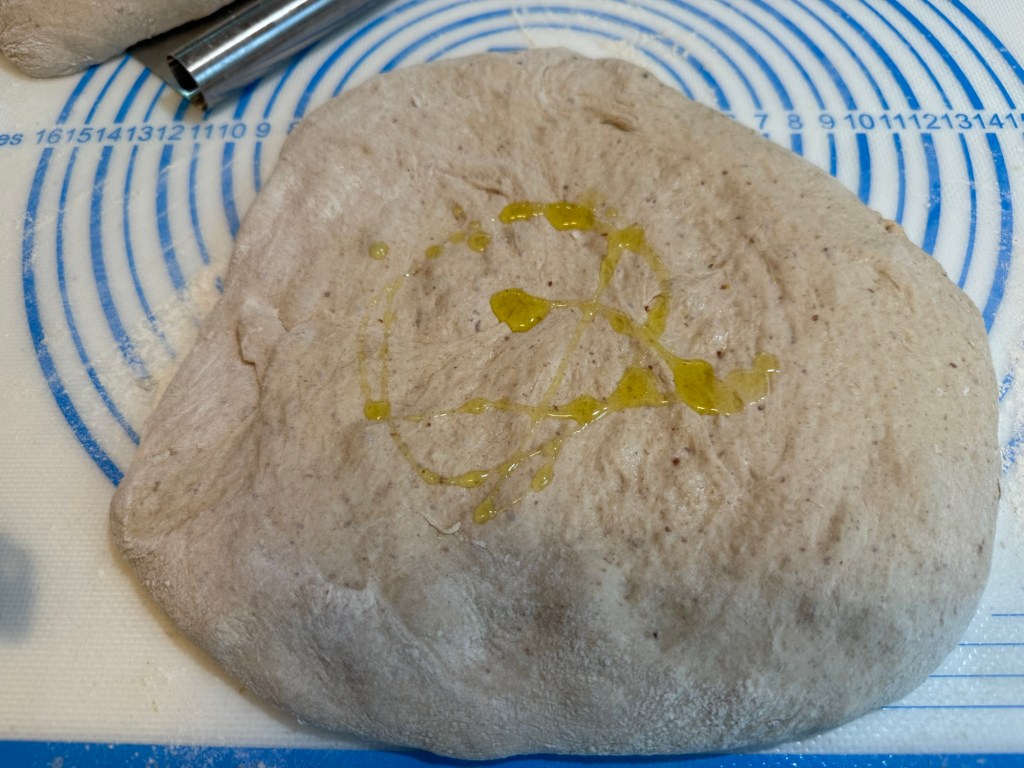
** After the 10-minute rest, turn the dough over and gently press into a 9- to 10-inch round.
This was way more than needed for my two loaves.
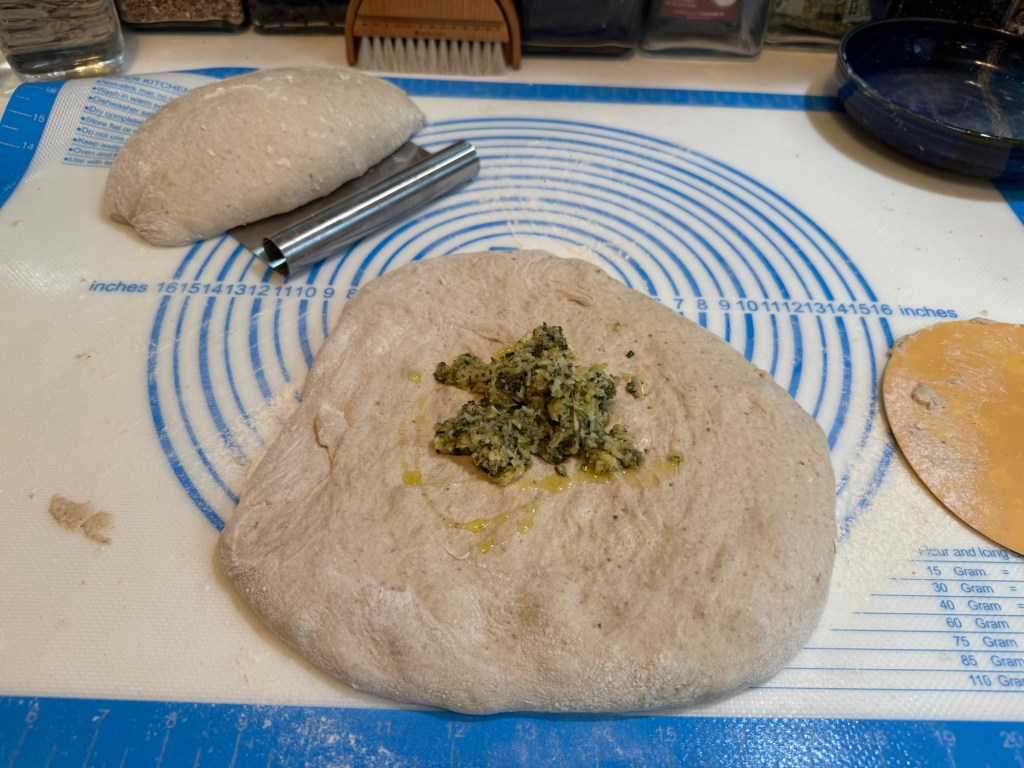
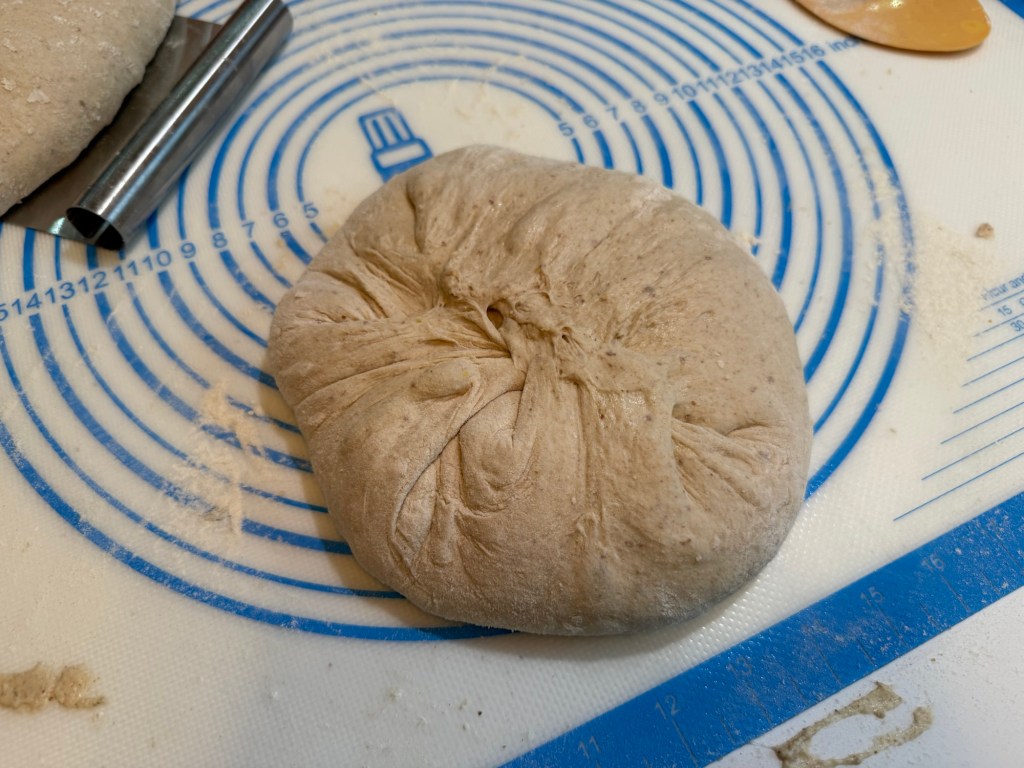
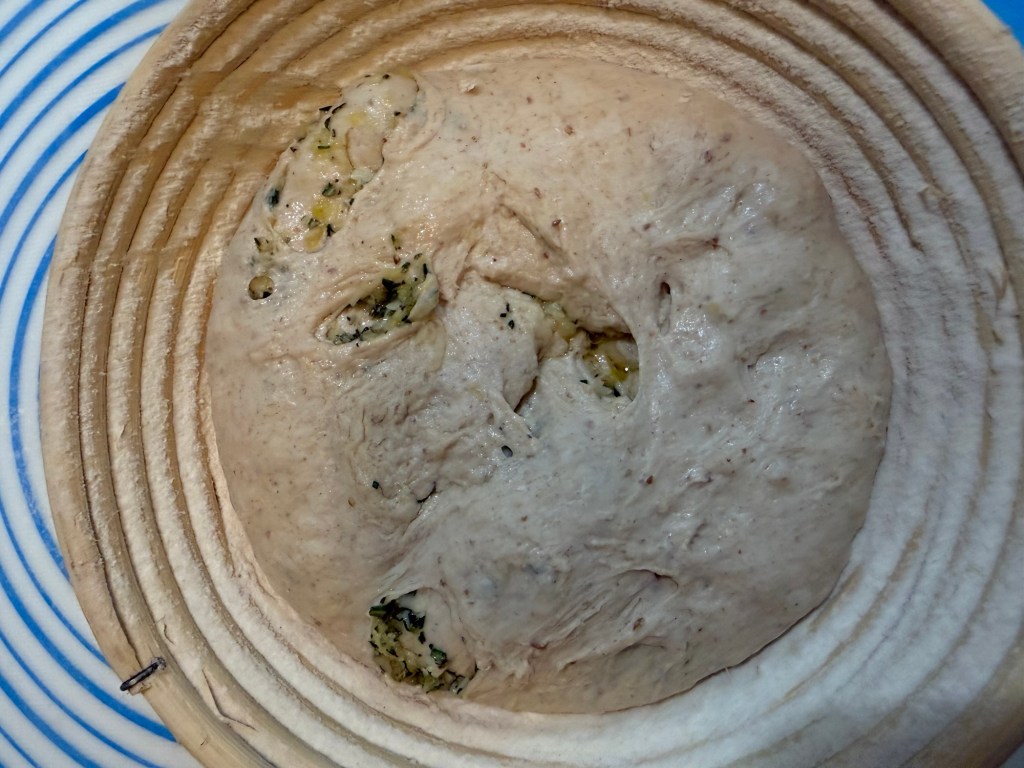
Dimple the top, make a well, and add the flavored olive oil mixture to the well. Fold the sides in, as when forming a boule, enclosing the mixture, then tighten the boule against the work surface until you just begin to see the rosemary mixture under the surface of the dough.
Garlic … Garlic
The video that the Richard Hart ‘Bread’ allows you to access is the best I have found to see what those words translate to in action. However, I will tell you I never saw the rosemary under my dough skin even though I feel I got an excellent look on the bread.
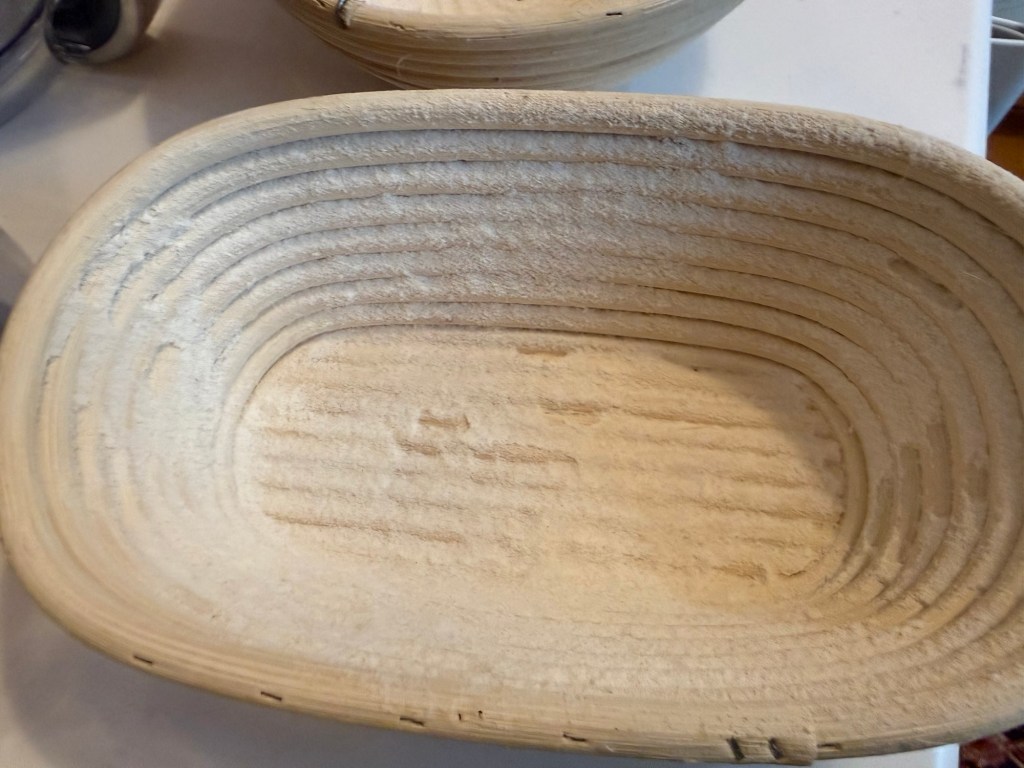
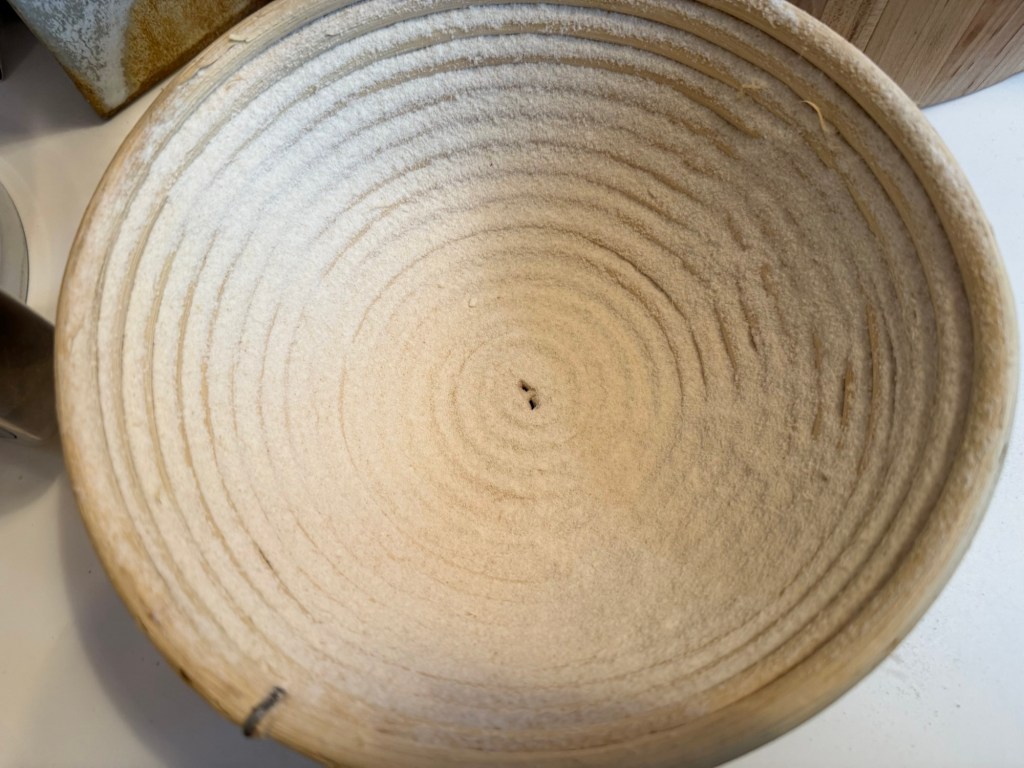
** Generously dust a 9-inch bread basket or linen-lined bowl with flour or a mixture of four and wheat bran. I always use rice flour; the wheat bran idea is intriguing and if it occurs to me some time I may try that.
Final shape: Sprinkle rice flour into the bannetons and sprinkle a very light dusting of all-purpose flour over the tops of the loaves. Using your bench scraper, shimmy the dough into a round. Hold one hand over the center of the loaf, take your scraper in the other hand, and scrape evenly across the surface of the table toward the loaf, lifting it up and into the other hand. Put down the scraper and cradle the loaf in both hands. Now fold it inward and gently place it into the basket seam side up.
If it tries to fall back open, you can gently pinch it together at the top. That’s it. It’s safe and happy just the way it is. No need for aggressive shaping.
***** Cold retard: Lightly flour the loaves again. Leave them on the counter in your kitchen for 1-2 hours. I did not use a towel, I used my trusty shower cap to cover and placed the dough in the refrigerator and let the loaves sit overnight in the refrigerator, or up to 12 hours (at most 15 hours), to develop flavor. Then you will be ready for fresh bread in the morning.
Next morning, preheat the oven to 500°F/ 260°C for at least 1 hour, AND with the Dutch oven that you will be baking the bread in to get radiant hot. The Dutch oven will be an oven inside the oven. Put the lid on the top shelf and the bottom of the Dutch oven in the middle.
Once the Dutch oven is preheated, I usually place it on the oven door covered with two folded in half t-towels, but be careful: it’s radiant hot. Use heavy-duty oven mitts or a few layers of dry tea towels when handling it. Or you can take it out and place it on a sturdy, heatproof surface. I prefer not to move it too far from the hot oven. These vessels are designed to hold their heat, so don’t panic or rush; you have time.
When the oven and Dutch oven are fully preheated, take the dough out of the refrigerator, turn it seam side down, and score it. I mist the top with water and sprinkle the sea salt over the top.
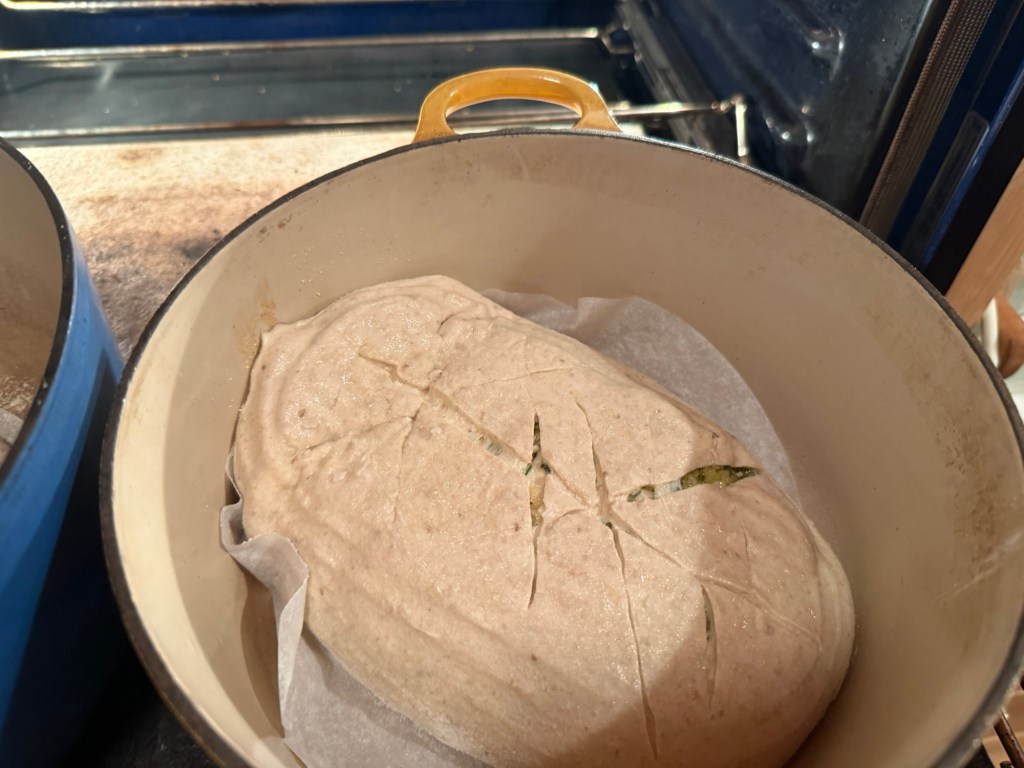
Scoring: I made four slashes, you may chose to do fewer. I suppose if you chose to make just one loaf with all the dough you could do more slashes. That would be an over the top crown. The loaf/loaves is/are now ready for the super hot Dutch oven.
Use those heavy-duty oven mitts. Take the bottom of the Dutch oven out of the oven, drop the scored dough round into the Dutch oven, put the lid back on and place all back in the hot oven..
Bake the loaf: With Dutch oven back inside your oven, reduce the temperature to 450°F/ 230°C, and set a timer for 20 minutes. As your bread bakes, water will escape from the dough. Baking the bread in the closed environment of your Dutch oven ensures that those water vapors are trapped, steaming the bread in the process and allowing the loaf to rise fully.
After 20 minutes, that steam will have done its job. Remove the inverted pot, so the loaf is directly exposed to the oven’s heat. Set the timer for 20 more minutes and let the loaf finish baking. I baked my two loaves together. Generally speaking I bake my loaves to between 198 and 205° F internal temperature at which point I consider them baked. Since I used more whole grain than the recipe called for I baked my loaves another 15 minutes.
Depending upon how caramelized you want your crust, you decide when to pull it out because you are in charge not the recipe and not the oven.
You should let the loaf cool on a cooling rack before cutting it open unless you like a gummy shiny crumb, give it at least an hour. My rule is when the internal temperature has reached whatever my room temperature is, it’s ready to slice.
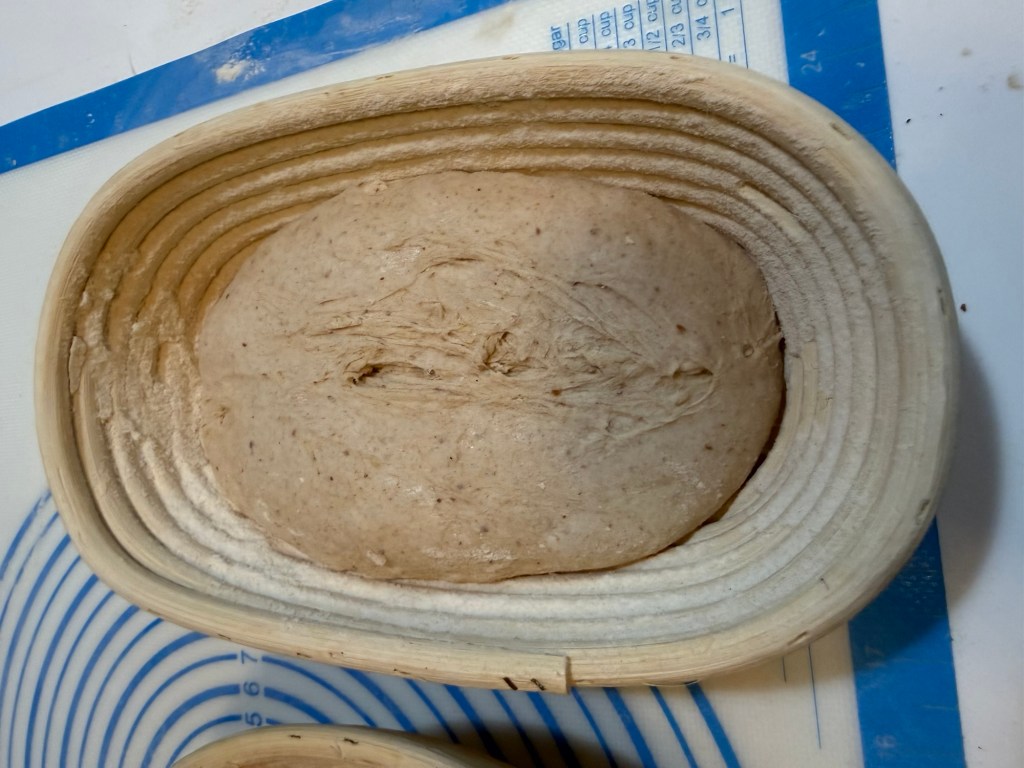
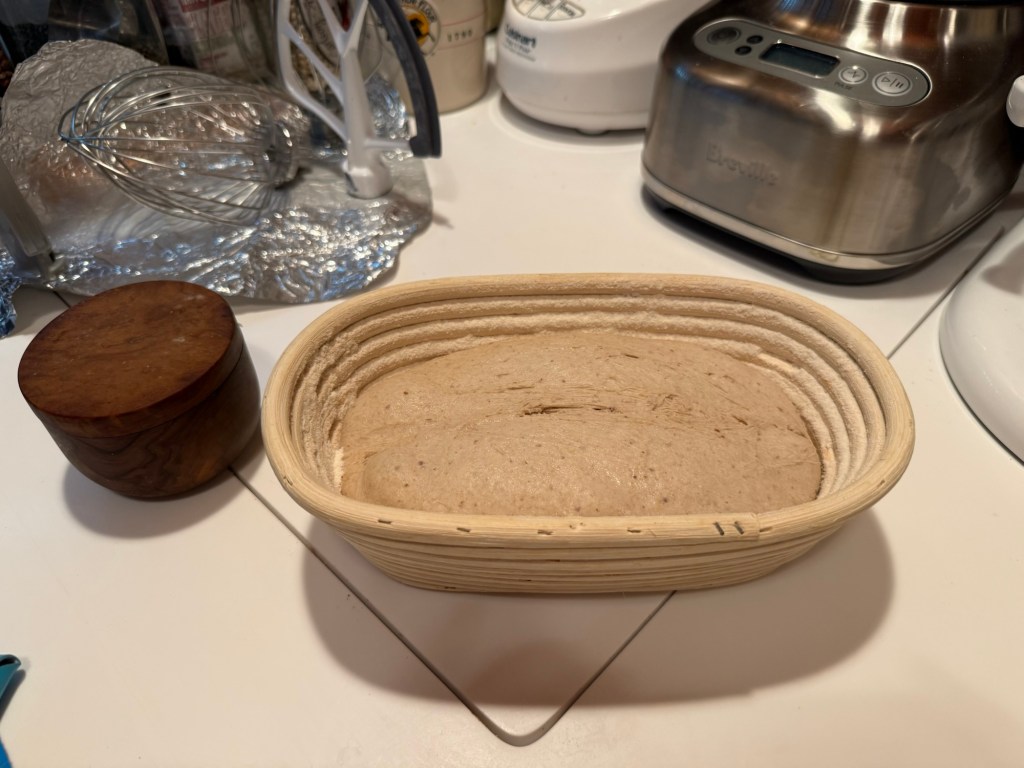
My total weight was 692 grams which I divided into two balls one slightly larger than the other because my bannetons where not equal.
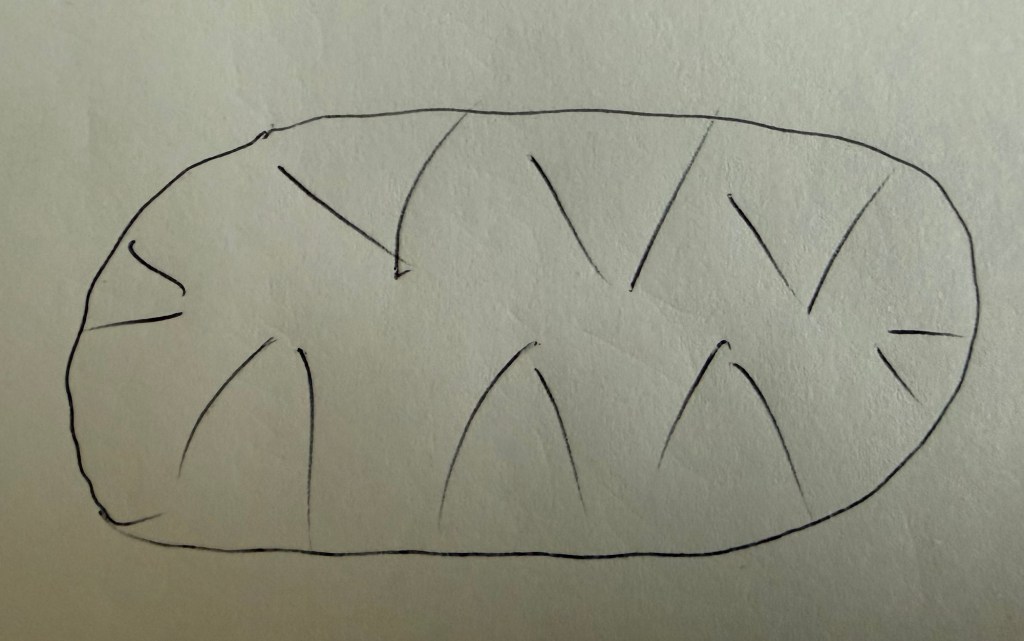
My oval/rectangular loaf did not come out with nice points. I believe if I had more carefully thought through scoring and done it as below:
Left tried to be oval.
I might have gotten a much better result.
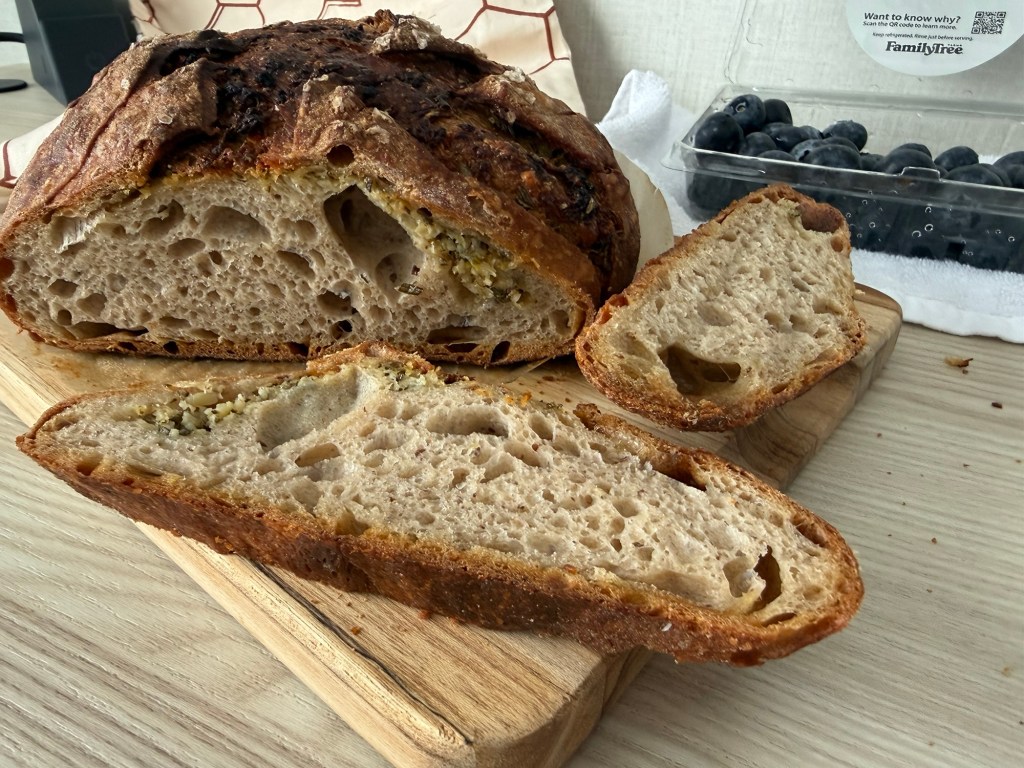
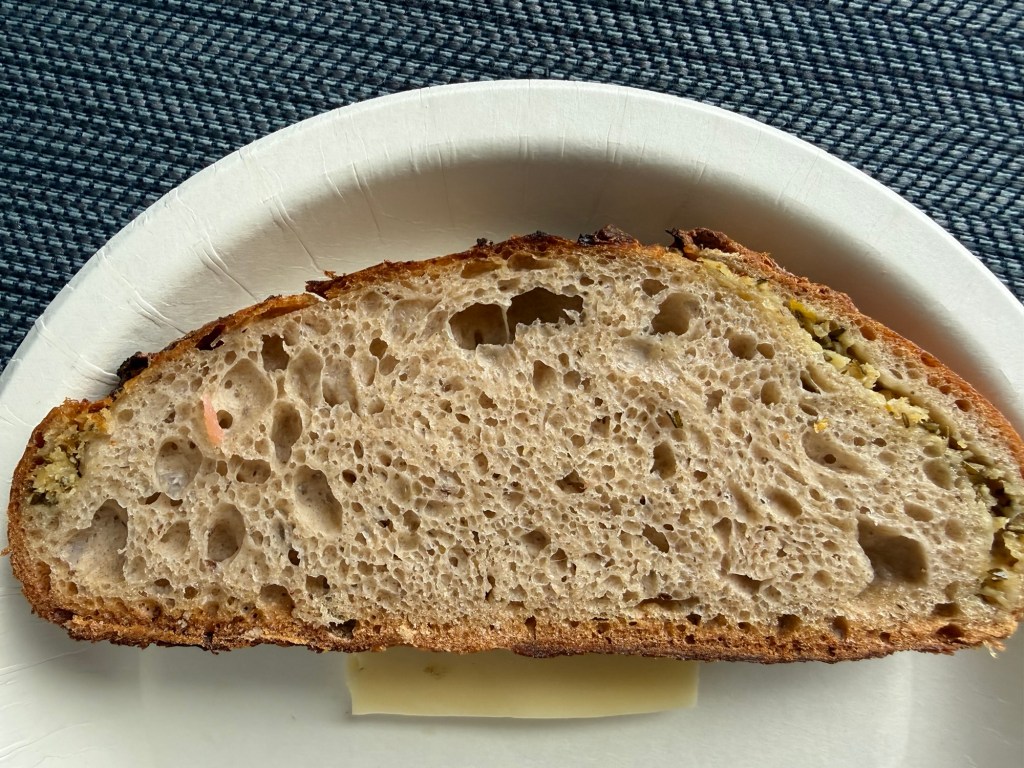
This is truly a marvelous loaf and I know it will be on my table many times in future … like in two weeks for a special occasion.
Happy Baking to all and to all the aroma of fresh bread from the oven.
I figure the first question here is: What is your secret/individual/unique way to eat peanut butter? The almost universal answer is probably: on a spoon straight out of the jar … and yes I certainly have enjoyed my share of peanut butter that way. But from a very long time ago, 65 years ago, my favorite peanut butter sandwich has always been open face peanut and mayo. In the last year that has morphed into bacon hot chili jam, peanut butter and mayo on toast.
Happy chaos!
One should never worry about pronunciation when bread is this easy to put in the oven and brings smiles when someone takes a first bite.
All together now.
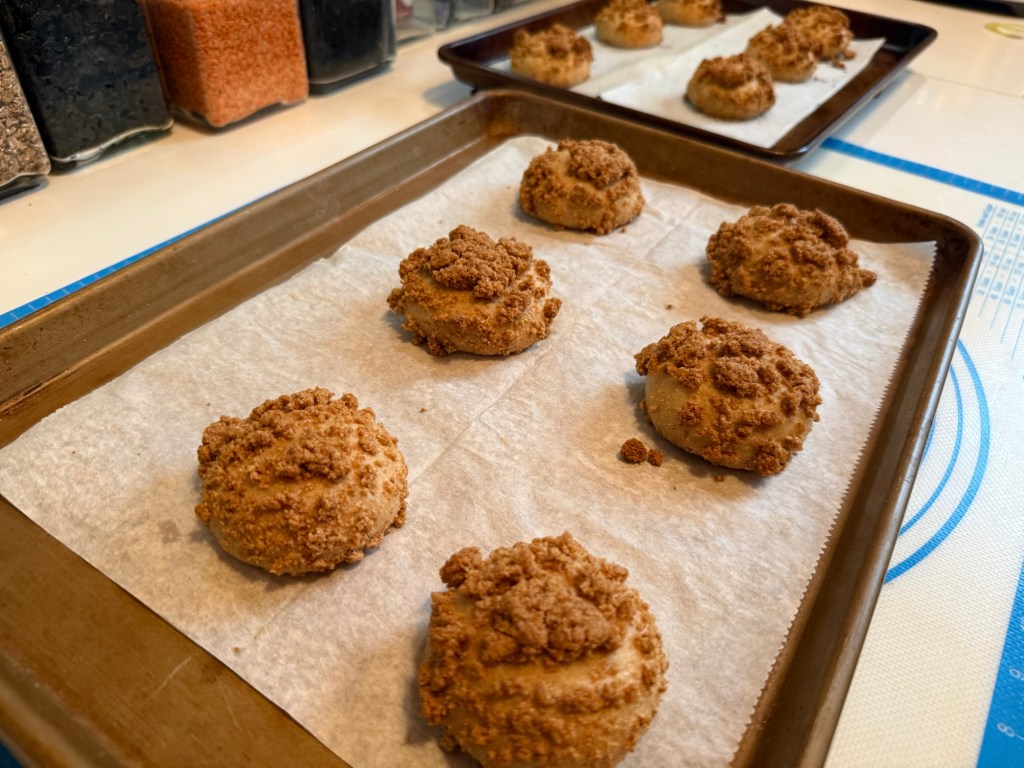
Aparna is our Kitchen of the Month and she will have the full recipe on her site. True to the Babe Code, she gave us lots of room to play with this recipe. Recipes on offering: Aparna adapted this recipe; make it with SourDough; make it NoKnead; Google the title and you can find any number of variations. Filling? Don’t be silly, sweet red bean maybe the traditional but in true Babe Fashion please use your imagination, I certainly did.
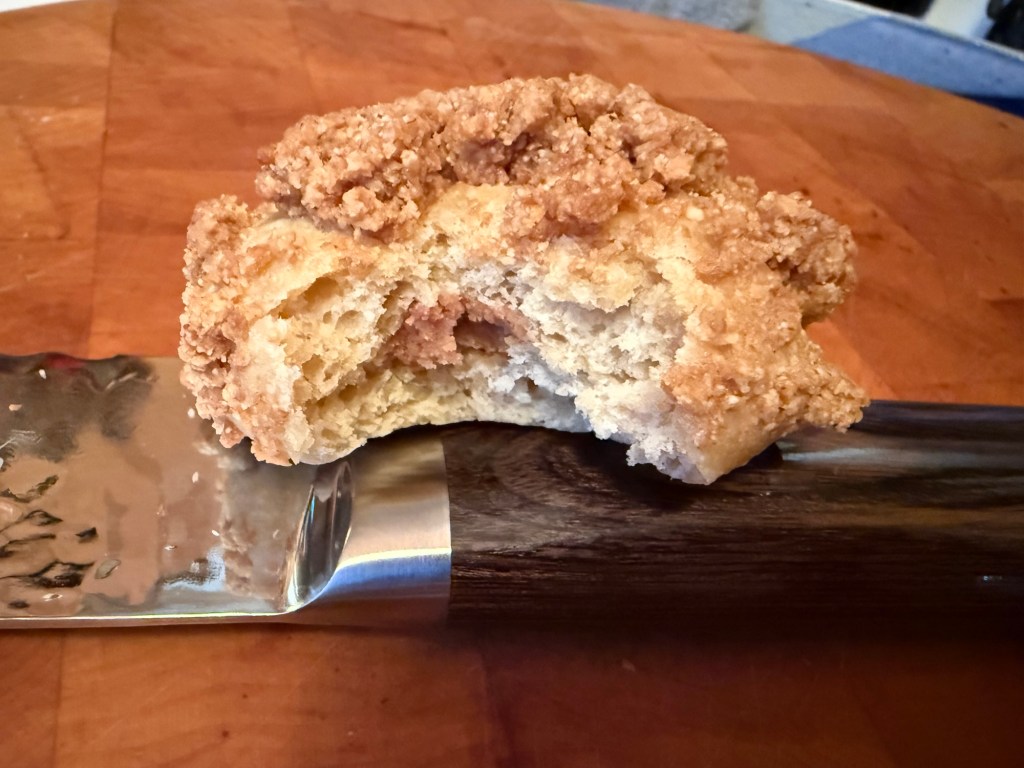
For something of a demo on applying the streusel check out this video. BUT what ever you do DO NOT MISS OUT ON THE STREUSEL! This is a winning topping. I have some left in the refrigerator and know I will find another fantastic way to use it.
Change? Fiddle with a recipe? Well of course. In the STREUSEL I replaced cornstarch with oat bran (my theory was oat bran will make it more crumbly, I think it did). I cut any place the recipe called for any kind of sweetener by 5 to 15 grams. To make the DOUGH, I used 140 g white whole wheat flour + 100 g AP flour to replace 238 g AP flour. FILLING I totally ignored any amounts and mixed some canned red beans, peanut butter, bacon hot chili jam and coconut flour to a consistency I could roll into balls.
Take a bite … and Smile!!
It’s not really about the filling, it’s all about that streusel topping. Go for it. Bake with us if you dare! Put your own touch on it and Smile!
Going fast …
We would love for you to bake along with us this month and try out these crispy topped rolls. Check out our Facebook group to see the participants’ baking results. If you would like to post your results with a Buddy badge on a blog, let us know in the comments or on the Facebook page.
What happens when you refresh your sour dough yeasties and then ask them to stay alive for 33 days in a dark refrigerator … I find they are VERY reluctant to greet you with bubbling smiles upon your return. I had 7 days to coach the little boys and girls back into bubbles. It didn’t go as well as one would hope.
I took the two that seemed to have the most bubbles yesterday … and I spiked it with a pinch of yeast.
Our Kitchen of the Month, Judy of Jody’s Gross Eats, presented us with SourDough Hawaiian Rolls and gave us two options … I should have gone with the sourdough discard seeing’s as how I was discarding everyday for over a week. I tried for the straight sourdough. My yeasties were sluggish and I didn’t get the light fluffy ones like I’m imagining all the other Babes did BUT I did get some incredibly glorious aromas and delicious rolls that my husband is crazy for.
I followed Judy’s Sourdough recipe in every way except I replaced 100 grams of bread flour with King Arthur’s Golden Wheat. So right there is a small degree that accounts for the lack of fluffy.
Ingredients added to the mixer and the dough comes together easily.Dough ball 948 grams.Last dough ball 107 gramsAll other dough balls 105 grams7 hours after shaping …Brush with cream …
BAKE!
Tops … brushed with butter.Bottoms …Side …Nine all together…Not the lightest crumb …I do love toasted!
The aroma of these is not not pineapple but it’s not pineapple … I think the vanilla does some alchemy with the pineapple and it is glorious.
All in all, I’m very happy. I believe anyone would be happy with these.
I’m giving my starter one more try before I start over. We’ll see.
Long ago and far away, I dreamed a dream … of a Sourdough Croissant Loaf … can there be such a thing?
Leave it to a Babe, in this case it is Cathy of Bread Experience who tuned us onto this one and is Kitchen of the Month.
Did I get any croissant effect? Um, well. You can always count of something unique if you’re coming to a Babe’s Bread Baking Kitchen Table.
Cast Iron bread loaf pan … is that butter?
Yes, dear friends that was butter that baked out of the loaf baked in the special French cast iron loaf pan. I divided Cathy’s recipe and baked one loaf for a friend in a cast iron casserole pan with lid.
Both loaves rose in baskets.
And I put both loaves into the fridge for a slow overnight rise covering them with a shower cap.
Butter baked out of only the one.The casserole pan: NO butter.Kept it frozen until I folded into the dough.I grated frozen butter.With butter folded in and dough now ready to shape.After resting overnight in fridge, turned out of baskets, scored and ready for the preheated pans and oven. You do want to preheat the pans and lids. You will note the special French pan comes with a mesh liner which makes it easy to drop into the super hot cast iron pan and I used a parchment round to drop the other loaf into the casserole cast iron pan.French special cast iron loaf pan.Cast iron casserole pan.Both loaves: Super crust!
I got two beautiful loaves I was very happy to share one with a friend.
Did I get croissant effect?Not so much.Did I care? Not so much! and I think fairly close to what Cathy’s looks like. Just do not compare me with Kelly’s A Messy Kitchen!
Even though so much butter leaked out of the one loaf, they both shared the croissant butter flavor and especially when toasted, the croissant flavor. Why did the one leak and not the other? Was it the liner? OR Was the special French pan so much heavier and so required longer preheating to reach the same heat as the other? OR Was it hotter because it was heavier and absorbed more heat than the casserole cast iron pan? I will try some alternative baking but didn’t have time for this bake.
How much did I change Cathy’s recipe? It’s pretty much a given that a Babe must! So yes I did but all I did was use 50% sprouted rye and 50% bread.
Bake it. There will be no regrets! This is just fabulously tasty!!!
Bake on …
And check out the other Babes bakes as well. I know each will be beautiful and as always Babe unique.
Oatmeal … how do I love you … let me count the ways … #1: Burger Buns
I do love oatmeal.
Super Bun!
Elizabeth – yes that Elizabeth of blog from our kitchen, has given the Babes our June bread, Oatmeal Burger Buns, and let me tell you, this is one not to miss that will be the star of your summer grill … and since I can attest that it works great in the oven and on the indoor grill, the star of your winter indoor grill as well. In fewer words, this is a star keeper. I suggest you check out all the Babes, because we all have our ways with the same recipe.
For my part – my way: in place of Elizabeth’s whole wheat starter, I used 200 grams of my refreshed the night before excited rye starter, in place of all purpose flour, 100 grams sprouted spelt, 20 grams bread flour and 130 grams white whole wheat, I added 20 grams of ground flax seed. I topped the buns with King Arthur’s Everything Babel Topping. I did use the added dry yeast, not sure why. For the ultimate ‘my way’ I added 50 grams of slow cooker caramelized onions! I highly recommend the caramelized onions!
Here’s where I added those caramelized onions!Heirloom Tomatoes.On my stove, top grill.Where’s my burger? Amazing crosshatch!
I think because I added those caramelized onions and all the liquid, my dough required more flour. Because I used whole grain flours, my buns required an extra 15 minutes (30 minute total) in the oven.
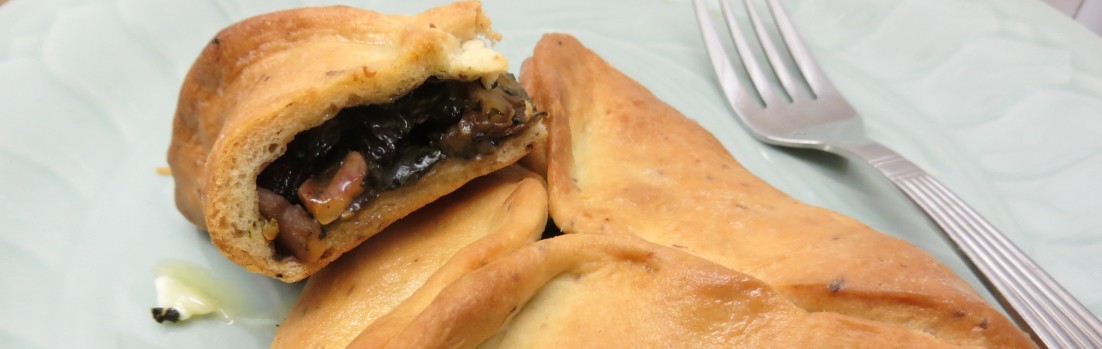
Let me count the ways after that first burger: #2 used for avocado toast, then #3 topped with Dishoom’s House Black Daal (page 215 from Dishoom: From Bombay with Love by Shamir Thakrar, Kari Thakrar and Naved Nasir – WOW of a Daal), next #4 topped with mushrooms & spinach, and finally #5 topped with black beans and broccoli!
My notes.
If you bake this we’d love to hear about it. I can just about guarantee you won’t be disappointed and more than likely it will become your routine bun.
I’ve baked bread and I’ve baked BREAD and then I’ve baked BREAD and then some. But, I’ve never gotten tired of baking bread. Karen from Karen’s Kitchen Stories suggested the Babes bake Dollywood Cinnamon Bread. It’s bread but it’s also Cinnamon Bread but then it’s Cinnamon Bread like you’ve knot known it before. Oh and it’s not a knot! It’s more pull apart log but different even so.
Karen found this recipe in a beautiful new book – and yes I succumbed and now have a copy in my library. I love all the stories Anne Byrn has, one for each recipe. And I’ve bookmarked too many to ever get them all baked but life should be full of challenges one chooses!
I used two rolling pins about the same size so I could cut without going through to the bottom.
Ready to slice …
The slice in allows all the goo …
To filter down and permeate the loaf … I will confess, the two best slices are the ends…heaven.
I did observe the overnight rest in the fridge. I will make it again with double the topping and open those slices more to allow that topping further in if that’s at all possible.
Karen’s got her adaption of Anne Byrn’s recipe on her site but I’d encourage you to check out the book and the other Babes baking this month.